Overview
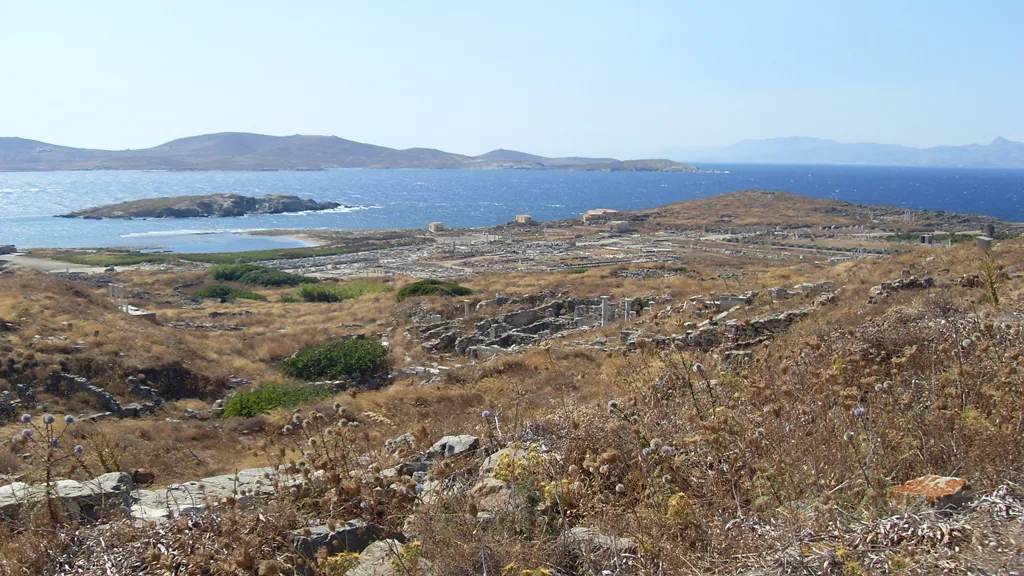
Delos is a small island near the centre of the Cyclades archipelago in the Aegean Sea, close to Mykonos. Barely 3.5 kilometres long and largely waterless, its importance was entirely religious and commercial rather than agricultural. In Greek myth it was the floating island that anchored itself to receive the goddess Leto, who there gave birth to the twin deities Apollo and Artemis — making Delos one of the holiest places in the Greek world.
A sanctuary of Apollo grew on the island from at least the early first millennium BCE and became a major Panhellenic cult centre. By the Archaic and Classical periods it hosted great festivals drawing pilgrims and offerings from across the Aegean. The island's sanctity made it a political prize: in 478 BCE it became the treasury and meeting place of the Delian League, the Athenian-led alliance, until Athens moved the treasury to its own acropolis in 454 BCE. Athens also conducted ritual "purifications" of the island, forbidding birth and death on its sacred soil and removing graves.
Delos reached its material peak after 166 BCE, when Rome declared it a free port under Athenian administration. It became one of the busiest commercial hubs of the eastern Mediterranean and a notorious centre of the slave trade — ancient sources claim that tens of thousands of slaves could change hands there in a single day. Wealthy merchants of many nationalities settled on the island, building richly decorated houses with peristyle courtyards and mosaic floors, alongside sanctuaries to Egyptian and Syrian gods reflecting its cosmopolitan population. This prosperity ended abruptly when the island was sacked during the Mithridatic Wars (88 BCE) and again in 69 BCE, after which it declined and was eventually abandoned.
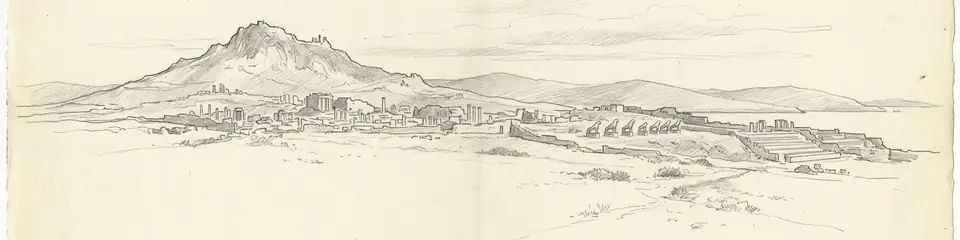
The site, excavated by the French School at Athens since 1873, preserves a vast range of remains: the sanctuaries of Apollo, the Terrace of the Lions (archaic marble lions dedicated by the Naxians), the Sacred Lake, theatres, cisterns, and entire residential quarters with famous mosaics such as the House of the Dolphins and the House of Dionysos.