
Перейти к содержанию
Atlas Anatolia
НовостиЗубы ледникового периода на Сулавеси отодвигают использование бетеля на 25 000 лет назадРимская мозаика и голова Эрота обнаружены в базилике Помпейополиса, Кастамону
Prehistoric rock paintings on a sandstone wall at Tassili n'Ajjer, Algeria

Wikimedia Commons

Continent Record

Longest Recorded History in Africa

СвятилищеЮНЕСКОИзбранное

Tassili n'Ajjer

Seyfi Cem Baskin

Tasili n Ajjer10000 до н. э. – 1000 до н. э.

A vast sandstone plateau in the central Sahara sheltering the world's largest collection of prehistoric rock art — over 15,000 engravings and paintings spanning 12,000 years that document the Sahara's green past, its vanished animals, and its ancient peoples.

31
Интерес 57

Местоположение

Алжир

25.50°N · 9.00°E · Африка

Rock art count

Over 15,000 engravings and paintings

Time span

c. 10,000 BCE - 2,000 BCE (12,000 years)

Styles

Round Head, Pastoral/Bovidian, Horse, Camel phases

Animals depicted

Hippos, elephants, giraffes, crocodiles — now absent from the Sahara

Area

72,000 km2 sandstone plateau

UNESCO

Mixed cultural and natural World Heritage Site, 1982

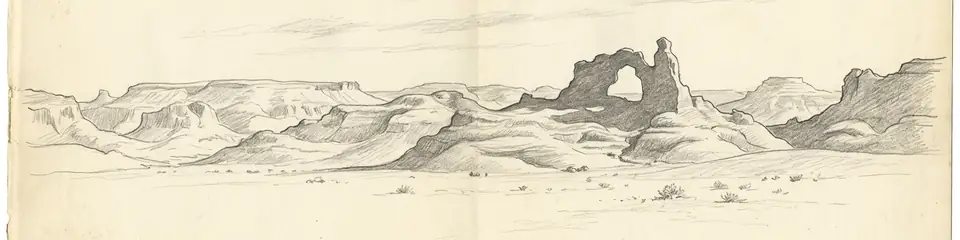
Graphite pencil sketch banner of Tassili n'Ajjer

“Tassili n'Ajjer is humanity's greatest outdoor art gallery and the most important record of the Green Sahara — a 12,000-year visual chronicle of climate change, human adaptation, and ecological transformation.”

Местоположение

Обзор

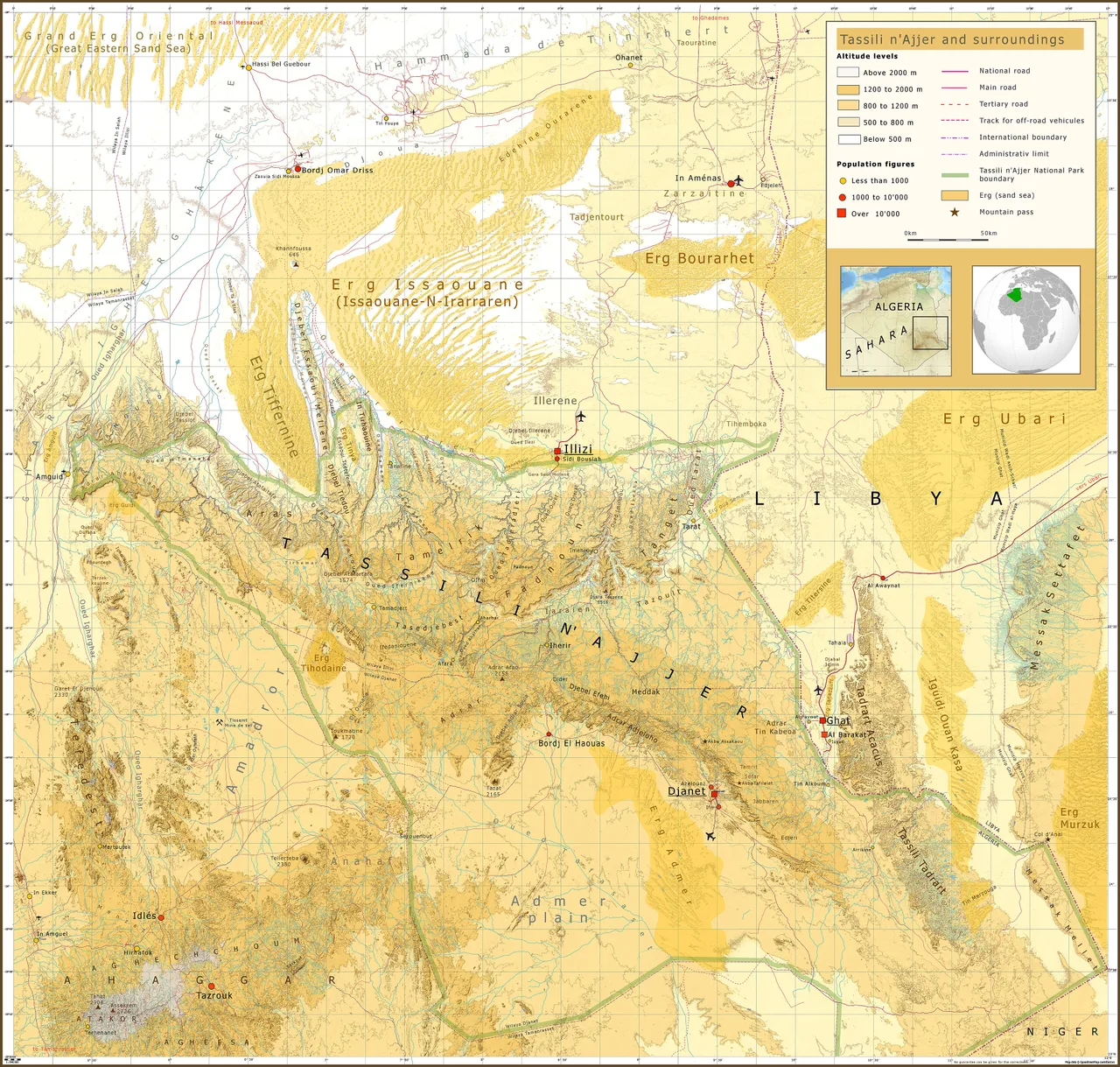
Tassili n'Ajjer occupies a 72,000 km2 sandstone massif in the eastern Algerian Sahara, near the borders of Libya and Niger. The name means "plateau of the rivers" in Tuareg — an accurate description of what this now-hyperarid landscape once was. Between approximately 10,000 BCE and 3,000 BCE the Sahara experienced a "Green Period" when a wetter climate supported grasslands, lakes, rivers, and abundant wildlife including hippos, elephants, giraffes, and crocodiles.

The rock art of Tassili n'Ajjer is the supreme visual archive of that vanished world. Over 15,000 individual drawings and engravings — many of extraordinary artistic quality — are scattered across the plateau's rock faces and shelters. Scholars divide the sequence into broad phases: the Round Head phase (c. 10,000-6,000 BCE) shows large stylised human figures with rounded featureless heads; the Pastoral phase (c. 7,500-3,500 BCE) documents domesticated cattle and the herdspeople who tended them; the Horse and Camel phases record the progressive desiccation of the Sahara.

The images include hunting scenes, cattle herds, ritual dances, and extraordinary depictions of wild animals rendered with vitality that rivals any prehistoric art in the world. UNESCO inscribed Tassili n'Ajjer as a mixed cultural and natural World Heritage Site in 1982.

Почему это важно

Tassili n'Ajjer is humanity's greatest outdoor art gallery and the most important record of the Green Sahara — a 12,000-year visual chronicle of climate change, human adaptation, and ecological transformation. Its paintings document species (hippos, elephants, giraffes in the Sahara) and cultures that left no other evidence, making it irreplaceable for understanding North African prehistory. The sheer quantity and quality of the art — spanning the transition from Palaeolithic hunting cultures through the pastoral revolution — makes it one of the most important archaeological sites in the world. It is also a powerful reminder that the Sahara, now the world's largest hot desert, was once a verdant landscape teeming with life.

Свидетельства и интерпретация

Различать, что хорошо установлено, а что остаётся предметом дискуссий.

Хорошо установленные факты

3
  • Radiocarbon dating of organic pigments and associated occupation layers dates the earliest Round Head paintings to approximately 10,000-8,000 BCE, placing them among the oldest figurative art in Africa.
  • Depictions of hippos, elephants, giraffes, and crocodiles in what is now hyperarid desert corroborate palaeoclimatic evidence for the African Humid Period (c. 11,000-5,000 BP) when the Sahara supported abundant water and wildlife.
  • The Pastoral phase paintings show domesticated humped cattle and human herding activities, consistent with the spread of pastoralism into the Sahara after c. 7,500 BCE documented by archaeological and genetic evidence.

Научные выводы

1
  • The featureless rounded heads of the Round Head phase figures are interpreted by most researchers as shamanic or ritual imagery, though their precise meaning and the identity of the people who made them remain unknown.

Фотографии сообщества

Поделитесь своими впечатлениями

Вы посещали это место? Загрузите свои фотографии, чтобы помочь другим открыть его для себя.

Как цитировать эту страницу

Atlas Anatolia. (10000). Tassili n'Ajjer. Atlas Anatolia. https://atlasanatolia.com/ru/site/tassili-najjer

Материалы распространяются по лицензии CC BY-SA 4.0 — при повторном использовании указание авторства обязательно.

Источники

  • The Search for the Tassili Frescoes — Lhote, Henri (1959)
  • Rock Art in Africa: Mythology and Legend — Le Quellec, Jean-Loic (2004)

Часто задаваемые вопросы

Где находится Tassili n'Ajjer?

Tassili n'Ajjer находится в Algeria.

Сколько лет Tassili n'Ajjer?

Tassili n'Ajjer датируется приблизительно 10000 до н. э. – 1000 до н. э..

Почему Tassili n'Ajjer имеет важное значение?

Tassili n'Ajjer is humanity's greatest outdoor art gallery and the most important record of the Green Sahara — a 12,000-year visual chronicle of climate change, human adaptation, and ecological transformation.

Входит ли Tassili n'Ajjer в список Всемирного наследия ЮНЕСКО?

Да — Tassili n'Ajjer включено в список Всемирного наследия ЮНЕСКО.