

Перейти к содержанию
Atlas Anatolia
НовостиЗубы ледникового периода на Сулавеси отодвигают использование бетеля на 25 000 лет назадРимская мозаика и голова Эрота обнаружены в базилике Помпейополиса, Кастамону
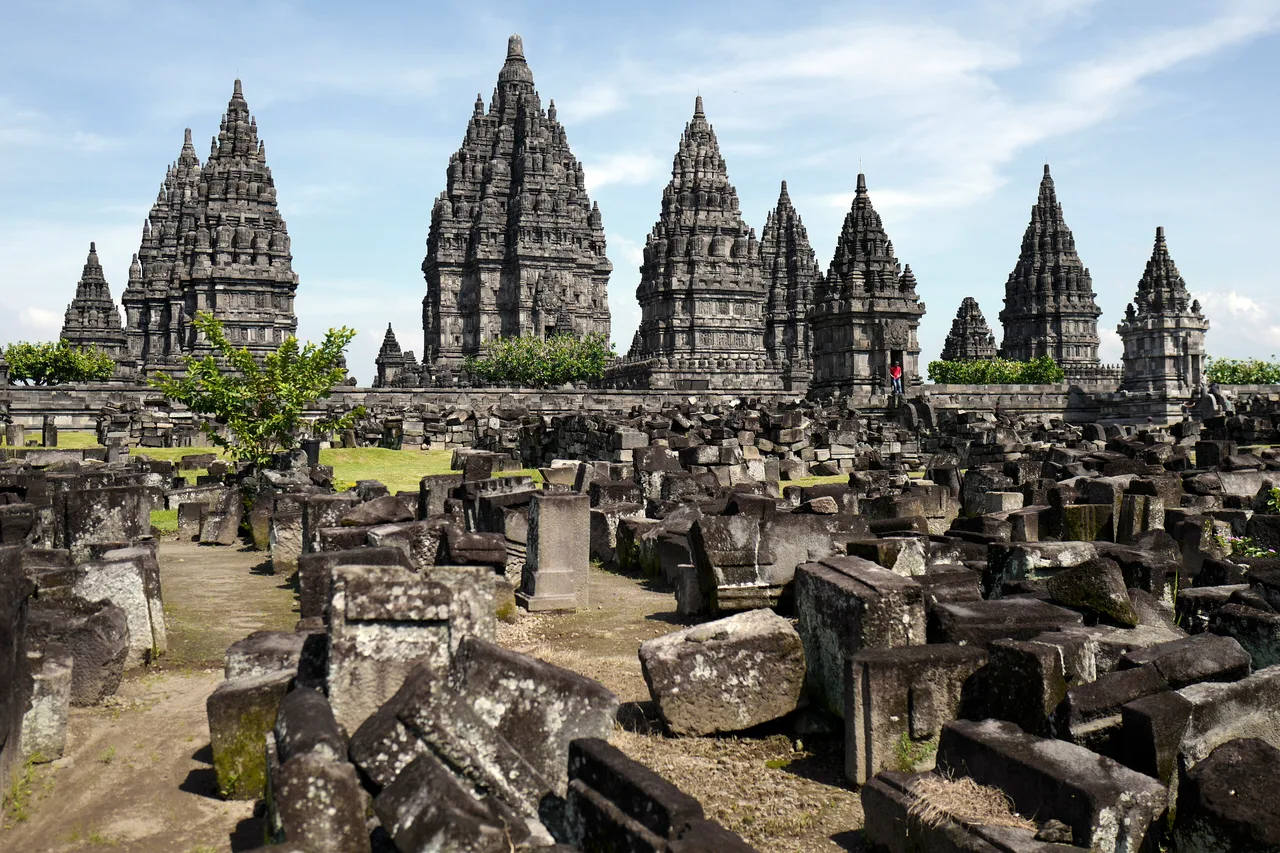
The three main towers of Prambanan at sunset, Java

Wikimedia Commons

Continent Record

Southernmost Known Site in Asia

ХрамЮНЕСКОИзбранное

Prambanan

Seyfi Cem Baskin

Candi Prambanan850 н. э. – 930 н. э.

The largest Hindu temple complex in Southeast Asia, built on Java c. 850 CE, comprising 240 temples centered on three towers rising 47 m dedicated to Brahma, Vishnu, and Shiva.

21
Интерес 77

Местоположение

Индонезия

7.75°S · 110.49°E · Азия

Central tower height

47 m (Shiva temple)

Total temples (original)

240

Construction date

c. 850 CE

Relief panel length (total)

~2 km of continuous narrative

Nearest active volcano

Mount Merapi, 28 km north

UNESCO

World Heritage Site since 1991

Graphite pencil sketch banner of Prambanan

“Prambanan represents the peak of classical Javanese Hindu art and architecture.”

Местоположение

Обзор

Prambanan stands on the border of Central Java and Yogyakarta, 17 km northeast of Yogyakarta city, in the valley between Merapi volcano and the Indian Ocean. The complex was built during the Sanjaya dynasty of the Mataram kingdom, with the main temples constructed around 850 CE under King Rakai Pikatan or his successor. The complex originally comprised 240 individual temples arranged in three concentric squares around a central courtyard. The three principal towers (perwara) in the inner zone rise 47 m above the Prambanan Plain: the central Shiva temple, the Vishnu temple to its north, and the Brahma temple to its south. The towers are clad in bas-relief panels narrating the Ramayana (on the Shiva and Brahma temples) and the Krishnayana (on the Vishnu temple) — among the most extensive stone narrative cycles in the world. Prambanan was probably damaged by a major earthquake shortly after its construction and was abandoned following the shift of the Mataram kingdom's political center to East Java around 930 CE. The complex was largely forgotten, further damaged by a 1549 earthquake, and rediscovered by the Dutch colonialist C.A. Lons in 1733. Systematic restoration began in the 1930s and continues; the 2006 Yogyakarta earthquake (6.3 Mw) caused significant new damage.

Почему это важно

Prambanan represents the peak of classical Javanese Hindu art and architecture. Its 47-meter towers are among the tallest ancient religious structures in Southeast Asia. The 1,224 bas-relief panels on the outer walls of the main temples constitute an uninterrupted narrative stone frieze of the Ramayana and Krishnayana more than 2 km in total length — among the most comprehensive visual tellings of these epics anywhere. The complex's design principles — the central mountain-symbol of the cosmic Mount Meru surrounded by attendant shrines — influenced Hindu and Buddhist temple architecture across Java, Bali, and mainland Southeast Asia. The co-existence of Prambanan and the Buddhist Borobudur (built just 40 km away, 50 years earlier, by a different ruling house) testifies to the unusual religious pluralism of early Java.

Свидетельства и интерпретация

Различать, что хорошо установлено, а что остаётся предметом дискуссий.

Хорошо установленные факты

2
  • The Shivagrha inscription (856 CE) records the construction of a Shiva temple — almost certainly Prambanan — by the Sanjaya king Rakai Pikatan, establishing a firm date for the complex's foundation.
  • The Ramayana bas-reliefs on the balustrades of the Shiva and Brahma temples constitute one of the world's most extensive stone narrative sequences of the epic, carved in a continuous strip more than 100 m long per temple.

Научные выводы

1
  • The complex was probably damaged by a large earthquake shortly after construction and may have been structurally compromised before its formal abandonment c. 930 CE following the eastward shift of the Mataram court.

Фотографии сообщества

Поделитесь своими впечатлениями

Вы посещали это место? Загрузите свои фотографии, чтобы помочь другим открыть его для себя.

Как цитировать эту страницу

Atlas Anatolia. (850). Prambanan. Atlas Anatolia. https://atlasanatolia.com/ru/site/prambanan

Материалы распространяются по лицензии CC BY-SA 4.0 — при повторном использовании указание авторства обязательно.

Источники

  • Prambanan: Its Architecture, History and Cultural Significance — Hariani Santiko (1995)
  • UNESCO World Heritage — Prambanan Temple CompoundsСсылка

Часто задаваемые вопросы

Где находится Prambanan?

Prambanan находится в Indonesia.

Сколько лет Prambanan?

Prambanan датируется приблизительно 850 н. э. – 930 н. э..

С какими цивилизациями связано место Prambanan?

Prambanan связано с цивилизацией: Majapahit.

Почему Prambanan имеет важное значение?

Prambanan represents the peak of classical Javanese Hindu art and architecture.

Входит ли Prambanan в список Всемирного наследия ЮНЕСКО?

Да — Prambanan включено в список Всемирного наследия ЮНЕСКО.