
콘텐츠로 건너뛰기
Atlas Anatolia
디그
뉴스술라웨시 빙하기 치아에서 빈랑 사용 25,000년 전까지 소급카스타모누 폼페이오폴리스 바실리카에서 로마 모자이크와 에로스 두상 발견
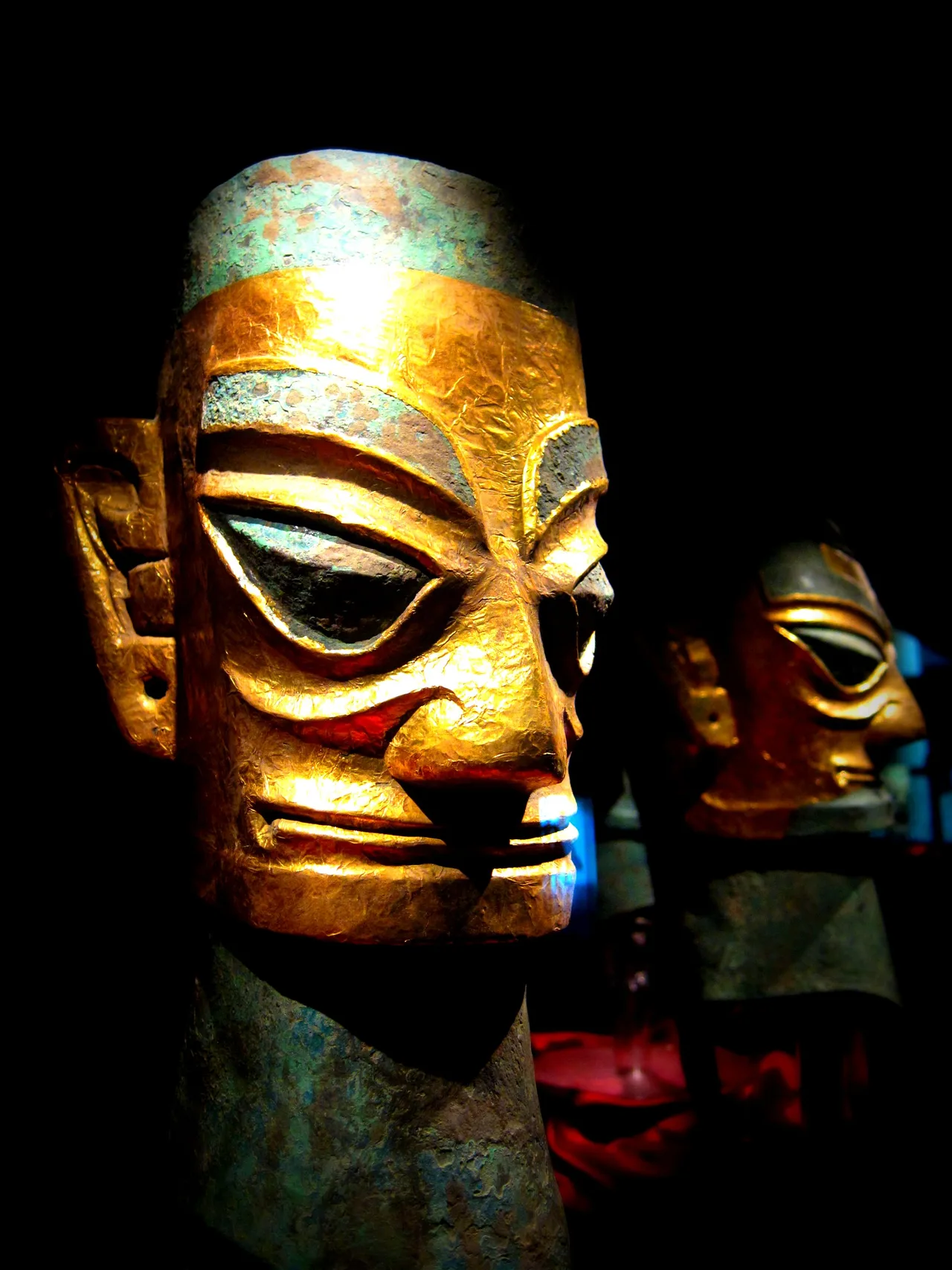
Bronze mask with protruding cylindrical eyes from the Sanxingdui sacrificial pits, Sichuan, China

Wikimedia Commons

Country Record

Oldest Settlement in China

정착지주요

Sanxingdui

Seyfi Cem Baskin

三星堆2800 기원전 – 800 기원전

A Bronze Age walled city in Sichuan that has forced a rewrite of early Chinese history — home to a civilization with no confirmed writing system, unrelated artistic conventions, and no clear match to any known Chinese dynasty, yet capable of casting bronze on a scale and sophistication rivalling the Shang dynasty of the Yellow River heartland. Vast sacrificial pits discovered in 1986, and again in 2019–2022, have yielded towering bronze masks with alien, protruding eyes, a 4-metre bronze "sacred tree," and gold masks unlike anything else found in ancient China.

312
관심 69

위치

Guanghan · Sichuan · 중국

31.00°N · 104.21°E · 아시아

Culture

Sanxingdui culture, part of the Bronze Age Shu civilization, c. 2800–800 BCE

1986 discovery

Pits 1 & 2 uncovered accidentally by construction workers

2019–2022 excavation

Six further pits (3–8) excavated with modern conservation methods

Bronze figure

2.62 m bronze standing figure — the largest known from the ancient Bronze Age world

Writing

No confirmed writing system identified — culture reconstructed from material remains alone

Graphite pencil sketch banner of Sanxingdui

“Sanxingdui overturned the long-standing assumption that Chinese civilization radiated outward from a single Yellow River cultural core.”

위치

개요

Sanxingdui ("Three Stars Mound") lies near Guanghan in Sichuan province, southwestern China, on the floodplain of the Yazi River. It is the type-site of the Sanxingdui culture, part of the broader Bronze Age Shu civilization that flourished in the Sichuan Basin from roughly 2800 to 800 BCE — largely contemporary with the Shang and early Zhou dynasties of the Yellow River valley, over a thousand kilometres to the north, but archaeologically and artistically almost entirely distinct from them.

The site was first noticed in 1929 when a farmer clearing an irrigation ditch uncovered a cache of jade artefacts, but its true scale only became apparent in 1986, when construction workers accidentally exposed two large sacrificial pits. Pits 1 and 2 contained an extraordinary hoard of bronze, gold, jade, ivory, and bone objects — many of them deliberately broken, burned, and buried, apparently in a ritual act — including dozens of bronze masks and heads with sharply angular features, some with eyes protruding on cylindrical stalks up to 16 centimetres from the face. A bronze standing figure 2.62 metres tall (including its base), the largest bronze human figure known from the ancient world, was found alongside a bronze "sacred tree" originally standing nearly 4 metres, its branches hung with birds, fruit, and dragons.

Between 2019 and 2022, Chinese archaeologists excavated six additional sacrificial pits (Pits 3–8) using climate-controlled excavation tents and advanced conservation techniques unavailable in 1986, recovering thousands of further objects, including a gilded bronze mask, a bronze box with a tortoise-shaped lid, silk residue — the earliest confirmed evidence of silk in the region — and additional fragments that, remarkably, in some cases fit together with pieces excavated more than three decades earlier from the original 1986 pits, confirming that objects had been broken up and dispersed across multiple pits during the same ritual events.

No confirmed writing system has been identified at Sanxingdui, which leaves the identity, language, religious beliefs, and even the name of the civilization that built it almost entirely reconstructed from material culture alone. The exaggerated, otherworldly features of the bronze masks — some interpreted as representing Cancong, a legendary founding king of Shu described in much later Chinese texts as having protruding, vertical eyes — have no close parallel anywhere else in the Bronze Age world, fuelling both serious scholarly debate and popular speculation about the culture's origins and beliefs.

Sanxingdui's bronze-casting technology, using piece-mould methods broadly comparable to Shang metallurgy, indicates sustained contact and technological exchange with the Yellow River civilizations, even as its artistic and religious vocabulary developed along an entirely independent path. The site is associated with the ancient Kingdom of Shu, later referenced in Chinese historical texts, and is linked to the nearby, later Bronze Age site of Jinsha, which may represent a successor settlement after Sanxingdui's decline around 1000–800 BCE. A dedicated on-site museum displays the excavated bronzes, and the site remains under active excavation.

중요성

Sanxingdui overturned the long-standing assumption that Chinese civilization radiated outward from a single Yellow River cultural core. Its discovery proved that Bronze Age China supported multiple, independently developed, technologically sophisticated civilizations simultaneously — a "multiple origins" model that has reshaped how archaeologists understand the formation of early Chinese identity. The scale and strangeness of the bronzes — masks with dimensions and features unlike any other Bronze Age artistic tradition on Earth — represent one of archaeology's most striking reminders that even well-studied regions can conceal entire visual and religious worlds with no textual record to explain them. Every interpretation of Sanxingdui's masks, trees, and ritual pits rests on inference from objects alone, making it an unusually pure test case for how archaeologists reconstruct belief systems without writing. The 2019–2022 excavations, conducted with modern conservation science and broadcast partially live to a fascinated Chinese public, also demonstrate how ongoing excavation at a single site can still fundamentally expand the known scope of a civilization — matching fragments across pits dug 33 years apart turned a startling discovery into a still-unfolding one.

증거와 해석

확립된 사실과 논쟁 중인 사항을 구분합니다.

잘 확립된 사실

3
  • Radiocarbon dating of organic material from the sacrificial pits places the main ritual deposition events within the Sanxingdui culture's late phase, broadly contemporary with the late Shang dynasty (c. 1300–1046 BCE).
  • Physical fragments excavated from Pits 3–8 (2019–2022) have been directly matched and rejoined with broken pieces recovered from Pits 1 and 2 in 1986, confirming the pits represent related, possibly contemporaneous ritual events.
  • Metallurgical analysis of the bronze objects shows piece-mould casting techniques comparable to contemporary Shang dynasty bronze production, indicating technological contact between the Sanxingdui and Yellow River civilizations.

학술적 추론

1
  • The deliberate breaking and burning of objects before burial in the pits suggests a ritual of sacrifice or termination, though the precise religious or political occasion for these events remains inferred rather than documented.

논쟁 중인 해석

2
  • No confirmed writing system has been found at Sanxingdui; a small number of symbols on pottery and other objects have been proposed as proto-writing, but this interpretation is not widely accepted among specialists.
  • The identity and purpose of the bronze masks with protruding eyes is unresolved; the leading hypothesis links them to Cancong, a legendary king of Shu described in later Chinese texts, but this connection cannot be confirmed archaeologically.

발견과 발굴

1929

Initial discovery

A local farmer uncovers a cache of jade artefacts while digging an irrigation ditch, the first modern documentation of the site.

1986

Pits 1 and 2 excavation

Accidental discovery during brick-factory construction leads to excavation of two major sacrificial pits containing hundreds of bronze, gold, and jade objects.

2019–2022

Pits 3–8 excavation

Six additional sacrificial pits excavated using climate-controlled tents and modern conservation science, yielding thousands of further objects and fragments matching the 1986 finds.

커뮤니티 사진

당신의 경험을 공유하세요

이 유적지를 방문하셨나요? 다른 탐험가들을 위해 사진을 업로드해 보세요.

이 페이지 인용 방법

Atlas Anatolia. (2800). Sanxingdui. Atlas Anatolia. https://atlasanatolia.com/ko/site/sanxingdui

콘텐츠는 CC BY-SA 4.0 라이선스에 따라 제공됩니다 — 재사용 시 출처 표시가 필요합니다.

출처

  • Reconstructing Ancient Sichuan: The Archaeological Discoveries at Sanxingdui — Xu, Jay (2001)
  • Ancient Sichuan: Treasures from a Lost Civilization — Bagley, Robert (ed.) (2001)
  • New excavation results from Sanxingdui Sacrificial Pits 3–8 — Sichuan Provincial Cultural Relics and Archaeology Research Institute (2022)

자주 묻는 질문

Sanxingdui은(는) 어디에 위치해 있나요?

Sanxingdui은(는) Guanghan, Sichuan, China에 위치해 있습니다.

Sanxingdui의 연대는 언제인가요?

Sanxingdui의 연대는 대략 2800 기원전 – 800 기원전로 거슬러 올라갑니다.

Sanxingdui과(와) 관련된 고대 문명은 무엇인가요?

Sanxingdui은(는) Sanxingdui 문명과 관련이 있습니다.

Sanxingdui이(가) 중요한 이유는 무엇인가요?

Sanxingdui overturned the long-standing assumption that Chinese civilization radiated outward from a single Yellow River cultural core.

Sanxingdui은(는) 유네스코 세계유산인가요?

Sanxingdui은(는) 현재 유네스코 세계유산 목록에 등재되어 있지 않습니다.