
콘텐츠로 건너뛰기
Atlas Anatolia
디그
뉴스술라웨시 빙하기 치아에서 빈랑 사용 25,000년 전까지 소급카스타모누 폼페이오폴리스 바실리카에서 로마 모자이크와 에로스 두상 발견
The Hall of Prayer for Good Harvests at the Temple of Heaven, Beijing

Wikimedia Commons (CC BY-SA 4.0)

유산복합 단지유네스코주요

Temple of Heaven

Seyfi Cem Baskin

天坛1406 서기 – 1912 서기

The Ming dynasty's sacred ritual park in southern Beijing — circular altars and the blue-tiled Hall of Prayer for Good Harvests where emperors offered sacrifices for the year's crops — ranks among the most searched historic sites in Chinese Wikipedia and global travel guides.

21
관심 83

위치

중국

39.88°N · 116.41°E · 아시아

Founded

1406–1420 CE under the Yongle Emperor (Ming)

Hall rebuilt

Present Hall of Prayer for Good Harvests, 1890–after 1889 fire

Park area

~273 ha walled ritual landscape

UNESCO

Temple of Heaven: an Imperial Sacrificial Altar (1998)

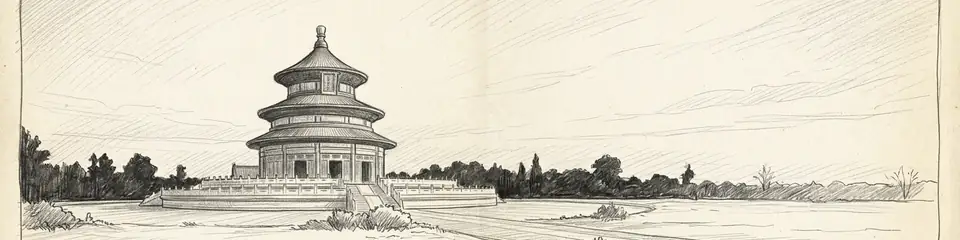
Graphite pencil sketch banner of Temple of Heaven

“The Temple of Heaven is the best-preserved imperial cosmological landscape in East Asia — architecture, ritual, and urban axis fused to express Ming–Qing state ideology.”

위치

개요

The Temple of Heaven (Tiantan) occupies a walled park of about 273 hectares in the Dongcheng district of Beijing, south of the Forbidden City along the city's central axis. The Yongle Emperor of the Ming dynasty created the complex in the early 15th century as a counterpart to his new imperial palace: where the Forbidden City was the emperor's earthly residence, Tiantan was where he performed rites as Son of Heaven.

The architectural climax is the Hall of Prayer for Good Harvests (Qinian Dian), a triple-gabled circular wooden hall raised on a three-tier marble terrace, rebuilt in its present form after a lightning fire in 1889. The emperor prayed here at the winter solstice for abundant harvests. To the south, the Circular Mound Altar (Huanqiu Tan) and the Imperial Vault of Heaven (Huangqiong Yu) served complementary rituals connecting square earth and round heaven.

Qing rulers maintained and adjusted the rites until the abdication of 1912. The park opened to the public in 1918 and became a UNESCO World Heritage Site in 1998 as part of a serial inscription with the Forbidden City and Summer Palace. Morning tai chi among cypress trees and the sight of the blue-roofed hall against Beijing smog or snow make it one of China's most photographed monuments.

중요성

The Temple of Heaven is the best-preserved imperial cosmological landscape in East Asia — architecture, ritual, and urban axis fused to express Ming–Qing state ideology. Its timber hall and marble altars are the reference point for understanding how Chinese emperors performed agricultural sovereignty through sacrifice rather than military conquest alone.

증거와 해석

확립된 사실과 논쟁 중인 사항을 구분합니다.

잘 확립된 사실

2
  • Ming and Qing ritual manuals prescribe winter solstice ceremonies at the Circular Mound Altar and Hall of Prayer.
  • Architectural survey confirms triple-gabled dougong bracket hall on marble terrace consistent with late imperial workshops.

학술적 추론

1
  • Placement on Beijing's south–north axis links Tiantan cosmologically to the Forbidden City — inferred from urban planning texts.

커뮤니티 사진

당신의 경험을 공유하세요

이 유적지를 방문하셨나요? 다른 탐험가들을 위해 사진을 업로드해 보세요.

이 페이지 인용 방법

Atlas Anatolia. (1406). Temple of Heaven. Atlas Anatolia. https://atlasanatolia.com/ko/site/temple-of-heaven

콘텐츠는 CC BY-SA 4.0 라이선스에 따라 제공됩니다 — 재사용 시 출처 표시가 필요합니다.

출처

  • Chinese Architecture — Steinhardt, Nancy Shatzman (2019)
  • UNESCO — Temple of Heaven링크

자주 묻는 질문

Temple of Heaven은(는) 어디에 위치해 있나요?

Temple of Heaven은(는) China에 위치해 있습니다.

Temple of Heaven의 연대는 언제인가요?

Temple of Heaven의 연대는 대략 1406 서기 – 1912 서기로 거슬러 올라갑니다.

Temple of Heaven과(와) 관련된 고대 문명은 무엇인가요?

Temple of Heaven은(는) Ming, Qing 문명과 관련이 있습니다.

Temple of Heaven이(가) 중요한 이유는 무엇인가요?

The Temple of Heaven is the best-preserved imperial cosmological landscape in East Asia — architecture, ritual, and urban axis fused to express Ming–Qing state ideology.

Temple of Heaven은(는) 유네스코 세계유산인가요?

예 — Temple of Heaven은(는) 유네스코 세계유산으로 등재되어 있습니다.