
콘텐츠로 건너뛰기
Atlas Anatolia
디그
뉴스술라웨시 빙하기 치아에서 빈랑 사용 25,000년 전까지 소급카스타모누 폼페이오폴리스 바실리카에서 로마 모자이크와 에로스 두상 발견
The brick vault of Taq Kasra, the great ayvān of Ctesiphon, Iraq

Wikimedia Commons (CC BY-SA 4.0)

Country Record

Known by the Most Names in Iraq

도시주요

Ctesiphon

Seyfi Cem Baskin

قطيسفون129 기원전 – 637 서기

The Parthian and Sasanian capital on the Tigris south of Baghdad — celebrated for the colossal brick vault of Taq Kasra — is among the most searched late-antique archaeological sites and the administrative twin of Seleucia on the opposite bank.

21
관심 62

위치

이라크

33.09°N · 44.58°E · 아시아

Capitals

Parthian winter seat; Sasanian imperial capital

Taq Kasra

~30 m high brick vault (ayvān)

Fall

Taken by Arab armies, 637 CE

Location

East bank of Tigris, ~35 km SE of Baghdad

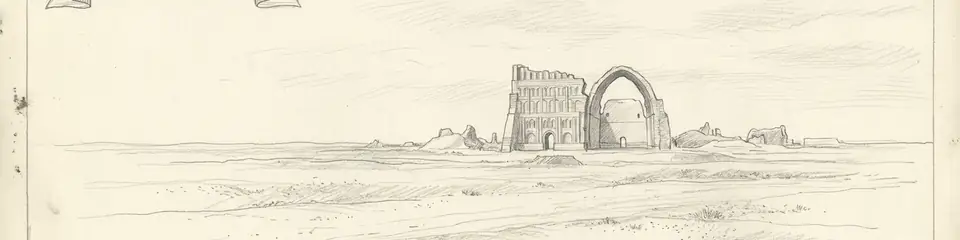
Graphite pencil sketch banner of Ctesiphon

“Ctesiphon was the primary capital of the last pre-Islamic Iranian empire and the eastern pole opposite Constantinople in late antique geopolitics.”

위치

개요

Ctesiphon developed on the east bank of the Tigris opposite Hellenistic Seleucia, consolidating into the twin cities later called al-Mada’in. Parthian kings wintered here; Sasanian shahanshahs made it the ceremonial and administrative heart of Erānshahr from Ardashir I through Khosrow II. Arab armies captured the city in 637 CE after the Battle of al-Qādisiyyah; much of the palace quarter decayed as Baghdad rose.

What remains most dramatically visible is Taq Kasra (the Arch of Khosrow / ayvān of al-Madāʾin): a free-standing baked-brick vault roughly 30 metres high spanning about 25 metres — one of the largest unreinforced brick arches ever built. Excavations and early travellers documented palace complexes, residential mounds, and canalised floodplains; modern damage, flood, and conflict have thinned standing fabric beyond the arch.

The site anchors debates on Sasanian court culture, silk-road diplomacy with Byzantium, and the transfer of imperial capitalship from Mesopotamian to Islamic Iraq. Pair with Hatra and Persepolis for complementary Iranian imperial landscapes, and with Palmyra for late antique caravan politics.

중요성

Ctesiphon was the primary capital of the last pre-Islamic Iranian empire and the eastern pole opposite Constantinople in late antique geopolitics. Taq Kasra remains the clearest standing monument of Sasanian brick technology and royal architecture.

증거와 해석

확립된 사실과 논쟁 중인 사항을 구분합니다.

잘 확립된 사실

2
  • Classical, Syriac, and early Islamic sources identify Ctesiphon as the Sasanian capital opposite Seleucia.
  • Structural surveys of Taq Kasra document brick bonding and span unique among surviving Sasanian vaults.

논쟁 중인 해석

1
  • Exact royal builders and phases of the standing vault (Shapur I vs later Khosrows) are still argued from sparse building inscriptions.

커뮤니티 사진

당신의 경험을 공유하세요

이 유적지를 방문하셨나요? 다른 탐험가들을 위해 사진을 업로드해 보세요.

이 페이지 인용 방법

Atlas Anatolia. (129). Ctesiphon. Atlas Anatolia. https://atlasanatolia.com/ko/site/ctesiphon

콘텐츠는 CC BY-SA 4.0 라이선스에 따라 제공됩니다 — 재사용 시 출처 표시가 필요합니다.

출처

  • Ctesiphon — Keall, Edward J. (1975)
  • Sasanian Persia: The Rise and Fall of an Empire — Daryaee, Touraj (2009)

자주 묻는 질문

Ctesiphon은(는) 어디에 위치해 있나요?

Ctesiphon은(는) Iraq에 위치해 있습니다.

Ctesiphon의 연대는 언제인가요?

Ctesiphon의 연대는 대략 129 기원전 – 637 서기로 거슬러 올라갑니다.

Ctesiphon과(와) 관련된 고대 문명은 무엇인가요?

Ctesiphon은(는) Parthian, Sasanian 문명과 관련이 있습니다.

Ctesiphon이(가) 중요한 이유는 무엇인가요?

Ctesiphon was the primary capital of the last pre-Islamic Iranian empire and the eastern pole opposite Constantinople in late antique geopolitics.

Ctesiphon은(는) 유네스코 세계유산인가요?

Ctesiphon은(는) 현재 유네스코 세계유산 목록에 등재되어 있지 않습니다.