
콘텐츠로 건너뛰기
Atlas Anatolia
디그
뉴스술라웨시 빙하기 치아에서 빈랑 사용 25,000년 전까지 소급카스타모누 폼페이오폴리스 바실리카에서 로마 모자이크와 에로스 두상 발견
Copán — Honduras

Wikimedia Commons (CC BY-SA)

Continent Record

Southernmost Known Site in North America

도시유네스코주요

Copán

Seyfi Cem Baskin

426 서기 – 822 서기

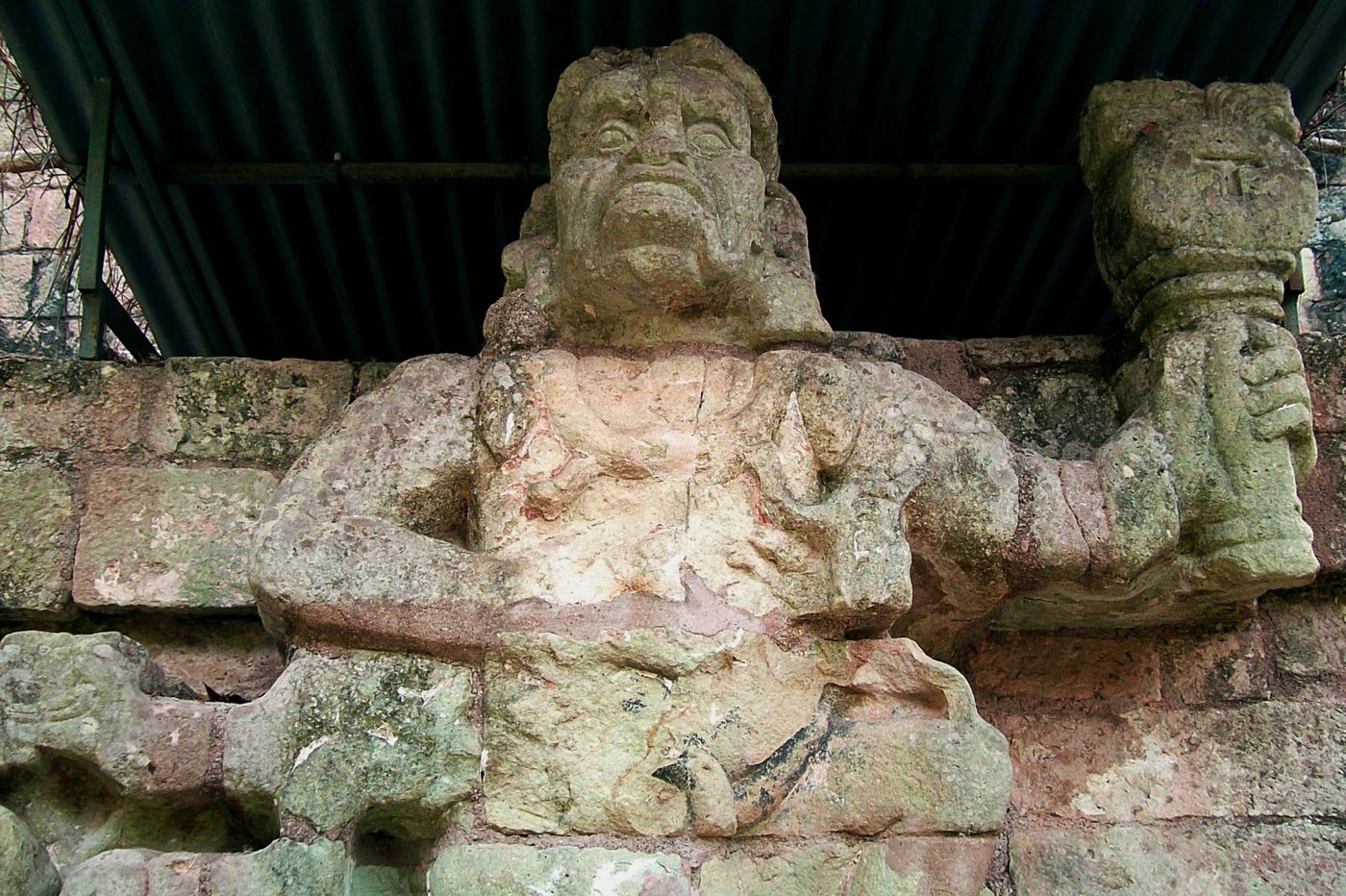
Copán, a major Classic Maya city (426–822 CE) in western Honduras, is renowned for its sculptured stelae, hieroglyphic stairway, and sophisticated art.

322
관심 66

위치

Copán Department · Western Honduras · 온두라스

14.84°N · 89.14°W · 북아메리카

Built

c. 426–822 CE

Civilization

Maya (Classic Period)

Ancient Name

Oxwitik

Discovered

Documented by Europeans in 1570; systematic exploration began in 1839

Status

UNESCO World Heritage Site (inscribed 1980)

Notable Ruler

Kʼinich Yax Kʼukʼ Moʼ (founder, 426–c. 437 CE)

Graphite pencil sketch banner of Copán

“Copán preserves one of the most complete historical records of a Classic Maya dynasty, connecting monument datings to detailed political narratives.”

위치

개요

Discovery and Early Accounts

Copán was first documented by Europeans in 1570 when Spanish explorer Diego García de Palacio described the ruins to King Philip II. However, the site remained largely unknown to the outside world until the 1839 expedition of John Lloyd Stephens and Frederick Catherwood, whose vivid illustrations and accounts in Incidents of Travel in Central America, Chiapas, and Yucatán sparked widespread interest. Subsequent visits by Alfred Maudslay in the 1880s produced the first detailed photographs and plaster casts, laying the groundwork for scientific archaeology.

Political History and Dynasty

Copán was the capital of a Classic Maya kingdom that rose to prominence under Kʼinich Yax Kʼukʼ Moʼ, a founder who arrived in 426 CE and established a dynastic lineage that endured for over 400 years. The dynasty reached its apogee during the reign of Kʼakʼ Joplaj Chan Kʼawiil (738–749 CE), who commissioned the famous Hieroglyphic Stairway. The last known ruler, Yax Pasaj Chan Yopaat (763–810 CE), struggled with political fragmentation, and the dynasty collapsed around 822 CE. Altar Q, erected by Yax Pasaj, depicts all 16 kings of the Copán dynasty, serving as a key historical document.
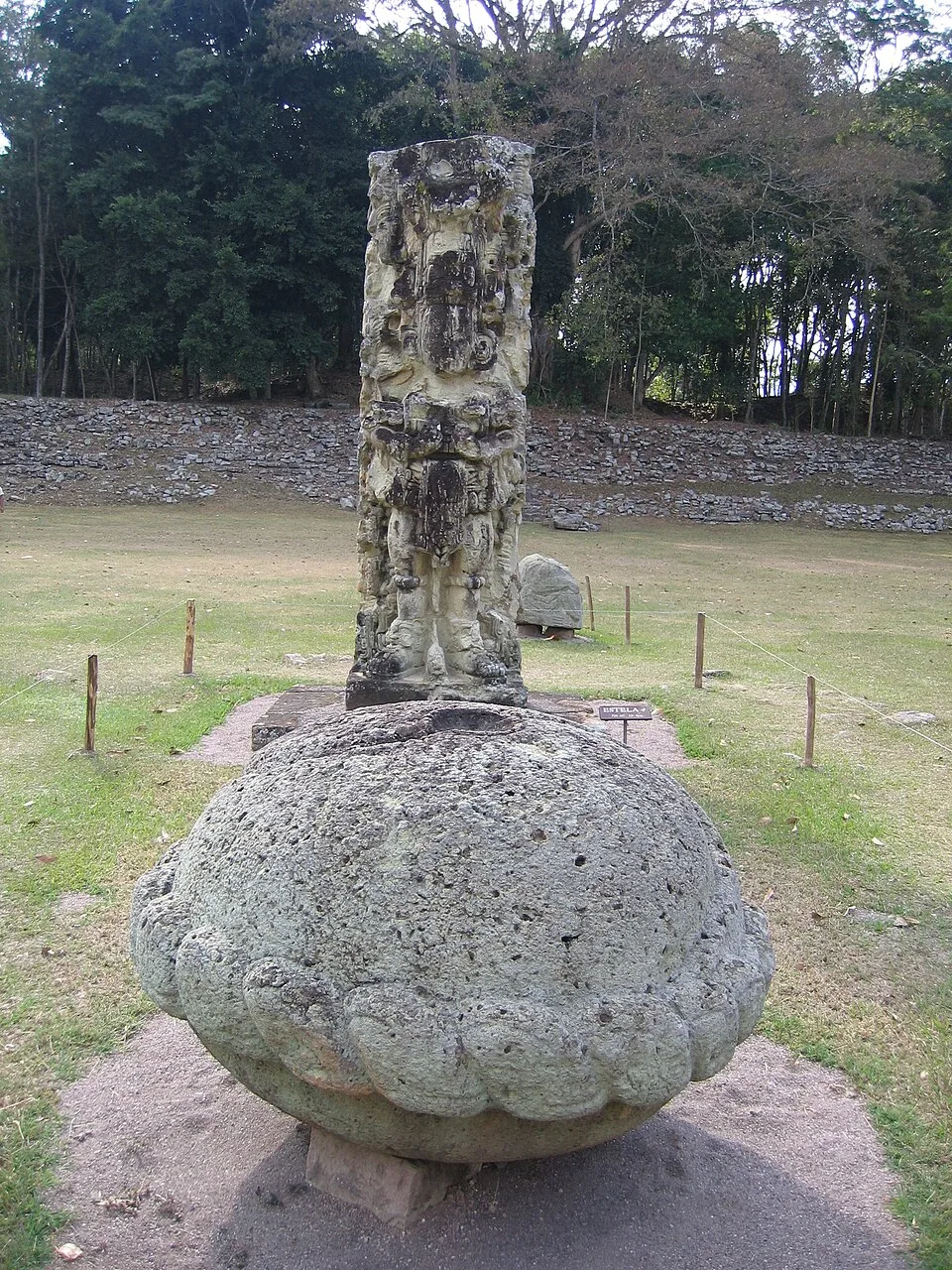
Copán Maya stelae
Copán Maya stelae | Peter Andersen (CC BY 2.5)
"In the days of the great-great-grandfathers of our great-great-grandfathers, the lord K'inich Yax K'uk' Mo' came down from the lands of the west and seated himself upon the mat of Copán. From him sprang the dynasty of sixteen kings."
— Altar Q inscription, Copán, commissioned by King Yax Pasaj Chan Yopaat in 776 CE

Architecture and Monuments

The site’s monumental core includes the Acropolis, a massive complex of superimposed courts and temples built over centuries, and the Great Plaza, which hosts many of Copán’s iconic stelae. The Hieroglyphic Stairway, constructed under Kʼakʼ Joplaj Chan Kʼawiil, comprises 63 steps inscribed with over 2,000 glyphs—the longest Maya text known—chronicling the dynasty’s history. The Ball Court, the second largest in Mesoamerica, is lined with parrot-shaped markers and reflects the ritual and political significance of the ballgame.
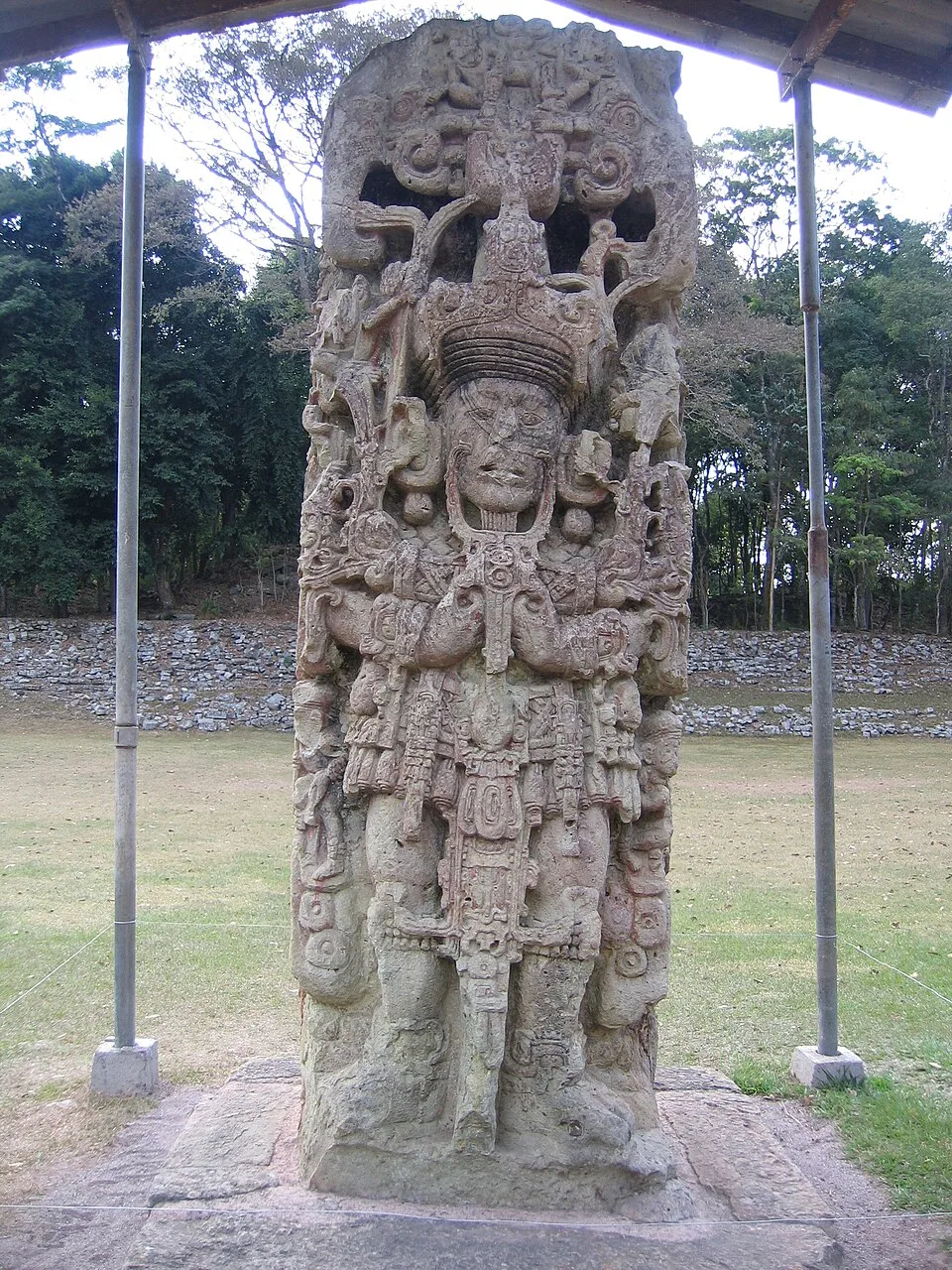
Copán Maya stelae 2
Copán Maya stelae 2 | Peter Andersen (CC BY 2.5)

Art and Inscriptions

Copán’s sculptural tradition is exceptional for its intricate, high-relief carvings and narrative detail. Stelae, such as Stela A and Stela B, depict rulers in elaborate regalia, accompanied by calendrical and historical texts. The inscriptions provide a wealth of information on dynastic succession, warfare, and ritual practices. While much is understood of the site’s political history, the symbolic meaning of certain iconographic motifs remains a subject of interpretation, with scholars debating the extent of Teotihuacan influence on early Copán art.

Decline and Abandonment

Archaeological evidence points to a gradual decline in the Late Classic, marked by environmental stress, deforestation, and soil erosion, as indicated by pollen cores and erosion deposits. The cessation of dated monuments after 822 CE suggests a collapse of centralized authority, though some occupation continued in the valley. The exact interplay of factors—whether primarily ecological, political, or a combination—remains debated. Skeletal studies from elite and commoner burials reveal evidence of malnutrition and disease in the terminal phase, supporting a scenario of systemic crisis.
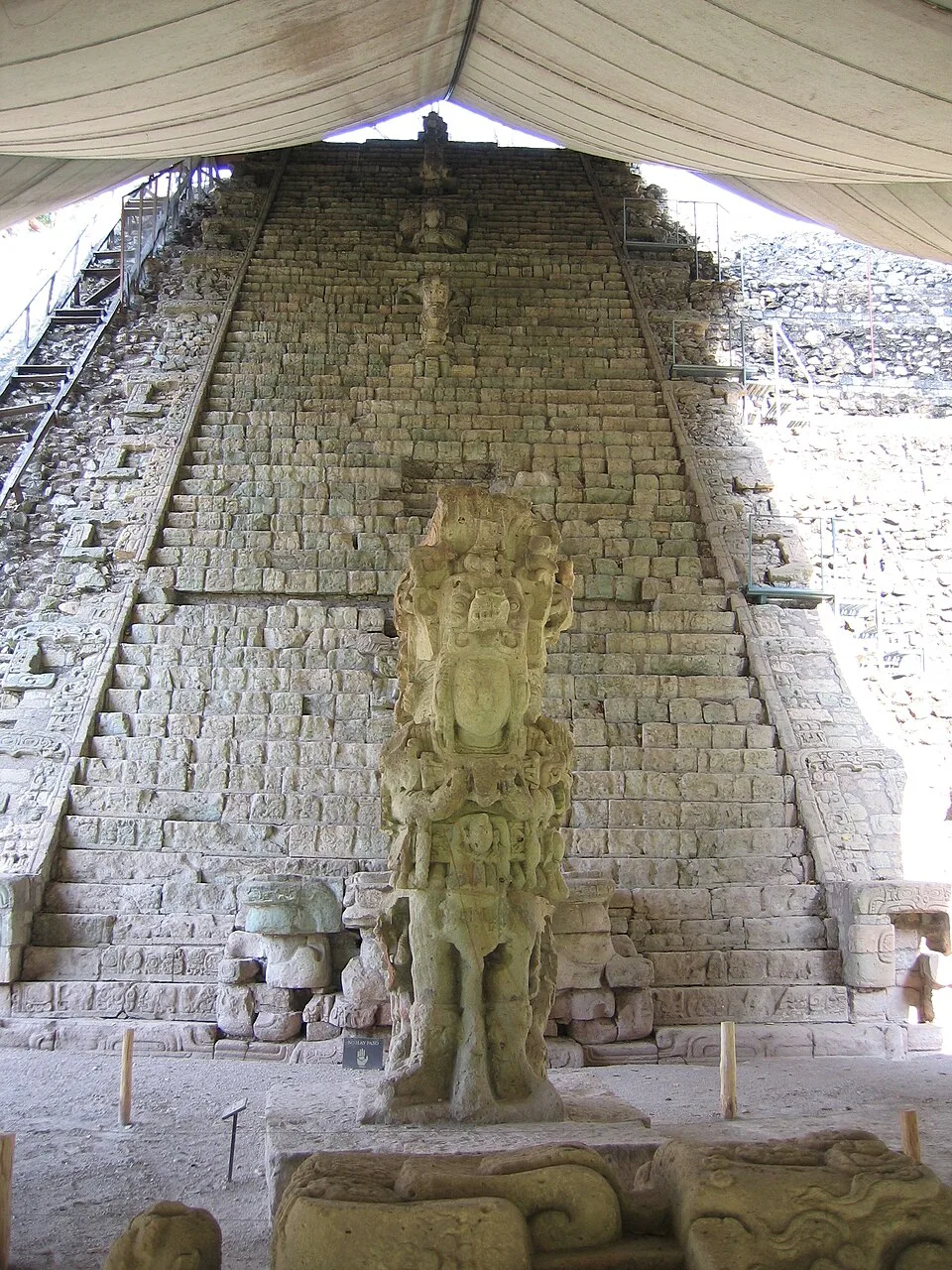
Stela M and the Hieroglyphic Stairway on the archeological site of Copán, a mayan city
Stela M and the Hieroglyphic Stairway on the archeological site of Copán, a mayan city | Peter Andersen (talk) (CC BY 2.5)

Research and Significance

Modern archaeological work at Copán began with the Carnegie Institution of Washington’s excavations in the 1930s, which restored many structures. More recently, tunnel excavations inside the Acropolis have revealed earlier construction phases, yielding rich tombs and offerings that illuminate the dynasty’s origins. As a UNESCO World Heritage Site since 1980, Copán is a cornerstone of Maya studies, offering an unparalleled record of Classic Maya kingship, urbanism, and artistic expression.
중요성

Copán preserves one of the most complete historical records of a Classic Maya dynasty, connecting monument datings to detailed political narratives. Its richly carved stelae and the longest known hieroglyphic inscription in the Maya world offer an exceptional window into ancient statecraft and cosmology. The site’s detailed archaeological context has made it a model for understanding Maya urban decline and resilience.

증거와 해석

확립된 사실과 논쟁 중인 사항을 구분합니다.

잘 확립된 사실

3
  • The Hieroglyphic Stairway contains the longest known Maya inscription, with over 2,000 glyphs.
  • Altar Q depicts all 16 rulers of the Copán dynasty in sequential order.
  • The founder Kʼinich Yax Kʼukʼ Moʼ arrived in 426 CE, as indicated by iconographic and epigraphic evidence.

학술적 추론

2
  • The dynasty traced its authority to a foreign origin, likely from the central Maya lowlands, to legitimize rule.
  • Environmental degradation, including deforestation and soil erosion, contributed significantly to Copán’s decline.

논쟁 중인 해석

2
  • The degree of Teotihuacan influence on Copán’s early art and political structure remains disputed, with some scholars proposing a direct ‘stranger king’ connection.
  • The primary cause of Copán’s collapse—whether political mismanagement, ecological crisis, or a combination—is still contested.

발견과 발굴

1839–1841

Stephens and Catherwood Expedition

지휘 John Lloyd Stephens and Frederick Catherwood

Documented the ruins with detailed drawings and descriptions, introducing Copán to an international audience.

1881–1894

Maudslay’s Surveys

지휘 Alfred P. Maudslay

Alfred Maudslay produced the first comprehensive photographic and plaster cast record of the site for the British Museum.

1935–1946

Carnegie Institution Excavations

지휘 Carnegie Institution of Washington

Large-scale excavation and restoration of the Acropolis, Hieroglyphic Stairway, and Ball Court, directed by Gustav Strömsvik and including epigraphic work by Tatiana Proskouriakoff.

1977–1996

Copán Acropolis Archaeological Project

지휘 Harvard University and the Honduran Institute of Anthropology

Multi-phase project involving tunnel excavations within the Acropolis to reconstruct architectural sequences and recover royal tombs, co-directed by William Fash.

2000

Ongoing Conservation and Digital Documentation

지휘 Instituto Hondureño de Antropología e Historia (IHAH)

Continuous conservation and site management by IHAH, including 3D laser scanning and digital recording of monuments.

커뮤니티 사진

당신의 경험을 공유하세요

이 유적지를 방문하셨나요? 다른 탐험가들을 위해 사진을 업로드해 보세요.

관련 이야기

이 페이지 인용 방법

Atlas Anatolia. (426). Copán. Atlas Anatolia. https://atlasanatolia.com/ko/site/copan

콘텐츠는 CC BY-SA 4.0 라이선스에 따라 제공됩니다 — 재사용 시 출처 표시가 필요합니다.

그래프

관련 유적지와 스토리로의 연결.

출처

  • Fash, William L. (2011), Scribes, Warriors and Kings: The City of Copán and the Ancient Maya — William L. Fash (2011)
  • Andrews, E. Wyllys and Fash, Barbara W. (2005), ‘Issues in Copán Archaeology’ in Copán: The History of an Ancient Maya Kingdom — E. Wyllys Andrews and Barbara W. Fash (2005)
  • Stuart, David (2004), ‘The Beginnings of the Copan Dynasty: A Review of the Hieroglyphic and Historical Evidence’ in Understanding Early Classic Copan — David Stuart (2004)
  • Martin, Simon and Nikolai Grube (2008), Chronicle of the Maya Kings and Queens — Simon Martin and Nikolai Grube (2008)
  • UNESCO World Heritage entry, Maya Site of Copan링크
  • Webster, David (2002), The Fall of the Ancient Maya — David Webster (2002)

자주 묻는 질문

Copán은(는) 어디에 위치해 있나요?

Copán은(는) Copán Department, Western Honduras, Honduras에 위치해 있습니다.

Copán의 연대는 언제인가요?

Copán의 연대는 대략 426 서기 – 822 서기로 거슬러 올라갑니다.

Copán과(와) 관련된 고대 문명은 무엇인가요?

Copán은(는) Maya 문명과 관련이 있습니다.

Copán이(가) 중요한 이유는 무엇인가요?

Copán preserves one of the most complete historical records of a Classic Maya dynasty, connecting monument datings to detailed political narratives.

Copán은(는) 유네스코 세계유산인가요?

예 — Copán은(는) 유네스코 세계유산으로 등재되어 있습니다.