
In 1994, a Kurdish shepherd named Mehmet Yıldız kicked at an odd stone protruding from a hillside near the town of Şanlıurfa in southeastern Turkey. He had no way of knowing he had just touched one of the most important archaeological discoveries of the twentieth century. Below the surface lay Göbekli Tepe — a site that would force scholars to rethink the very foundations of human civilization.
Before Göbekli Tepe, the standard story of prehistory ran something like this: hunter-gatherers, scattered and nomadic, eventually settled down to farm. As agriculture created surplus food, that surplus supported specialists — priests, builders, administrators. Complexity came from farming. Temples came last.
"First came the temple, then the city."
— Klaus Schmidt, Excavation Director (1995–2014)
Göbekli Tepe turned this sequence on its head.
What Is Göbekli Tepe?
!Gobekli Tepe, enclosure D stela. Şanlıurfa Museum
Gobekli Tepe, enclosure D stela. Şanlıurfa Museum | Dosseman (CC BY-SA 4.0)
!T-shaped pillars at Göbekli Tepe archaeological site")
Göbekli Tepe Birthing Women | Bernietaylor (CC BY 4.0)
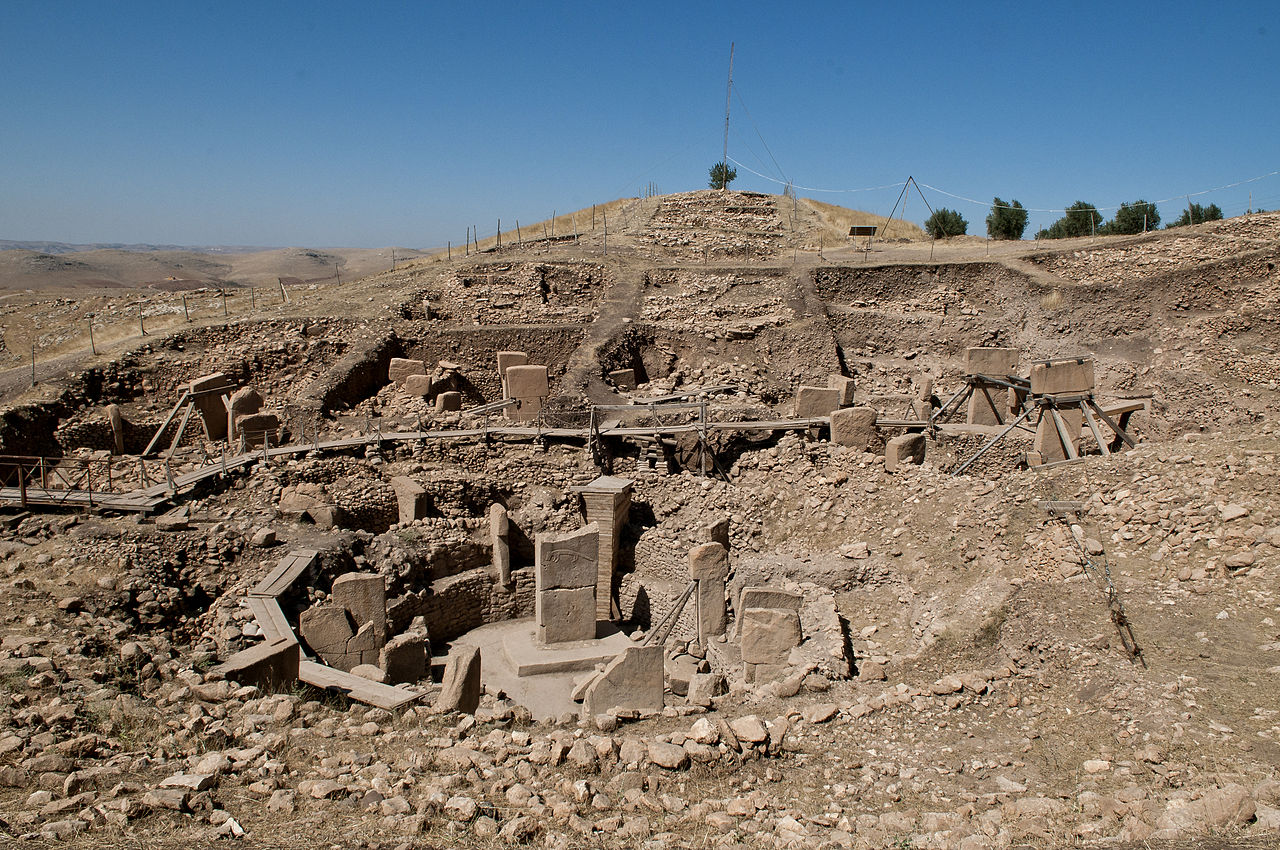
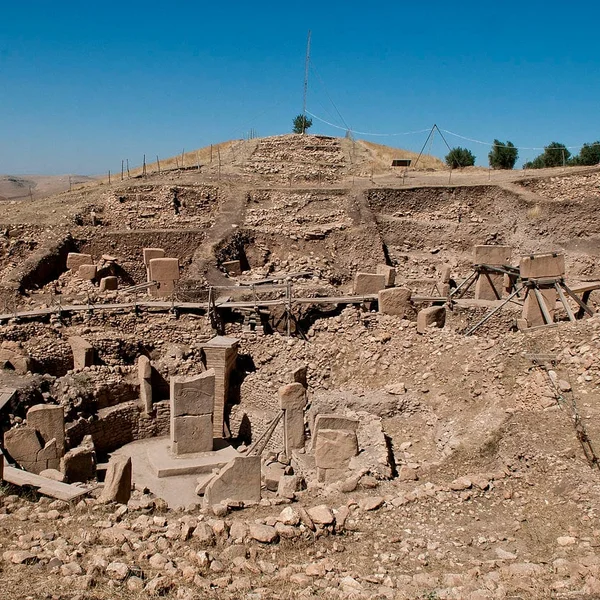
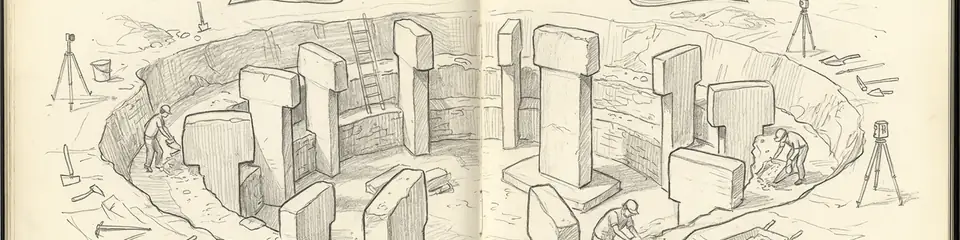
The site is a series of circular and oval stone enclosures set into a hillside. At the center of each enclosure stand pairs of massive T-shaped limestone pillars, sometimes more than five meters tall and weighing up to fifteen tons. The pillars are carved with extraordinary reliefs: foxes, vultures, aurochs, snakes, scorpions, cranes, and abstract human-like forms. Some pillars appear to represent anthropomorphic beings — they have arms, hands, and elaborate belts carved in low relief.
Radiocarbon dating has placed the earliest layers of the site at approximately 9500 BCE, making Göbekli Tepe roughly six thousand years older than Stonehenge and four thousand years older than the first known cities of Mesopotamia. At the time it was built, agriculture had not yet been invented. The people who constructed these monuments were hunter-gatherers.
The Scale of the Problem
!Boncuklu Tarla excavation site")
The logistical challenge of building Göbekli Tepe without agriculture is staggering. The largest pillars at the site weigh between ten and twenty tons and were quarried from bedrock up to a quarter-kilometer away. Cutting, transporting, and erecting them required coordinated labor on a scale that archaeologists previously associated only with settled, food-producing societies.
Feeding the workers who built and used the site would have required extraordinary efforts. Zooarchaeological analysis has found the bones of hundreds of thousands of animals at the site — aurochs, wild sheep, gazelle, red deer. The animal remains suggest that large-scale communal feasts were held here, perhaps drawing people from across a wide region to participate in rituals whose exact nature we can only guess at.
What Happened Here?
No one knows for certain. Klaus Schmidt, the German archaeologist who led excavations at Göbekli Tepe from 1994 until his death in 2014, described the site as a "cathedral on a hill" — a ritual center that served a dispersed population of hunter-gatherers. He argued that the need to build and maintain such a place may actually have driven the transition to agriculture: the labor demands of the site may have pushed communities toward cultivating grain to feed the builders.
This "temple first" hypothesis remains debated. Some researchers believe the site was used for ancestor veneration — the T-shaped pillars possibly representing deceased individuals or protective spirits. Others point to the astronomical alignments of the enclosures as evidence for sophisticated celestial knowledge. The vultures carved on the pillars have led some archaeologists to suggest connections with mortuary practices involving sky burial.
Karahantepe and the Taş Tepeler Network
In the decades since Schmidt's work began, surveys of the surrounding landscape have revealed that Göbekli Tepe was not unique. A cluster of similar sites, collectively called the Taş Tepeler (Stone Hills), extends across southeastern Anatolia. Karahantepe, discovered in the 1990s but only excavated systematically since 2019, has produced some of the most startling discoveries.
At Karahantepe, archaeologists have found not just T-shaped pillars but three-dimensional human sculptures unlike anything seen at Göbekli Tepe. Life-sized heads carved from stone, a human figure apparently emerging from a wall, and a remarkable seated figure with an exposed ribcage have all been recovered in recent seasons. These finds suggest that the artistic and ritual traditions of the pre-pottery Neolithic were more varied and complex than previously imagined.
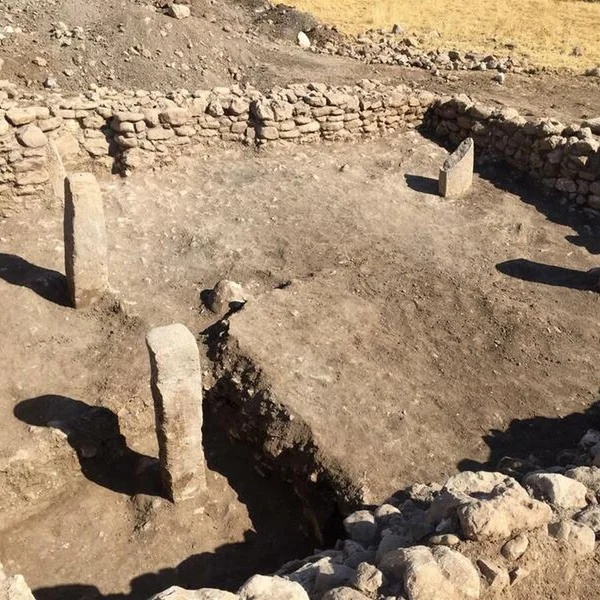
Boncuklu Tarla, another site in the network, has yielded evidence of early architecture and communal structures. The emerging picture is of a world more connected, and more architecturally ambitious, than the simple term "hunter-gatherer" suggests.
The Deliberate Burial
One of the most puzzling facts about Göbekli Tepe is that it was intentionally filled in. Around 8000 BCE, the enclosures were deliberately backfilled with stone, bone, and debris. The site was not abandoned — it was buried. Whether this was a ritual act of closure, a practical decision to build new structures on top, or something else entirely, no one can say. The burial is one reason the site has been so well preserved, but it also hints at the depth of intentionality involved in its construction and use.
Why It Matters
Göbekli Tepe does not just push the date of monumental architecture back by thousands of years. It fundamentally challenges our assumptions about complexity and cognition in prehistoric societies. The people who built it had no metal tools, no writing, no wheeled transport, and no agriculture. They had stone tools, organizational capacity, and apparently a rich symbolic and religious life that demanded monumental expression.
What it tells us is that the capacity for large-scale cooperation, for symbolic thought, and for architectural ambition is far older than we once believed. Göbekli Tepe did not change the beginning of the story — it revealed that the story had been going on much longer than we knew.


