
コンテンツへスキップ
Atlas Anatolia
ニュースIce Age teeth in Sulawesi push betel-nut use back as far as 25,000 yearsRoman mosaic and Eros head uncovered in the basilica at Pompeiopolis, Kastamonu
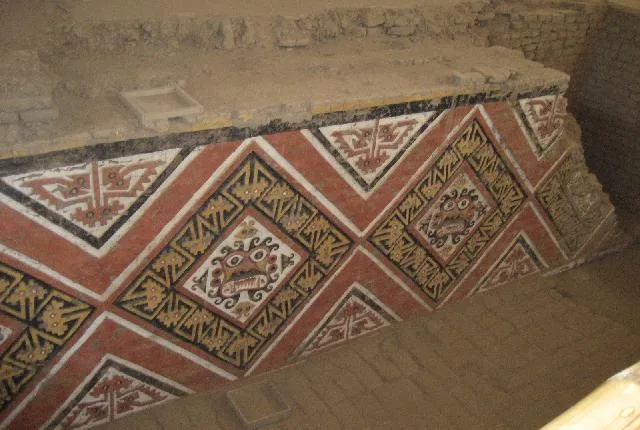
Polychrome mural depicting the Moche deity Ai Apaec at Huaca de la Luna, La Libertad, Peru

Wikimedia Commons

Country Record

Longest Recorded History in Peru

神殿

Huaca de la Luna

Seyfi Cem Baskin

100 西暦 – 700 西暦

A major temple-pyramid of the Moche civilization on Peru's northern coast, built and rebuilt in successive layers over some six centuries and decorated with extraordinarily well-preserved polychrome murals depicting the fanged, staff-wielding deity known to archaeologists as Ai Apaec — the "Decapitator." Alongside the neighbouring Huaca del Sol, it formed the ceremonial and administrative heart of one of the Moche state's principal capitals.

31
関心 46

所在地

La Libertad · ペルー

8.11°S · 79.00°W · 南アメリカ

Period

c. 100–700 CE, built in at least 6 successive construction phases

Murals

Extensive polychrome paintings of the deity Ai Apaec ("the Decapitator")

Preservation

Later phases encased rather than demolished earlier ones, preserving murals intact

Sacrifice evidence

Skeletal remains of ritually sacrificed men found in the adjacent plaza

Contrast with Huaca del Sol

Neighbouring pyramid was heavily damaged by 17th-century Spanish river-diversion treasure hunting

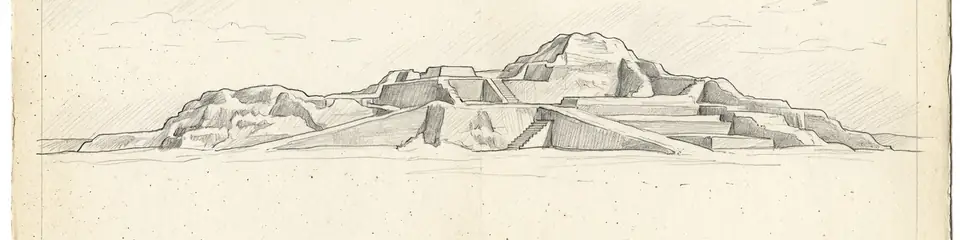
Graphite pencil sketch banner of Huaca de la Luna

“Huaca de la Luna preserves the most complete surviving programme of Moche monumental painting, offering art historians and archaeologists their clearest direct view into Moche religious iconography exactly as it was originally composed and coloured — a level of preservation rare among Andean painted architecture, most of which has been lost to erosion, looting, or later rebuilding that destroyed rather than encased earlier phases.”

所在地

概要

Huaca de la Luna stands at the base of Cerro Blanco, a sacred hill near the modern city of Trujillo on Peru's arid northern coast, directly facing its larger companion structure, Huaca del Sol, across an open plaza that once held the residential and administrative core of a major Moche city. Together the two huacas (a term for sacred structures or objects in Andean tradition) formed one of the most important capitals of the Moche civilization, which dominated Peru's north coast from roughly 100 to 800 CE.

Unlike Huaca del Sol, which suffered severe damage when Spanish colonial treasure-hunters diverted the adjacent Moche River to wash away part of the structure in search of gold in the 17th century, Huaca de la Luna survived largely intact, preserving one of the most complete records of Moche religious architecture and monumental painting known anywhere. The structure was not built once but rebuilt and enlarged in at least six successive construction phases across roughly six centuries, with each new phase largely encasing and preserving the previous one rather than demolishing it — a practice that has allowed archaeologists to excavate through the layers and recover wall paintings from earlier phases in exceptional condition, protected for centuries beneath later construction.

The temple's most striking feature is its extensive polychrome mural programme, executed in mineral pigments of red, yellow, white, black, and blue-grey across large plastered wall surfaces. The dominant recurring image is a fanged, staring anthropomorphic being with spider-like or feline attributes, often shown holding a tumi (ceremonial knife) and a severed head — identified by archaeologists as Ai Apaec, sometimes translated as "the Decapitator" or "the Maker," believed to have served as a principal deity in Moche religious and possibly political ideology, closely associated with ritualised violence, sacrifice, and the natural cycles the Moche depended upon for agriculture in their harsh desert environment.

Excavations directed since the 1990s by Peruvian archaeologists Santiago Uceda and Ricardo Morales have uncovered further evidence connecting the temple directly to ritual sacrifice: the remains of dozens of adult male victims, many showing evidence of violent trauma and ritualised treatment of the body, were found in a plaza area associated with the site, providing direct physical corroboration for iconographic scenes of sacrifice and combat that had previously been known only from Moche ceramic and mural depictions — one of archaeology's clearer cases where painted imagery and skeletal evidence converge to confirm the same underlying ritual practice.

Huaca de la Luna remains an active excavation site, with ongoing Peruvian-led research continuing to refine understanding of its construction sequence, ritual function, and the broader urban settlement that once surrounded it.

重要性

Huaca de la Luna preserves the most complete surviving programme of Moche monumental painting, offering art historians and archaeologists their clearest direct view into Moche religious iconography exactly as it was originally composed and coloured — a level of preservation rare among Andean painted architecture, most of which has been lost to erosion, looting, or later rebuilding that destroyed rather than encased earlier phases. The direct correspondence between the sacrificial skeletal remains excavated in the temple's plaza and the violent ritual imagery painted on its walls is a rare and powerful case of physical and iconographic evidence confirming one another, moving Moche sacrificial practice from inferred symbolism to directly demonstrated historical reality. As one of the twin ceremonial centres of a major Moche capital, Huaca de la Luna anchors understanding of how the Moche state — which never developed writing and is known almost entirely through material and iconographic evidence — organised religious authority, monumental labour, and political power along Peru's northern coast centuries before the rise of the better-documented Inca Empire.

証拠と解釈

確立された事実と議論が続く事柄を区別する。

確立された事実

3
  • Stratigraphic excavation has identified at least six successive construction phases at Huaca de la Luna, each largely encasing rather than destroying the preceding phase, confirmed through direct excavation of the internal layering.
  • Skeletal analysis of human remains excavated in the plaza adjacent to the temple shows evidence of violent trauma and ritualised treatment consistent with sacrificial practice, directly corroborating imagery painted on the temple walls.
  • Pigment analysis of the murals confirms the use of mineral-based paints in a consistent palette across multiple construction phases, allowing art historians to trace stylistic development of the Ai Apaec imagery over several centuries.

学術的推論

1
  • The specific religious and political meaning of the Ai Apaec figure — the extent to which it represented a purely religious deity, a personification of royal authority, or both simultaneously — is inferred from the iconography and comparative Andean religious study rather than confirmed by any Moche textual source, since the Moche did not develop writing.

発見と発掘調査

1899

Early 20th-century documentation

Max Uhle conducts early scientific survey of the Huaca de la Luna and Huaca del Sol complex.

1991

Santiago Uceda and Ricardo Morales excavations

Ongoing systematic excavation programme uncovering the mural sequence, construction phases, and sacrificial plaza evidence, still active today.

コミュニティ写真

あなたの体験を共有する

この遺跡を訪れたことがありますか?写真をアップロードして魅力を共有しましょう。

このページの引用方法

Atlas Anatolia. (100). Huaca de la Luna. Atlas Anatolia. https://atlasanatolia.com/ja/site/huaca-de-la-luna

コンテンツはCC BY-SA 4.0ライセンスの下で提供されています — 再利用の際は出典表示が必要です。

出典

  • Moche: Hacia el Final del Milenio — Uceda, Santiago and Mujica, Elías (eds.) (2003)
  • Rituals of Sacrifice: Its Practice at Huaca de la Luna and Its Representation in Moche Iconography — Bourget, Steve (2001)
  • Proyecto Arqueológico Huacas del Sol y de la Lunaリンク

よくある質問

Huaca de la Lunaはどこにありますか?

Huaca de la LunaはLa Libertad, Peruに位置しています。

Huaca de la Lunaの年代はいつ頃ですか?

Huaca de la Lunaはおよそ100 西暦 – 700 西暦のものとされています。

Huaca de la Lunaはどの文明に関連していますか?

Huaca de la LunaはMoche文明に関連しています。

Huaca de la Lunaが重要な理由は何ですか?

Huaca de la Luna preserves the most complete surviving programme of Moche monumental painting, offering art historians and archaeologists their clearest direct view into Moche religious iconography exactly as it was originally composed and coloured — a level of preservation rare among Andean painted architecture, most of which has been lost to erosion, looting, or later rebuilding that destroyed rather than encased earlier phases.

Huaca de la Lunaはユネスコ世界遺産ですか?

Huaca de la Lunaは現在ユネスコ世界遺産には登録されていません。