
Vai al contenuto
Atlas Anatolia
NotizieIce Age teeth in Sulawesi push betel-nut use back as far as 25,000 yearsRoman mosaic and Eros head uncovered in the basilica at Pompeiopolis, Kastamonu
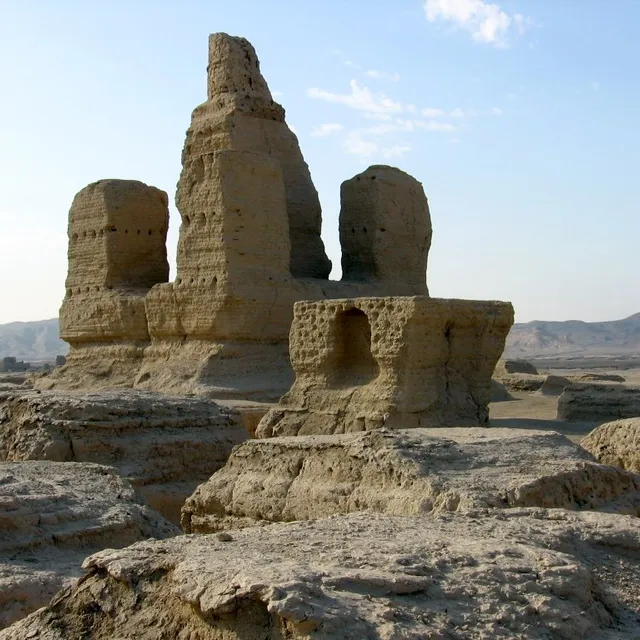
Wind-eroded mud-brick and loess ruins of the ancient city of Jiaohe near Turpan

Wikimedia Commons

Record continentale

Northernmost Known Site in Asia

CittàUNESCO

Jiaohe

Seyfi Cem Baskin

交河故城200 a.C. – 1400 d.C.

A spectacular cliff-top ruined city carved and built on a loess plateau between two river channels near Turpan — capital of the Nearer Jushi kingdom and later a key Silk Road garrison town, abandoned to the desert winds but retaining streets, Buddhist temples, and housing cut into yellow earth.

21
Interesse 47

Posizione

Cina

42.95°N · 89.06°E · Asia

Setting

Loess mesa between two river channels west of Turpan

Early role

Capital of the Nearer Jushi (Cheshi) kingdom

Architecture

Buildings carved into loess plus mud-brick surface structures

UNESCO

Silk Roads Chang’an–Tianshan Corridor component

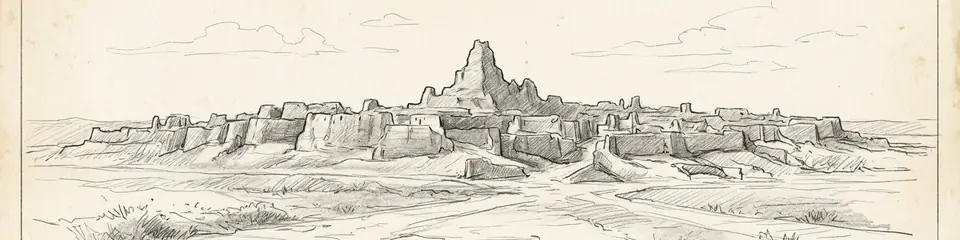
Graphite pencil sketch banner of Jiaohe

Jiaohe is the best-preserved large cliff-plateau city of the Turpan Depression — a textbook case of oasis urbanism adapting to extreme arid topography and river incision.”

Posizione

Panoramica

Jiaohe (Chinese: "Meeting Rivers") occupies a slender loess mesa about 10 kilometres west of Turpan in eastern Xinjiang, China. Two deep river ravines isolate the plateau on three sides, creating a natural fortress. From at least the Western Han period (2nd–1st centuries BCE) it served as the capital of the Nearer Jushi (Cheshi) kingdom; later it became a Tang Chinese military–administrative seat and continued under successive oasis regimes until abandonment around the 14th century after Mongol-era disruptions.

Unlike many Central Asian cities built of fired brick on open plains, much of Jiaohe was excavated downward into loess — subterranean and semi-subterranean houses, temples, and storage spaces — supplemented by surface mud-brick structures. The city plan retains a clear axial street, Buddhist monasteries, a large stupa complex, and defensive walls at the plateau edge. Wind erosion has sculpted the ruins into a lunar yellow landscape often photographed from the air.
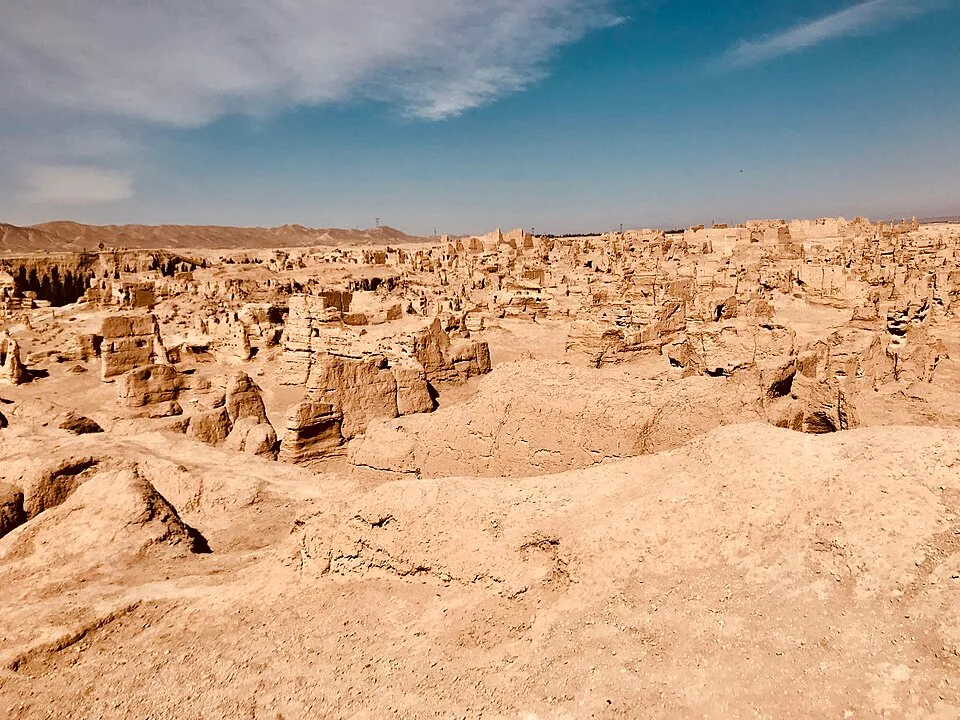
Jiaohe City(Yarkhoto),Turpan,Xinjiang HY3
Jiaohe City(Yarkhoto),Turpan,Xinjiang HY3 | Hiroooooo (CC BY-SA 3.0)
"The city of Jiaohe stands upon a river terrace like a ship between two streams; its people carved dwellings in yellow earth so that the precipice itself became their wall."
— Paraphrase of Chinese geographical notices of the Nearer Jushi capital (Han–Tang tradition)

Japanese, Chinese, and Western explorers documented the site from the early 20th century; systematic conservation continues under China’s Cultural Heritage system. Jiaohe is part of the broader UNESCO Silk Roads: the Routes Network of Chang’an–Tianshan Corridor World Heritage listing.
Perché è importante

Jiaohe is the best-preserved large cliff-plateau city of the Turpan Depression — a textbook case of oasis urbanism adapting to extreme arid topography and river incision. As Nearer Jushi capital then Tang fortress, it sits at the node where Chinese imperial logistics met Indo-Iranian and Turkic Silk Road cultures of the Tarim Basin.

Evidenze e interpretazione

Distinguere ciò che è ben consolidato da ciò che rimane dibattuto.

Fatti ben consolidati

2
  • Standing street plan, temples, and cliff-edge fortifications document a long-lived oasis capital and garrison.
  • Historical Chinese sources identify Jiaohe with the Nearer Jushi administrative centre.

Deduzioni accademiche

1
  • Defensive advantage of the plateau was decisive in its selection as capital and Tang military seat.

Foto della comunità

Condividi la tua esperienza

Hai visitato questo sito? Carica le tue foto per aiutare gli altri a scoprirlo.

Storie correlate

Come citare questa pagina

Atlas Anatolia. (200). Jiaohe. Atlas Anatolia. https://atlasanatolia.com/it/site/jiaohe

Contenuto con licenza CC BY-SA 4.0 — è richiesta l'attribuzione in caso di riutilizzo.

Grafico

Collegamenti a siti e storie correlati.

Fonti

  • Eurasian Crossroads: A History of XinjiangMillward, James A. (2007)
  • UNESCO — Silk Roads: Chang’an–Tianshan CorridorCollegamento

Domande frequenti

Dove si trova Jiaohe?

Jiaohe si trova in China.

A quando risale Jiaohe?

Jiaohe risale all'incirca al 200 a.C. – 1400 d.C..

Quali civiltà sono associate a Jiaohe?

Jiaohe è associato alla civiltà Han, Tang, Tocharian.

Perché Jiaohe è importante?

Jiaohe is the best-preserved large cliff-plateau city of the Turpan Depression — a textbook case of oasis urbanism adapting to extreme arid topography and river incision.

Jiaohe è un sito Patrimonio Mondiale dell'UNESCO?

Sì — Jiaohe è iscritto nella lista del Patrimonio Mondiale dell'UNESCO.