Vai al contenuto
Atlas Anatolia
NotizieIce Age teeth in Sulawesi push betel-nut use back as far as 25,000 yearsRoman mosaic and Eros head uncovered in the basilica at Pompeiopolis, Kastamonu
Abu Simbel — Egypt

Wikimedia Commons (CC BY-SA)

Record nazionale

Earliest Known Site in Egypt

TempioUNESCOIn evidenza

Abu Simbel

Seyfi Cem Baskin

أبو سمبل1264 a.C. – 1244 a.C.

The twin rock temples of Abu Simbel, carved by Ramesses II (c. 1264–1244 BCE) in Nubia, showcase colossal statues and a celebrated solar alignment; they were famously relocated in the 1960s to escape the rising Lake Nasser.

422
Interesse 79

Posizione

Aswan Governorate · Nubia · Egitto

22.34°N · 31.63°E · Africa

Built

c. 1264–1244 BCE

Civilization

Ancient Egyptian (New Kingdom, 19th Dynasty)

Dedication

Ramesses II, Amun, Ra-Horakhty, Ptah; Nefertari and Hathor

Rediscovered

1813 by J.L. Burckhardt; entered 1817 by G. Belzoni

Relocated

1964–1968 under UNESCO campaign

Status

UNESCO World Heritage Site since 1979

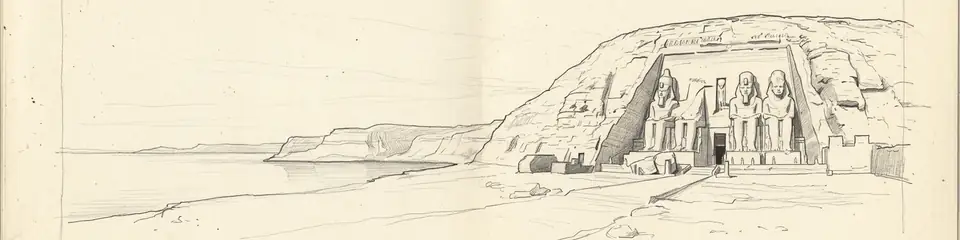
Graphite pencil sketch banner of Abu Simbel

Abu Simbel stands as a monumental testament to Ramesses II's divine kingship and Egypt's imperial reach.”

Posizione

Panoramica

Historical Context

Commissioned by Ramesses II (r. 1279–1213 BCE) during the 19th Dynasty of the New Kingdom, the temples at Abu Simbel were built as part of an ambitious program to deify the pharaoh and assert Egypt’s control over Nubia. Construction likely began around 1264 BCE and was completed by 1244 BCE, as indicated by royal inscriptions and stylistic analysis. The larger temple honors the king himself alongside the gods Amun, Ra-Horakhty, and Ptah, while the smaller one venerates his chief consort Nefertari and the goddess Hathor. After centuries of abandonment and partial burial by sand, the site was rediscovered in modern times by Swiss traveler Johann Ludwig Burckhardt in 1813, and first entered by Italian explorer Giovanni Belzoni in 1817.

Architectural Design

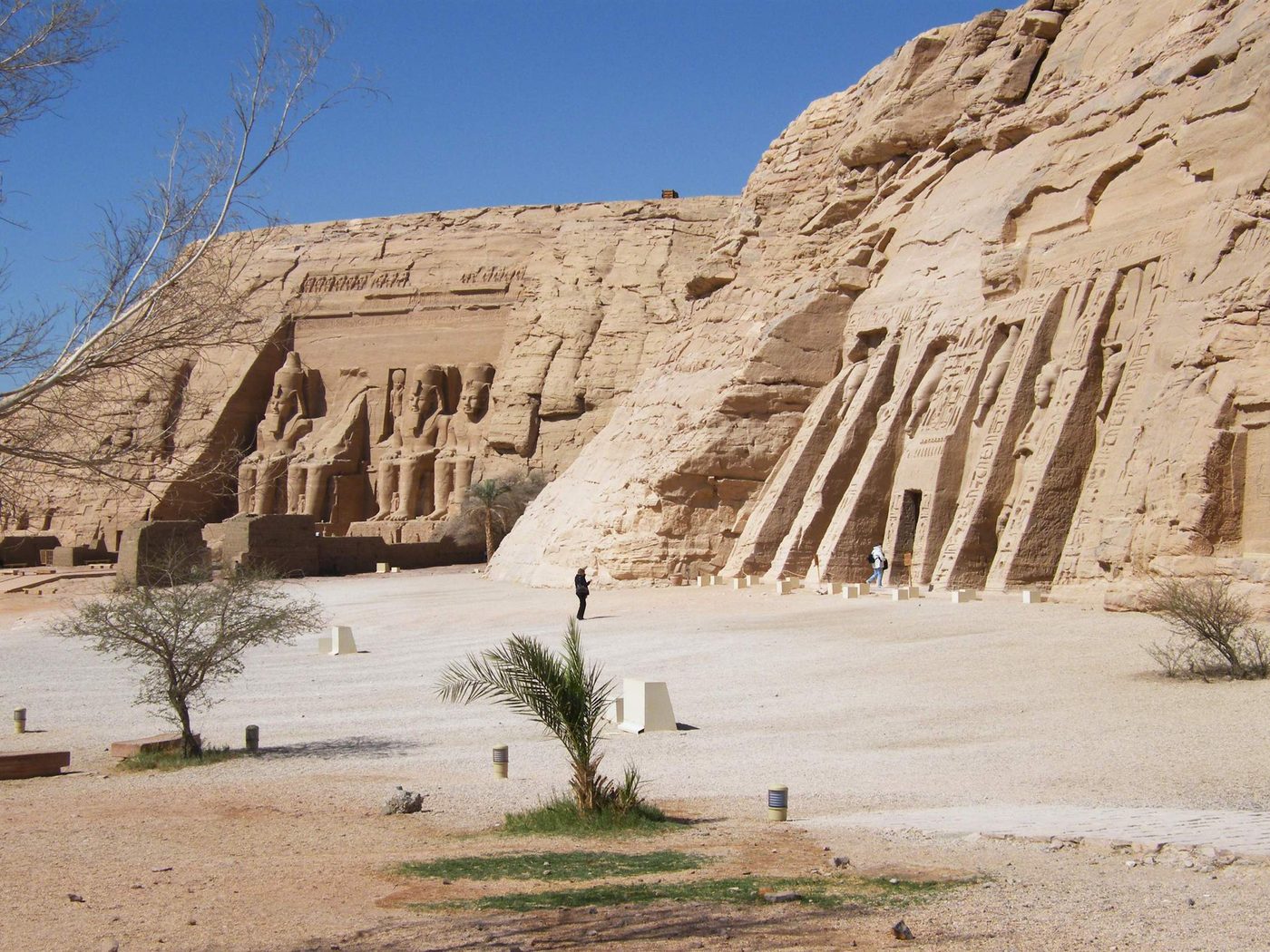
The Great Temple’s façade is dominated by four seated colossi of Ramesses II, each carved from the sandstone cliff and rising approximately 20 meters high. Inside, a hypostyle hall lined with giant Osiride pillars—showing the pharaoh in mummiform guise—leads through progressively smaller chambers to the innermost sanctuary. Here, statues of Ptah, Amun, Ramesses II, and Ra-Horakhty sit on a shared bench, dimly lit except during the solar alignment. The so-called Small Temple, located 150 meters to the north, features six standing statues (four of Ramesses, two of Nefertari) about 10 meters tall, a rare depiction in which the queen appears on equal scale with the pharaoh. Both temples are adorned with elaborate reliefs, notably the Battle of Kadesh scenes on the Great Temple’s north wall, underscoring Ramesses’ military prowess.
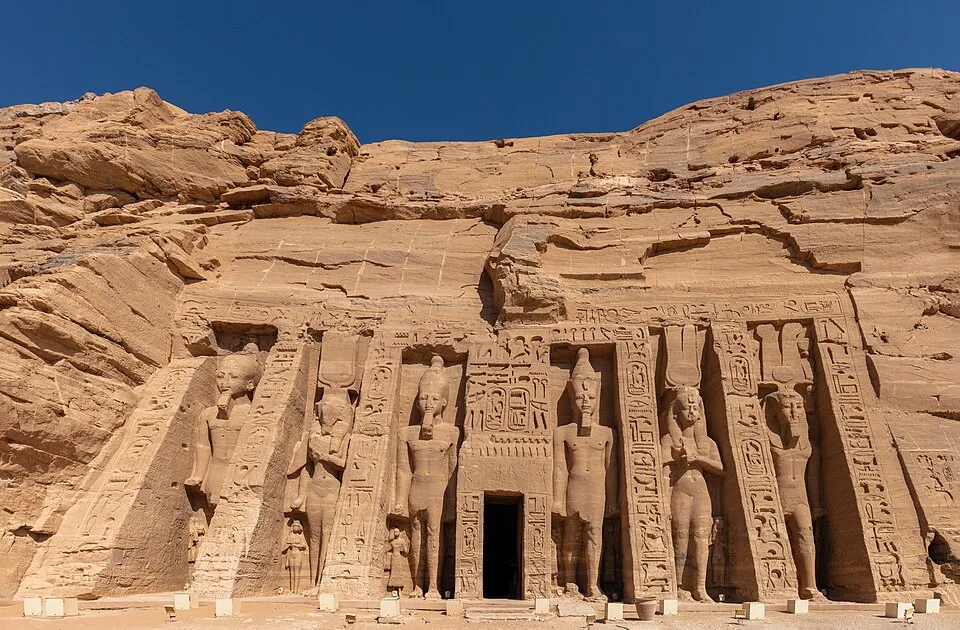
Templo de Nefertari, Abu Simbel, Egipto, 2022-04-02, DD 153
Templo de Nefertari, Abu Simbel, Egipto, 2022-04-02, DD 153 | Diego Delso (CC BY-SA 4.0)
"I am Ramesses, the king of kings. If any wish to know how great I am and where I lie, let him surpass any of my works."
— Inscription on the colossal seated figures of Ramesses II at Abu Simbel, c. 1264 BCE

Solar Alignment and Ritual Significance

Twice each year, on approximately February 22 and October 22, the rising sun penetrates the Great Temple’s axis to illuminate the sanctuary. The alignment selectively lights the statues of Amun, Ramesses II, and Ra-Horakhty, while Ptah—deity of darkness—remains in shadow. These dates are commonly interpreted as the pharaoh’s birthday and coronation day, transforming the temple into a solar clock that reaffirmed the king’s divine nature. The precision of this alignment, which has shifted slightly since antiquity due to changes in the Earth’s axial tilt and the relocation, attests to the sophisticated astronomical knowledge of Egyptian priests.
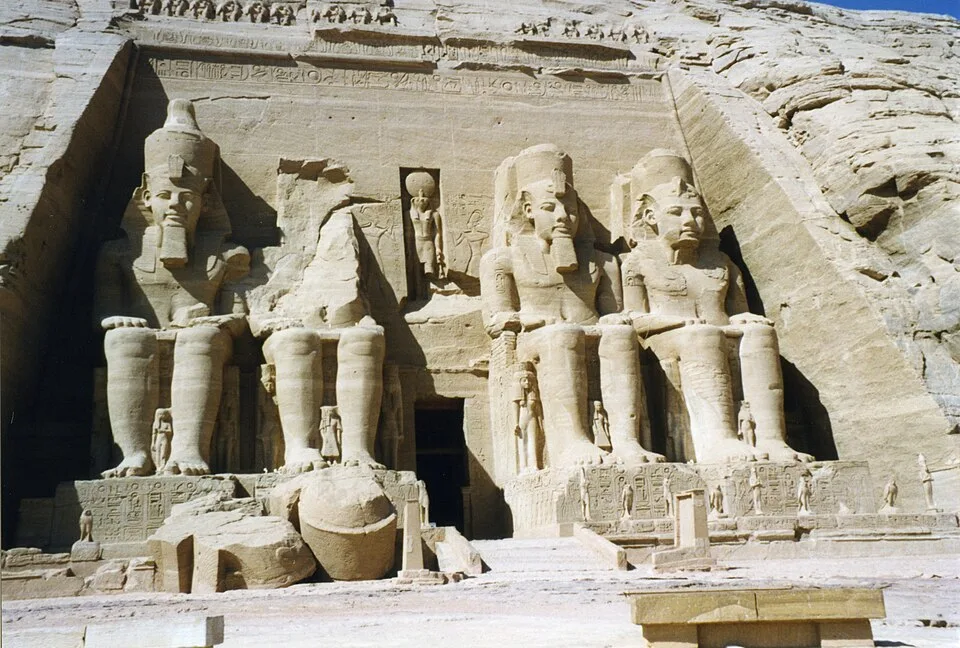
Abu Simbel, façade of the Great Temple (6201194723)
Abu Simbel, façade of the Great Temple (6201194723) | Arian Zwegers from Brussels, Belgium (CC BY 2.0)

The Relocation of the 1960s

With the construction of the Aswan High Dam threatening to submerge the entire Nubian valley under Lake Nasser, a UNESCO-led international campaign was launched in 1964. Between 1964 and 1968, the temples were cut into over 1,000 blocks weighing up to 30 tons each, then reassembled on an artificial hill 65 meters higher and 200 meters inland. Concrete domes and rockfill were used to recreate the original cliff setting, while painstaking measurements sought to maintain the solar alignment, albeit with a one-day discrepancy now observed in the illumination dates. This unprecedented engineering feat not only saved a cultural treasure but also catalyzed the modern global heritage conservation movement.
Perché è importante

Abu Simbel stands as a monumental testament to Ramesses II's divine kingship and Egypt's imperial reach. Its 1960s relocation became a landmark event in the global heritage conservation movement, leading to UNESCO's World Heritage program. The temples' intricate alignment with the sun continues to fascinate archaeologists and astronomers alike.

Evidenze e interpretazione

Distinguere ciò che è ben consolidato da ciò che rimane dibattuto.

Fatti ben consolidati

4
  • The Great Temple entrance features four seated colossi of Ramesses II carved from the rock face.
  • The temples were hewn from sandstone cliffs during the reign of Ramesses II, as attested by inscriptions and royal cartouches.
  • The entire complex was dismantled and reassembled on higher ground between 1964 and 1968 to prevent flooding from Lake Nasser.
  • Inside the Great Temple, a hypostyle hall with Osiride pillars leads to a sanctuary containing statues of Ptah, Amun, Ramesses II, and Ra-Horakhty.

Deduzioni accademiche

2
  • The solar alignment illuminating the sanctuary twice annually likely coincides with the pharaoh’s fertility festival and coronation, though exact dates may have shifted.
  • The equal scale of Nefertari’s statues in the smaller temple suggests she held an unusually high religious and political status for a queen.

Interpretazioni dibattute

2
  • The intended dates of the solar illumination are disputed due to Egyptian calendar drift and possible changes in the Sothic cycle.
  • Whether the temples’ original acoustic properties were preserved during relocation has been questioned by some archaeologists.

Scoperta e scavo

Modern conservation monitoring

Diretto da Supreme Council of Antiquities, World Monuments Fund

Ongoing environmental monitoring, 3D laser scanning, and structural assessments address weathering and tourism pressures.

1817

Initial clearance and entry

Diretto da Giovanni Battista Belzoni

Giovanni Belzoni removed sand from the Great Temple’s entrance and explored its interior, later publishing accounts of the reliefs.

1935–1936

Epigraphic survey by the Oriental Institute

Diretto da Harold H. Nelson

The University of Chicago’s Nubian Expedition, directed by Harold H. Nelson, recorded inscriptions and reliefs, producing a detailed corpus.

1960–1964

Pre-relocation salvage archaeology

Diretto da Egyptian Antiquities Department, UNESCO

Egyptian and international teams surveyed, photographed, and conducted limited excavations to document the temples and their immediate surroundings prior to dismantling.

Foto della comunità

Condividi la tua esperienza

Hai visitato questo sito? Carica le tue foto per aiutare gli altri a scoprirlo.

Storie correlate

Come citare questa pagina

Atlas Anatolia. (1264). Abu Simbel. Atlas Anatolia. https://atlasanatolia.com/it/site/abu-simbel

Contenuto con licenza CC BY-SA 4.0 — è richiesta l'attribuzione in caso di riutilizzo.

Grafico

Collegamenti a siti e storie correlati.

Fonti

  • Wilkinson, Richard H. (2000). The Complete Temples of Ancient EgyptRichard H. Wilkinson (2000)
  • Siliotti, Alberto (2001). Abu Simbel: Egypt's Sun TempleAlberto Siliotti (2001)
  • Badawy, Alexander (1973). 'The Solar Alignment of the Great Temple of Abu Simbel'. Chronique d'Égypte 48(96): 257–270.Alexander Badawy (1973)
  • Säve-Söderbergh, Torgny (1987). Temples and Tombs of Ancient Nubia: The International Rescue Campaign at Abu Simbel, Philae and Other SitesTorgny Säve-Söderbergh (1987)
  • UNESCO World Heritage entry for Nubian Monuments from Abu Simbel to PhilaeCollegamento
  • MacQuitty, William (1965). Abu Simbel: The Story of a RescueWilliam MacQuitty (1965)

Domande frequenti

Dove si trova Abu Simbel?

Abu Simbel si trova in Aswan Governorate, Nubia, Egypt.

A quando risale Abu Simbel?

Abu Simbel risale all'incirca al 1264 a.C. – 1244 a.C..

Quali civiltà sono associate a Abu Simbel?

Abu Simbel è associato alla civiltà Ancient Egyptian, Nubian / Kushite.

Perché Abu Simbel è importante?

Abu Simbel stands as a monumental testament to Ramesses II's divine kingship and Egypt's imperial reach.

Abu Simbel è un sito Patrimonio Mondiale dell'UNESCO?

Sì — Abu Simbel è iscritto nella lista del Patrimonio Mondiale dell'UNESCO.