
Aller au contenu
Atlas Anatolia
ActualitésIce Age teeth in Sulawesi push betel-nut use back as far as 25,000 yearsRoman mosaic and Eros head uncovered in the basilica at Pompeiopolis, Kastamonu
Sigiriya — Sri Lanka

Wikimedia Commons (CC BY-SA)

Country Record

Earliest Known Site in Sri Lanka

ForteresseUNESCOEn vedette

Sigiriya

Seyfi Cem Baskin

සීගිරිය477 apr. J.-C. – 495 apr. J.-C.

Sigiriya, the 5th-century rock fortress of King Kasyapa I, rises 200 meters above central Sri Lanka, its summit palace complex, water gardens, and frescoes epitomizing ancient Sinhalese urban planning and artistry.

322
Intérêt 76

Localisation

Central Province · Matale District · Sri Lanka

7.96°N · 80.76°E · Asie

Built

477–495 CE during the reign of King Kasyapa I

Civilization

Sinhalese civilization, Anuradhapura period

Discovered

Documented by Jonathan Forbes in 1831; archaeological surveys by H.C.P. Bell 1894–1898

Status

UNESCO World Heritage Site since 1982

Height

Rock summit 200 m above plain, 370 m above sea level

Graffiti Period

6th to 14th centuries CE, over 600 verses

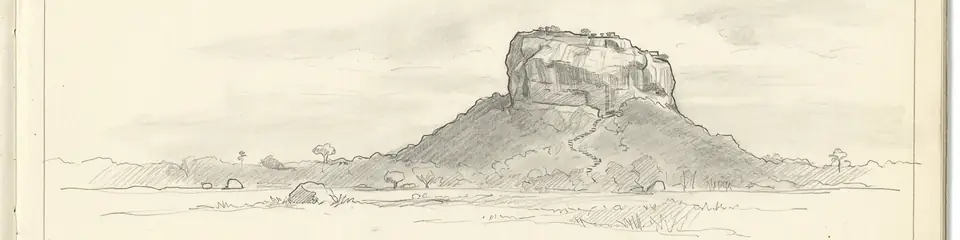
Graphite pencil sketch banner of Sigiriya

“Sigiriya represents a unique synthesis of urban planning, art, and engineering in 5th-century South Asia, challenging assumptions about early state formation outside the Old World.”

Localisation

Aperçu

Discovery and Early Documentation

Sigiriya was never truly lost; its ruins were visible to local communities and mentioned in medieval chronicles like the Mahavamsa. European accounts begin with Major Jonathan Forbes in 1831, but systematic archaeology started with H.C.P. Bell in the 1890s. Bell’s surveys (1894–1898) cleared jungle and mapped the site, revealing its extraordinary symmetry and hydraulic sophistication. Later, Senarath Paranavitana’s mid-20th-century excavations and epigraphical studies shaped modern understanding, particularly his reading of the mirror wall graffiti.

Architectural Marvel

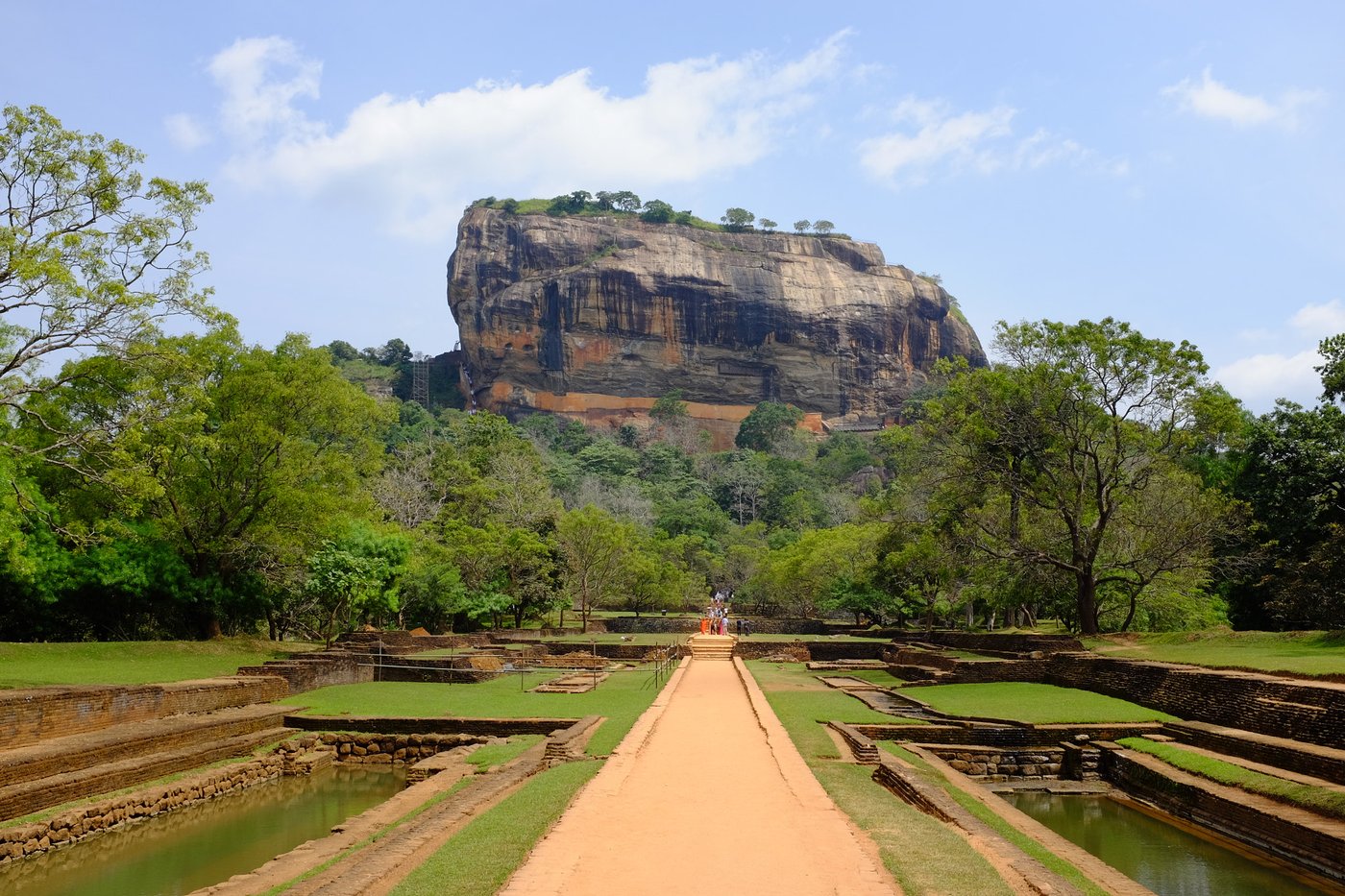
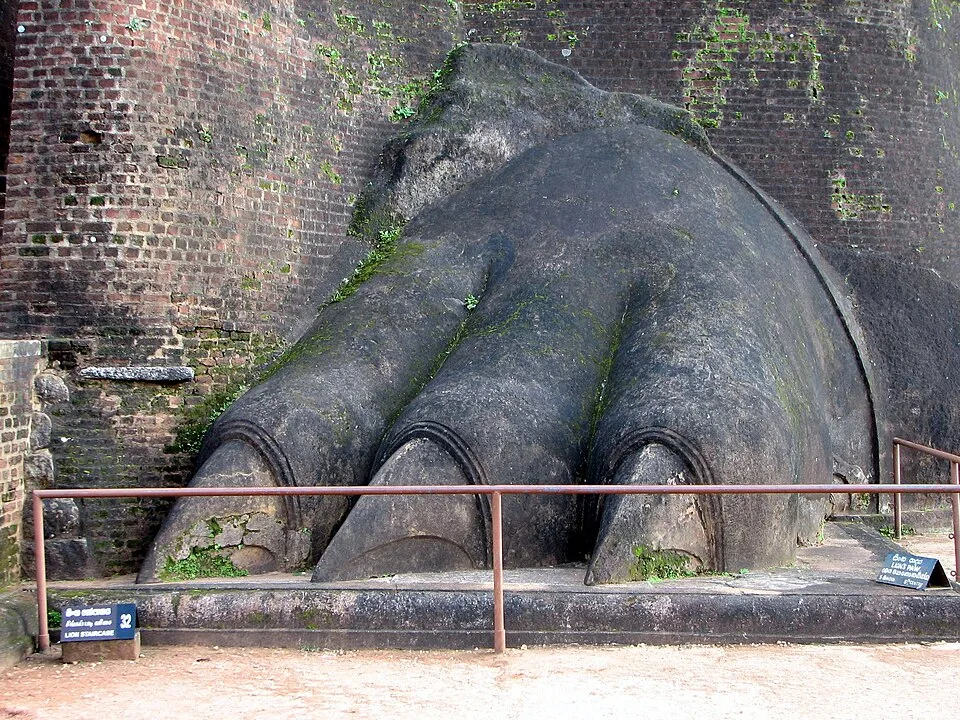
Sigiriya is a masterwork of landscape architecture, integrating natural rock with geometric design. The western precinct features elaborate water gardens with fountains still functional after 1,500 years, a testament to advanced hydraulic engineering. The ascent proceeds through boulder gardens to the iconic Lion Gate—a massive brick-and-stucco lion through whose mouth visitors once climbed to the summit. The palace complex atop the rock included pools, terraces, and royal quarters, all constructed in brick and wood. The layout reflects a cosmic Mandala, aligning with cardinal directions and perhaps embodying royal ideology.
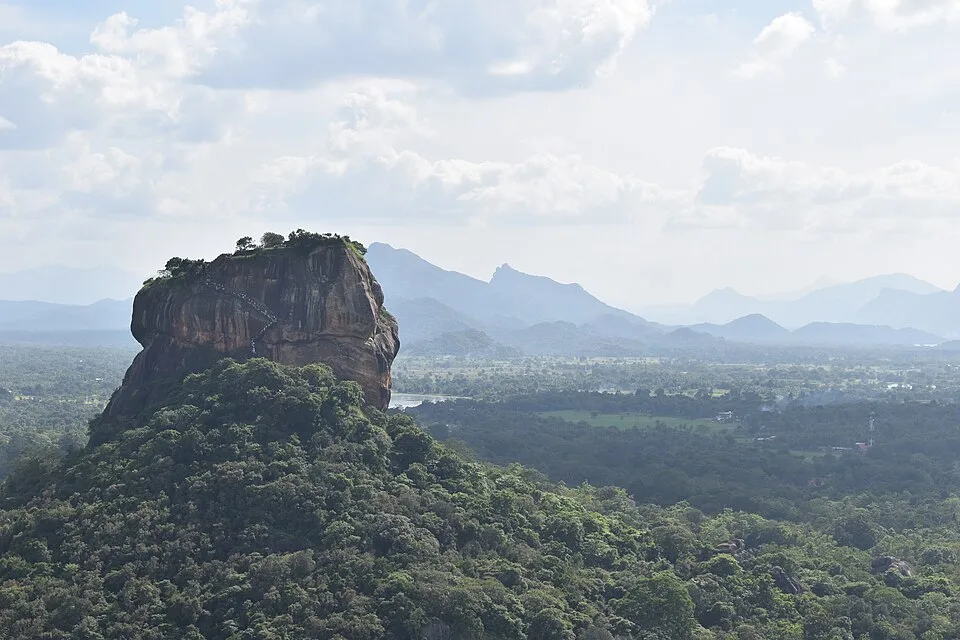
Sigiriya Rock Fortress View from Pidurangala Rock
Sigiriya Rock Fortress View from Pidurangala Rock | Gayomiw (CC BY-SA 4.0)
"The king Kassapa, fearing his brother's vengeance, raised on the great rock a fortress fit for the gods, and made his palace in the clouds, where no enemy could climb without leaving his bones beneath."
— Mahavamsa XXXIX, Sinhalese chronicle on King Kashyapa I and Sigiriya (5th century CE, compiled c. 6th century)

Frescoes and Artistic Legacy

Approximately 21 surviving frescoes in a sheltered western crevice depict celestial females, their stylized beauty sparking debates: are they apsaras, queens, or goddesses? Painted with natural pigments on a lime plaster base, they display volumetric modeling unknown elsewhere in South Asian art of the period. The adjacent ‘Mirror Wall’ bears over 600 verses inscribed by visitors from the 6th–14th centuries, offering priceless glimpses into early Sinhala literary culture and popular reception of the paintings.
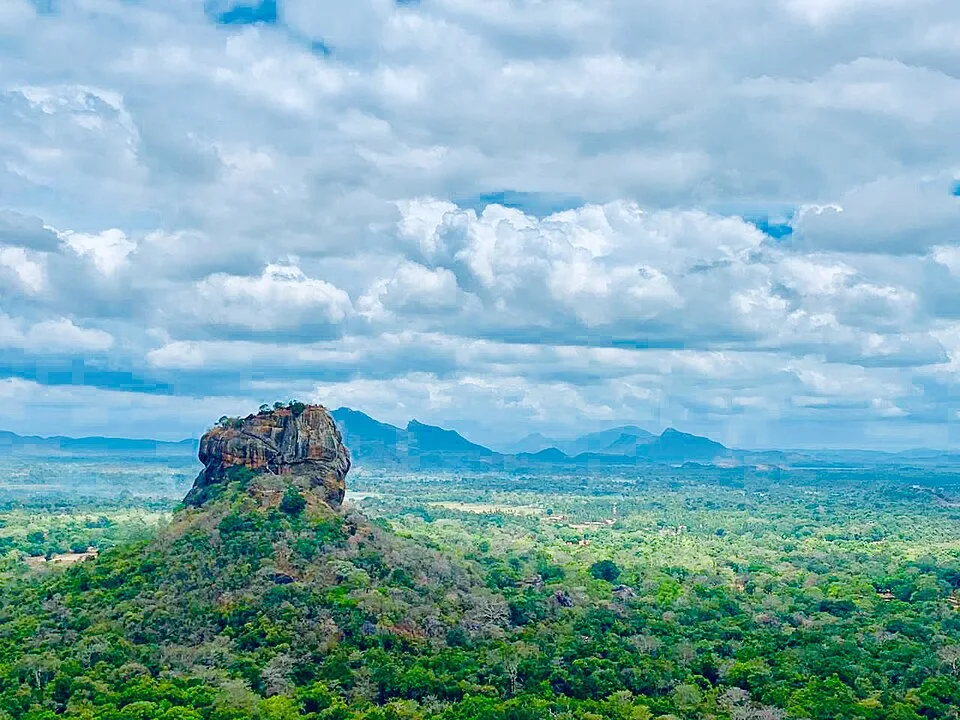
The Sigiriya Rock Fortress
The Sigiriya Rock Fortress | Thushara Nadeeja (CC BY-SA 4.0)

Significance and Function

Built during Kasyapa I’s reign (477–495 CE), Sigiriya is commonly interpreted as a royal citadel and pleasure palace, its defensive features and sumptuous design reflecting both paranoia and ambition. Yet the evidence for an earlier monastic phase—rock shelters with drip-ledges and Brahmi inscriptions dating to the 3rd century BCE—suggests the site had long been a hermitage. Kasyapa’s transformation of this sacred landscape into a political statement remains a central puzzle. After his death, Sigiriya reverted to a monastery until the 14th century, its memory preserved in Buddhist chronicles.

Interpretation and Debate

Scholars dispute whether the summit structures formed a functional palace or a ritual center. Paranavitana argued for a palace, while later researchers emphasize symbolic elements, such as the water gardens evoking Kuvera’s celestial city. The frescoes, too, are contested: are they secular depictions of Kasyapa’s court, or Tantric Buddhist imagery? Radiocarbon dating of plasters has clarified construction phases, but the site’s multi-layered history invites multiple readings.
Sigiriya 02
Sigiriya 02 | Bernard Gagnon (CC BY-SA 3.0)

Conservation and World Heritage

Declared a UNESCO World Heritage Site in 1982, Sigiriya faces challenges from tourism, weathering, and vegetation. The Central Cultural Fund of Sri Lanka, with international partners, balances preservation with access. Laser scanning and digital documentation now support fragile frescoes and masonry, ensuring that this pinnacle of the ancient world endures.

Pourquoi c'est important

Sigiriya represents a unique synthesis of urban planning, art, and engineering in 5th-century South Asia, challenging assumptions about early state formation outside the Old World. Its hydraulic systems predate comparable technologies by centuries, and its graffiti offer a rare direct link to medieval South Asian voices. As both a royal stronghold and a sacred landscape, it illuminates the fluid boundaries between power and spirituality in the ancient Indian Ocean world.

Preuves et interprétation

Distinguer ce qui est bien établi de ce qui reste débattu.

Faits bien établis

3
  • Sigiriya was constructed during the reign of King Kasyapa I (477–495 CE), as attested by the Culavamsa chronicle and stylistic dating of artworks.
  • The western water gardens employ a sophisticated hydraulic system with symmetrical fountains and underground conduits, some still functioning after 1,500 years.
  • The Mirror Wall preserves graffiti in Sinhala script from the 6th to 14th centuries, revealing literary and social history.

Inférences savantes

2
  • The site was likely chosen by Kasyapa for its defensive advantages and visual dominance, establishing a symbolic axis between the rock and the surrounding royal city.
  • The frescoes may represent celestial nymphs or royal ladies, drawing from both Hindu and Buddhist iconographic traditions.

Interprétations débattues

2
  • Whether the summit structures functioned primarily as a royal palace or a ritual/ceremonial complex remains contested, with evidence for both residential use and sacred geometry.
  • The extent to which Sigiriya was originally a Buddhist monastery before Kasyapa’s intervention is disputed, although early Brahmi inscriptions confirm earlier religious use.

Découverte et fouilles

Modern conservation and archaeological research

Dirigé par Central Cultural Fund / UNESCO

Ongoing work by the Central Cultural Fund, Sri Lanka, and international teams, including digital documentation, structural stabilization, and visitor management.

1894–1898

Pioneering surveys and clearance

Dirigé par H.C.P. Bell

H.C.P. Bell, Archaeological Commissioner, cleared jungle, mapped the water gardens, staircases, and summit ruins, producing the first systematic documentation.

1907

Early 20th-century exploration

Dirigé par John Still

John Still briefly investigated the site and recorded graffiti, drawing wider scholarly attention to the Sigiriya verses.

1947–1958

Comprehensive excavations and conservation

Dirigé par Senarath Paranavitana

Senarath Paranavitana conducted large-scale excavations on the summit and lower precincts, restored the Mirror Wall, and deciphered many graffiti, shaping modern interpretations.

Photos de la communauté

Partagez votre expérience

Avez-vous visité ce site ? Téléchargez vos photos pour aider les autres à le découvrir.

Comment citer cette page

Atlas Anatolia. (477). Sigiriya. Atlas Anatolia. https://atlasanatolia.com/fr/site/sigiriya

Contenu sous licence CC BY-SA 4.0 — attribution requise en cas de réutilisation.

Sources

  • Bandaranayake, S. (1999), Sigiriya: City, Palace, and Royal Gardens — Senake Bandaranayake (1999)
  • Paranavitana, S. (1956), Sigiri Graffiti: Being Sinhalese Verses of the Eighth, Ninth and Tenth Centuries — Senarath Paranavitana (1956)
  • Deraniyagala, S.U. (1992), 'The Prehistory of Sri Lanka' — S.U. Deraniyagala (1992)
  • Coningham, R. & Lewer, N. (1999), 'Paradise Lost: The Lion of Sigiriya, Sri Lanka’, Antiquity 73(281) — Robin Coningham and Nick Lewer (1999)
  • UNESCO World Heritage List: Ancient City of SigiriyaLien

Questions fréquentes

Où se trouve Sigiriya ?

Sigiriya est situé à/en Central Province, Matale District, Sri Lanka.

De quand date Sigiriya ?

Sigiriya remonte approximativement à 477 apr. J.-C. – 495 apr. J.-C..

Quelles civilisations sont associées à Sigiriya ?

Sigiriya est associé à la civilisation Sinhalese.

Pourquoi Sigiriya est-il important ?

Sigiriya represents a unique synthesis of urban planning, art, and engineering in 5th-century South Asia, challenging assumptions about early state formation outside the Old World.

Sigiriya est-il inscrit au patrimoine mondial de l'UNESCO ?

Oui — Sigiriya est inscrit sur la liste du patrimoine mondial de l'UNESCO.