
Aller au contenu
Atlas Anatolia
ActualitésIce Age teeth in Sulawesi push betel-nut use back as far as 25,000 yearsRoman mosaic and Eros head uncovered in the basilica at Pompeiopolis, Kastamonu
White main keep of Osaka Castle above stone ramparts and spring foliage

Wikimedia Commons (CC BY-SA 3.0)

PatrimoineForteresseEn vedette

Osaka Castle

Seyfi Cem Baskin

大阪城1583 apr. J.-C. – 1868 apr. J.-C.

Toyotomi Hideyoshi’s fortress reconstituted as a Tokugawa stronghold — white keep, gold roof ornaments, and stone ramparts above Osaka’s business core — is Japan’s most searched castle after Himeji in our multilingual audit.

21
Intérêt 77

Localisation

Japan

34.69°N · 135.53°E · Asie

Founded

1583 by Toyotomi Hideyoshi

Siege

Summer Siege of Osaka, 1615

Present keep

1931 ferroconcrete rebuild; renovated 1997

Surviving fabric

Stone walls, moats, baileys

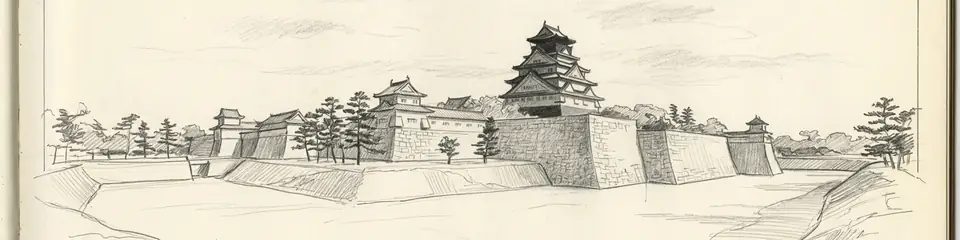
Graphite pencil sketch banner of Osaka Castle

“Osaka Castle concentrates Toyotomi–Tokugawa transition politics in Japan’s commercial capital and remains a primary pilgrimage site for Azuchi–Momoyama history.”

Localisation

Aperçu

Osaka Castle was founded by Toyotomi Hideyoshi in 1583 on the site of the Ishiyama Hongan-ji temple-fortress. Its colossal ashlar walls and multi-storey keep projected the unification wars’ climax. After the Summer Siege of 1615 the Tokugawa rebuilt and garrisoned the castle; fires and the 1868 Boshin War damaged successive keeps. The present ferroconcrete main keep (1931), renovated in 1997, is a historicist reconstruction housing a museum inside surviving stone walls and moats.

The Nishinomaru garden, outer baileys, and inscribed megaliths (including stones from Hideyoshi’s vassals) retain Edo-period spatial order. Pair with Himeji Castle for authentic wooden keep architecture versus Osaka’s urban memorial reconstruction.

Pourquoi c'est important

Osaka Castle concentrates Toyotomi–Tokugawa transition politics in Japan’s commercial capital and remains a primary pilgrimage site for Azuchi–Momoyama history. Its stone walls still display named contribution blocks that map late-16th-century warlord networks.

Preuves et interprétation

Distinguer ce qui est bien établi de ce qui reste débattu.

Faits bien établis

2
  • Chronicle accounts of Hideyoshi’s construction and Tokugawa siege maps document the castle’s late-16th and early-17th-century phases.
  • Inscribed ashlar blocks name daimyo contributors to the stone curtains.

Inférences savantes

1
  • The 1931 keep’s historicist design deliberately revived Toyotomi imagery for modern Osaka civic pride.

Photos de la communauté

Partagez votre expérience

Avez-vous visité ce site ? Téléchargez vos photos pour aider les autres à le découvrir.

Comment citer cette page

Atlas Anatolia. (1583). Osaka Castle. Atlas Anatolia. https://atlasanatolia.com/fr/site/osaka-castle

Contenu sous licence CC BY-SA 4.0 — attribution requise en cas de réutilisation.

Sources

  • Osaka 1615: The Last Battle of the Samurai — Turnbull, Stephen (2006)
  • Architecture and Authority in Japan — Coaldrake, William H. (1996)

Questions fréquentes

Où se trouve Osaka Castle ?

Osaka Castle est situé à/en Japan.

De quand date Osaka Castle ?

Osaka Castle remonte approximativement à 1583 apr. J.-C. – 1868 apr. J.-C..

Quelles civilisations sont associées à Osaka Castle ?

Osaka Castle est associé à la civilisation Tokugawa, Toyotomi.

Pourquoi Osaka Castle est-il important ?

Osaka Castle concentrates Toyotomi–Tokugawa transition politics in Japan’s commercial capital and remains a primary pilgrimage site for Azuchi–Momoyama history.

Osaka Castle est-il inscrit au patrimoine mondial de l'UNESCO ?

Osaka Castle n'est pas actuellement inscrit sur la liste du patrimoine mondial de l'UNESCO.