
Saltar al contenido
Atlas Anatolia
NoticiasIce Age teeth in Sulawesi push betel-nut use back as far as 25,000 yearsRoman mosaic and Eros head uncovered in the basilica at Pompeiopolis, Kastamonu
The Hall of Prayer for Good Harvests at the Temple of Heaven, Beijing

Wikimedia Commons (CC BY-SA 4.0)

PatrimonioComplejoUNESCODestacado

Temple of Heaven

Seyfi Cem Baskin

天坛1406 d. C. – 1912 d. C.

The Ming dynasty's sacred ritual park in southern Beijing — circular altars and the blue-tiled Hall of Prayer for Good Harvests where emperors offered sacrifices for the year's crops — ranks among the most searched historic sites in Chinese Wikipedia and global travel guides.

21
Interés 83

Ubicación

China

39.88°N · 116.41°E · Asia

Founded

1406–1420 CE under the Yongle Emperor (Ming)

Hall rebuilt

Present Hall of Prayer for Good Harvests, 1890–after 1889 fire

Park area

~273 ha walled ritual landscape

UNESCO

Temple of Heaven: an Imperial Sacrificial Altar (1998)

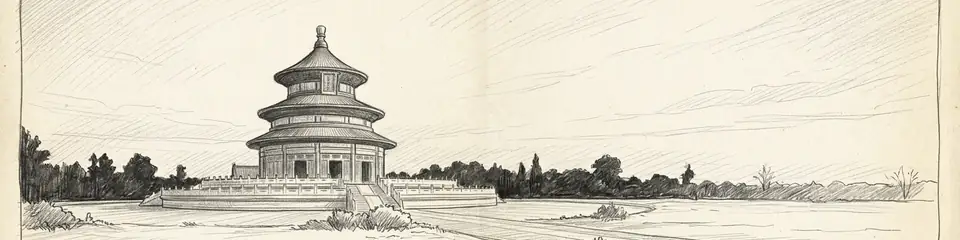
Graphite pencil sketch banner of Temple of Heaven

The Temple of Heaven is the best-preserved imperial cosmological landscape in East Asia — architecture, ritual, and urban axis fused to express Ming–Qing state ideology.”

Ubicación

Resumen

The Temple of Heaven (Tiantan) occupies a walled park of about 273 hectares in the Dongcheng district of Beijing, south of the Forbidden City along the city's central axis. The Yongle Emperor of the Ming dynasty created the complex in the early 15th century as a counterpart to his new imperial palace: where the Forbidden City was the emperor's earthly residence, Tiantan was where he performed rites as Son of Heaven.

The architectural climax is the Hall of Prayer for Good Harvests (Qinian Dian), a triple-gabled circular wooden hall raised on a three-tier marble terrace, rebuilt in its present form after a lightning fire in 1889. The emperor prayed here at the winter solstice for abundant harvests. To the south, the Circular Mound Altar (Huanqiu Tan) and the Imperial Vault of Heaven (Huangqiong Yu) served complementary rituals connecting square earth and round heaven.

Qing rulers maintained and adjusted the rites until the abdication of 1912. The park opened to the public in 1918 and became a UNESCO World Heritage Site in 1998 as part of a serial inscription with the Forbidden City and Summer Palace. Morning tai chi among cypress trees and the sight of the blue-roofed hall against Beijing smog or snow make it one of China's most photographed monuments.

Por qué es importante

The Temple of Heaven is the best-preserved imperial cosmological landscape in East Asia — architecture, ritual, and urban axis fused to express Ming–Qing state ideology. Its timber hall and marble altars are the reference point for understanding how Chinese emperors performed agricultural sovereignty through sacrifice rather than military conquest alone.

Evidencia e interpretación

Distinguir lo bien establecido de lo que sigue en debate.

Hechos bien establecidos

2
  • Ming and Qing ritual manuals prescribe winter solstice ceremonies at the Circular Mound Altar and Hall of Prayer.
  • Architectural survey confirms triple-gabled dougong bracket hall on marble terrace consistent with late imperial workshops.

Inferencias académicas

1
  • Placement on Beijing's south–north axis links Tiantan cosmologically to the Forbidden City — inferred from urban planning texts.

Fotos de la comunidad

Comparte tu experiencia

¿Has visitado este sitio? Sube tus fotos para ayudar a otros a descubrirlo.

Cómo citar esta página

Atlas Anatolia. (1406). Temple of Heaven. Atlas Anatolia. https://atlasanatolia.com/es/site/temple-of-heaven

Contenido bajo licencia CC BY-SA 4.0 — se requiere atribución al reutilizar.

Fuentes

  • Chinese ArchitectureSteinhardt, Nancy Shatzman (2019)
  • UNESCO — Temple of HeavenEnlace

Preguntas frecuentes

¿Dónde se encuentra Temple of Heaven?

Temple of Heaven se encuentra en China.

¿Qué antigüedad tiene Temple of Heaven?

Temple of Heaven se fecha aproximadamente en 1406 d. C. – 1912 d. C..

¿Qué civilizaciones se relacionan con Temple of Heaven?

Temple of Heaven se relaciona con Ming, Qing.

¿Por qué es importante Temple of Heaven?

The Temple of Heaven is the best-preserved imperial cosmological landscape in East Asia — architecture, ritual, and urban axis fused to express Ming–Qing state ideology.

¿Temple of Heaven es Patrimonio Mundial de la UNESCO?

Sí. Temple of Heaven está inscrito en la Lista del Patrimonio Mundial de la UNESCO.