

Overview
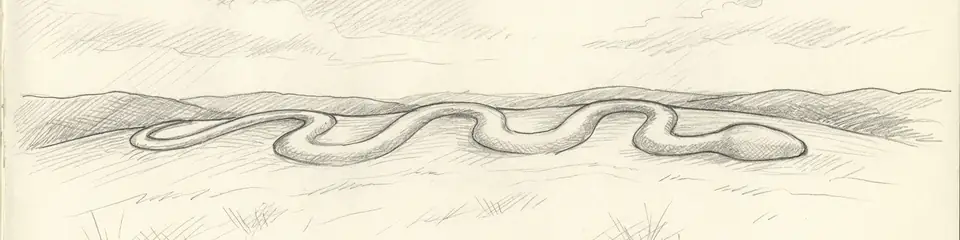
Serpent Mound sits atop a plateau overlooking a horseshoe bend of Ohio Brush Creek in Adams County, southern Ohio. The earthwork forms an undulating serpentine shape 411 metres (1,348 feet) long and up to 1.5 metres high, with seven distinct coils culminating in a triangular head aligned toward the summer solstice sunset, and a tightly coiled tail at the opposite end. An oval earthwork at the head, often interpreted as an egg being swallowed or an eye, adds to the figure's enigmatic composition. No burials or artefacts were found within the effigy itself, distinguishing it from the burial mounds commonly built by contemporary Ohio Valley cultures.
The mound's cultural attribution has shifted more than once. Frederic Ward Putnam's pioneering excavations in the 1880s, which preserved the site by purchasing it for Harvard University's Peabody Museum (later transferred to the Ohio Historical Society), associated the earthwork with the Adena culture (roughly 800 BCE – 100 CE) based on nearby burial mounds and the broader regional pattern of Adena effigy and geometric earthworks. This Adena attribution held as the standard scholarly view for over a century.
In 1996, however, radiocarbon dating of charcoal recovered from within the mound's fill produced dates clustering around 1070 CE, squarely within the later Fort Ancient culture period (circa 1000–1650 CE) — a Mississippian-influenced society quite distinct from the Adena. This finding prompted a significant reassessment, with some researchers proposing the effigy was built or substantially rebuilt by Fort Ancient people, possibly incorporating and reshaping an earlier Adena-era structure. Subsequent research has not settled the question definitively; some archaeologists continue to favour Adena origins with later Fort Ancient repair or reuse, while others accept a primarily Fort Ancient construction date.
Astronomical alignment studies have found that the serpent's coils correspond with notable precision to solstice and equinox sunrise/sunset positions as observed from the effigy, suggesting its builders — whichever culture is ultimately credited — incorporated careful astronomical observation into the design. Serpent Mound was designated a National Historic Landmark in 1966 and is one of the entries on the U.S. National Park Service's Tentative List for UNESCO World Heritage status, as part of a broader nomination of Ohio Hopewell-culture ceremonial earthworks.