

Skip to content
Atlas AnatoliaAtlas Anatolia
Aerial view of the Great Circle at the Newark Earthworks, Hopewell-culture geometric enclosures, Ohio

Country Record

Longest Recorded History in United States

Newark Earthworks

100 BCE – 400 CE
53

Interest

ClassicalRomanLate AntiquePre-ColumbianHopewellLicking County

Built

c. 100 BCE – 400 CE by the Hopewell culture

Scale

Originally ~7 sq km — the largest geometric earthwork complex on Earth

Great Circle

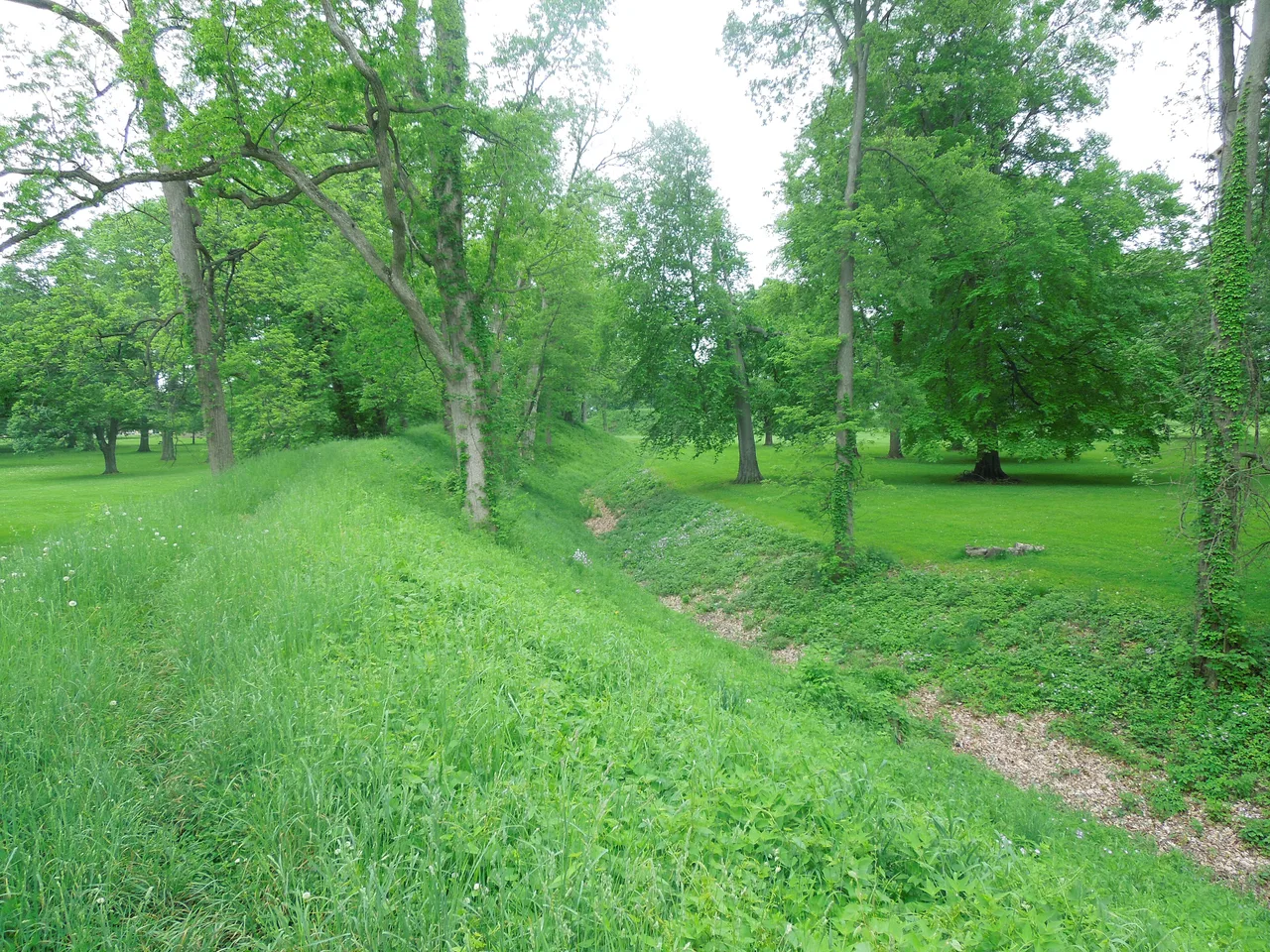
~365 m diameter, walls up to 4 m high with an interior ditch

Lunar alignment

Octagon aligned to the moon's 18.6-year standstill cycle

UNESCO

Part of the Hopewell Ceremonial Earthworks, World Heritage Site 2023

The Newark Earthworks overturn any assumption that monumental geometry and sophisticated astronomy require a centralised state, cities, or intensive agriculture.”

Overview

The Newark Earthworks, in and around the modern city of Newark, Ohio, were constructed between roughly 100 BCE and 400 CE by people of the Hopewell culture — a term archaeologists use not for a single unified society but for a widespread network of related communities across the eastern woodlands of North America, connected by shared ceremonial practices, artistic styles, and an extraordinary long-distance exchange system. Originally covering some seven square kilometres, the Newark complex was the largest concentration of geometric earthen enclosures in the Hopewell world, and the largest such geometric earthwork complex known anywhere on the planet.

The surviving portions — much of the complex was destroyed by 19th- and 20th-century urban development and agriculture — include two of the most remarkable individual monuments. The Great Circle, roughly 365 metres in diameter with walls up to 4 metres high enclosing a moat-like interior ditch, is one of the largest circular earthen enclosures in the world. The Octagon Earthworks, connected by parallel walls to a precise circle, enclose an area large enough to contain several dozen American football fields, their embankments forming a near-perfect octagonal figure joined to a circular one.

What elevates Newark beyond sheer scale is the geometric and astronomical sophistication built into its design. Modern survey has shown that the various enclosures share consistent units of measurement and geometric relationships across distances of kilometres, implying careful planning and a shared system of proportion. Most strikingly, research beginning in the 1980s by Ray Hively and Robert Horn demonstrated that the Octagon Earthworks are aligned to the complex 18.6-year cycle of the moon — the slow oscillation of the points on the horizon where the moon rises and sets, known as the lunar standstill cycle — with the octagon's walls and openings marking the moon's extreme rising and setting positions. Tracking this cycle requires sustained, multi-decade astronomical observation, since a single 18.6-year period exceeds a large part of a human lifetime in the ancient world, indicating a remarkable investment in celestial observation and record-keeping.

The Hopewell communities who built Newark were not a centralised state or empire; they lived in relatively dispersed settlements and did not farm intensively in the manner of later Mississippian societies. That such societies could mobilise the collective labour and sustain the astronomical knowledge needed to build and align these enormous, geometrically exact earthworks has made Newark central to understanding the social and intellectual capabilities of non-state, non-urban societies. The Newark Earthworks, together with several other Ohio Hopewell sites, were inscribed as part of the Hopewell Ceremonial Earthworks UNESCO World Heritage Site in 2023.

Why It Matters

The Newark Earthworks overturn any assumption that monumental geometry and sophisticated astronomy require a centralised state, cities, or intensive agriculture. The Hopewell were dispersed woodland communities without kings, standing armies, or large permanent towns, yet they planned and built the largest geometric earthworks on Earth and encoded within them a mastery of the moon's 18.6-year cycle — a striking demonstration of what decentralised societies could achieve through shared ceremony and knowledge. The lunar alignment of the Octagon is a landmark case in archaeoastronomy: it shows a North American society tracking one of the subtlest long-term astronomical cycles, one that requires observations sustained across nearly two decades to detect, embedding that knowledge permanently into monumental architecture — evidence of systematic sky-watching and knowledge transmission across generations in a society without writing. As the centrepiece of the Hopewell Ceremonial Earthworks, newly recognised by UNESCO in 2023, Newark also anchors the wider Hopewell phenomenon — a continent-spanning exchange network that moved obsidian from the Rocky Mountains, copper from the Great Lakes, and shells from the Gulf Coast to Ohio — reframing the ancient eastern woodlands of North America as a zone of far-reaching connection, sophisticated cosmology, and monumental ambition.

Stay curious

New stories and sites, once a month. No spam.

Evidence & Interpretation

Distinguishing what is well-established from what remains debated.

Well-Established Facts

3
  • Precision survey has established that the Newark enclosures share consistent units of measurement and geometric relationships across kilometres, confirming deliberate large-scale planning.
  • Archaeoastronomical analysis, beginning with the work of Ray Hively and Robert Horn in the 1980s, demonstrates that the Octagon Earthworks align with the extreme rising and setting points of the moon across its 18.6-year standstill cycle.
  • Excavation and material analysis across Hopewell sites confirm a continent-spanning exchange network bringing obsidian, copper, mica, and marine shell to Ohio from distant regions, situating Newark within that wider system.

Scholarly Inferences

1
  • The specific ceremonial, ritual, and social uses of the enclosures are inferred from their scale, alignment, and associated deposits rather than documented directly, since the Hopewell left no written records.

Discovery & Excavation

1847–1848

Squier and Davis survey

Early documentation of the earthworks in the foundational survey "Ancient Monuments of the Mississippi Valley," preserving records of portions later destroyed.

1975–1982

Hively and Horn archaeoastronomy

Survey work establishing the Octagon's alignment to the lunar standstill cycle, transforming understanding of the site's astronomical function.

More Photos

Museum Artifacts

Community Photos

Share your experience

Have you visited this site? Upload your photos to help others discover it.

Location

Sources

  • Ohio Archaeology: An Illustrated Chronicle of Ohio's Ancient American Indian CulturesLepper, Bradley T. (2005)
  • Geometry and Astronomy in Prehistoric OhioHively, Ray and Horn, Robert (1982)
  • UNESCO — Hopewell Ceremonial EarthworksLink

Research Papers

Frequently Asked Questions

Where is Newark Earthworks located?

Newark Earthworks is located in Licking County, Ohio, United States.

How old is Newark Earthworks?

Newark Earthworks dates to approximately 100 BCE – 400 CE.

Which civilizations are associated with Newark Earthworks?

Newark Earthworks is associated with the Hopewell.

Why is Newark Earthworks important?

The Newark Earthworks overturn any assumption that monumental geometry and sophisticated astronomy require a centralised state, cities, or intensive agriculture.

Is Newark Earthworks a UNESCO World Heritage Site?

Yes — Newark Earthworks is inscribed as a UNESCO World Heritage Site.