
Skip to content
Atlas AnatoliaAtlas Anatolia
Aboriginal rock art at the Anbangbang Gallery, Nourlangie Rock, Kakadu National Park, Australia

Kakadu

20000 BCE – 1900 CE
62

Interest

PaleolithicAboriginal Australian

Rock art

Thousands of painted sites; among the longest continuous art sequences documented anywhere

X-ray style

Distinctive technique depicting animals' internal bone structure and organs

Contact art

Paintings of 18th–19th century sailing ships within the same unbroken tradition

Management

Jointly managed by Bininj/Mungguy traditional owners and the Australian government

UNESCO

World Heritage Site for both natural and cultural values, 1981/1987/1992

Kakadu's rock art sequence is one of the longest continuously produced bodies of art documented anywhere on Earth, offering researchers a rare opportunity to study stylistic and cultural change within a single artistic tradition across tens of thousands of years — a timescale that dwarfs the entire written history of most other civilisations discussed in this atlas.”

Overview

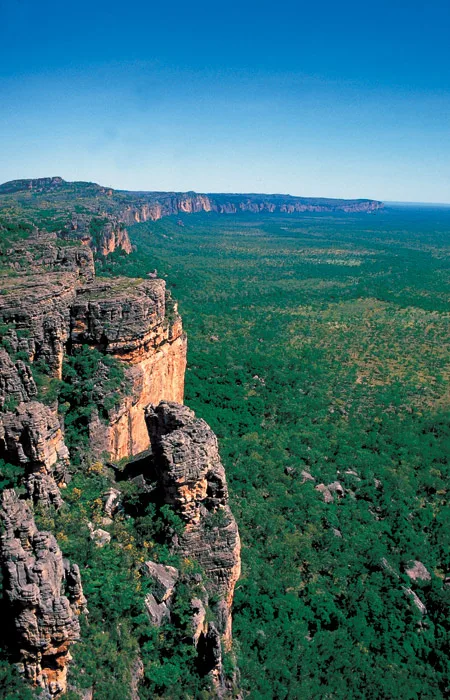
Kakadu National Park spans roughly 20,000 square kilometres of Australia's Northern Territory, encompassing wetlands, stone escarpments, monsoon forest, and savanna woodland — but its deepest significance lies in the sandstone galleries scattered across its rock country, where Bininj and Mungguy artists have painted continuously across what may be the longest unbroken sequence of art production documented anywhere in the world.

Major gallery sites including Ubirr, Nourlangie (Burrunggui), and Nanguluwur preserve overlapping layers of painting built up over an extraordinary timespan. The earliest identifiable phases include large naturalistic animal figures, some depicting species that have since gone locally extinct, painted using mineral ochre pigments whose exact age is difficult to establish directly but which stylistic and stratigraphic analysis places at many thousands of years old — with dated art and occupation evidence at associated rock shelters in the broader Arnhem Land region extending back over 20,000 years, among the oldest securely dated evidence of human artistic activity anywhere in the world.

Later phases show a shift toward the distinctive "X-ray style," depicting animals — barramundi, kangaroos, file snakes — with their internal bone structure and organs visible, a technique unique to this region of Australia and requiring specialised knowledge passed down through generations of artists. Mimi spirit figures, dynamic and elongated humanoid forms associated with ancestral beings believed to have taught the Bininj and Mungguy how to paint, appear in some of the oldest layers.

Most remarkably, the painting sequence continues into the historical period. "Contact art" at several Kakadu sites depicts sailing ships with rigging and sails, dated stylistically to the era of early European and Macassan (Sulawesi trepang-fishing) contact from the 18th and 19th centuries — meaning a single rock face can preserve a continuous record of artistic practice from the deep Ice Age through to the arrival of European colonisers, painted within one unbroken cultural tradition.

Beyond the paintings, Kakadu preserves stone tool scatters, quarry sites, and occupation shelters that document the material side of this long history, while the park remains a living cultural landscape: Bininj and Mungguy traditional owners continue to manage the land under a joint arrangement with the Australian government, established following the park's creation in stages from 1979 to 1991. Kakadu was inscribed as a UNESCO World Heritage Site for its cultural values in 1981, extended in 1987 and 1992, one of a small number of sites worldwide recognised for both outstanding natural and outstanding cultural significance.

Why It Matters

Kakadu's rock art sequence is one of the longest continuously produced bodies of art documented anywhere on Earth, offering researchers a rare opportunity to study stylistic and cultural change within a single artistic tradition across tens of thousands of years — a timescale that dwarfs the entire written history of most other civilisations discussed in this atlas. The contact-era paintings of sailing ships are a particularly striking category of evidence: they show Aboriginal artists actively documenting and interpreting the arrival of an entirely new kind of visitor using the same painting tradition, techniques, and rock surfaces their ancestors had used for millennia, directly linking deep prehistory to the documented historical record within a single physical site. As both a natural and cultural World Heritage site under continued Aboriginal management, Kakadu also stands as a model for how living Indigenous knowledge systems and formal conservation science can operate together, informing park management, fire regimes, and interpretation in ways that treat the rock art not as a closed archaeological record but as part of an unbroken, still-continuing cultural practice.

Stay curious

New stories and sites, once a month. No spam.

Evidence & Interpretation

Distinguishing what is well-established from what remains debated.

Well-Established Facts

3
  • Excavation and dating of occupation deposits at rock shelters in the broader Arnhem Land region, adjoining Kakadu, have produced securely dated evidence of human presence extending beyond 20,000 years, among the oldest confirmed anywhere in Australia.
  • Stylistic and subject analysis of "contact art" panels depicting rigged sailing ships confirms these were painted during the era of Macassan trepang-fishing contact and early European exploration, from approximately the 18th century onward.
  • The distinctive X-ray painting style, depicting animals' internal anatomy, has been documented across numerous Kakadu gallery sites and is recognised as a technique specific to this region of Arnhem Land.

Scholarly Inferences

1
  • The absolute age of most individual rock art panels is inferred from stylistic sequencing, superimposition of layers, and depicted extinct or locally absent species, rather than direct scientific dating of the pigments themselves, which remains technically difficult for much of the corpus.

Discovery & Excavation

1970–1993

George Chaloupka rock art survey

Extensive long-term documentation and stylistic sequencing of Kakadu and wider Arnhem Land rock art, establishing the chronological framework still used today.

1979–1991

Establishment of Kakadu National Park

Park created in stages, formalising joint management between Bininj/Mungguy traditional owners and the Australian government.

More Photos

Museum Artifacts

Community Photos

Share your experience

Have you visited this site? Upload your photos to help others discover it.

Location

Sources

  • Journey in Time: The World's Longest Continuing Art TraditionChaloupka, George (1993)
  • Australia's Ancient Warriors: Changing Depictions of Fighting in the Rock Art of Arnhem LandTaçon, Paul S.C. and Chippindale, Christopher (1994)
  • UNESCO — Kakadu National ParkLink

Research Papers

Frequently Asked Questions

Where is Kakadu located?

Kakadu is located in Northern Territory, Australia.

How old is Kakadu?

Kakadu dates to approximately 20000 BCE – 1900 CE.

Which civilizations are associated with Kakadu?

Kakadu is associated with the Aboriginal Australian.

Why is Kakadu important?

Kakadu's rock art sequence is one of the longest continuously produced bodies of art documented anywhere on Earth, offering researchers a rare opportunity to study stylistic and cultural change within a single artistic tradition across tens of thousands of years — a timescale that dwarfs the entire written history of most other civilisations discussed in this atlas.

Is Kakadu a UNESCO World Heritage Site?

Yes — Kakadu is inscribed as a UNESCO World Heritage Site.