
Overview
Igbo-Ukwu lies in Anambra State, southeastern Nigeria, in the Igbo-speaking heartland of the lower Niger region. The name refers to a town, but the archaeological significance centres on three distinct find-sites within it — Igbo Isaiah, Igbo Richard, and Igbo Jonah — each uncovered through different circumstances and revealing different facets of an early, highly sophisticated bronze-casting culture.
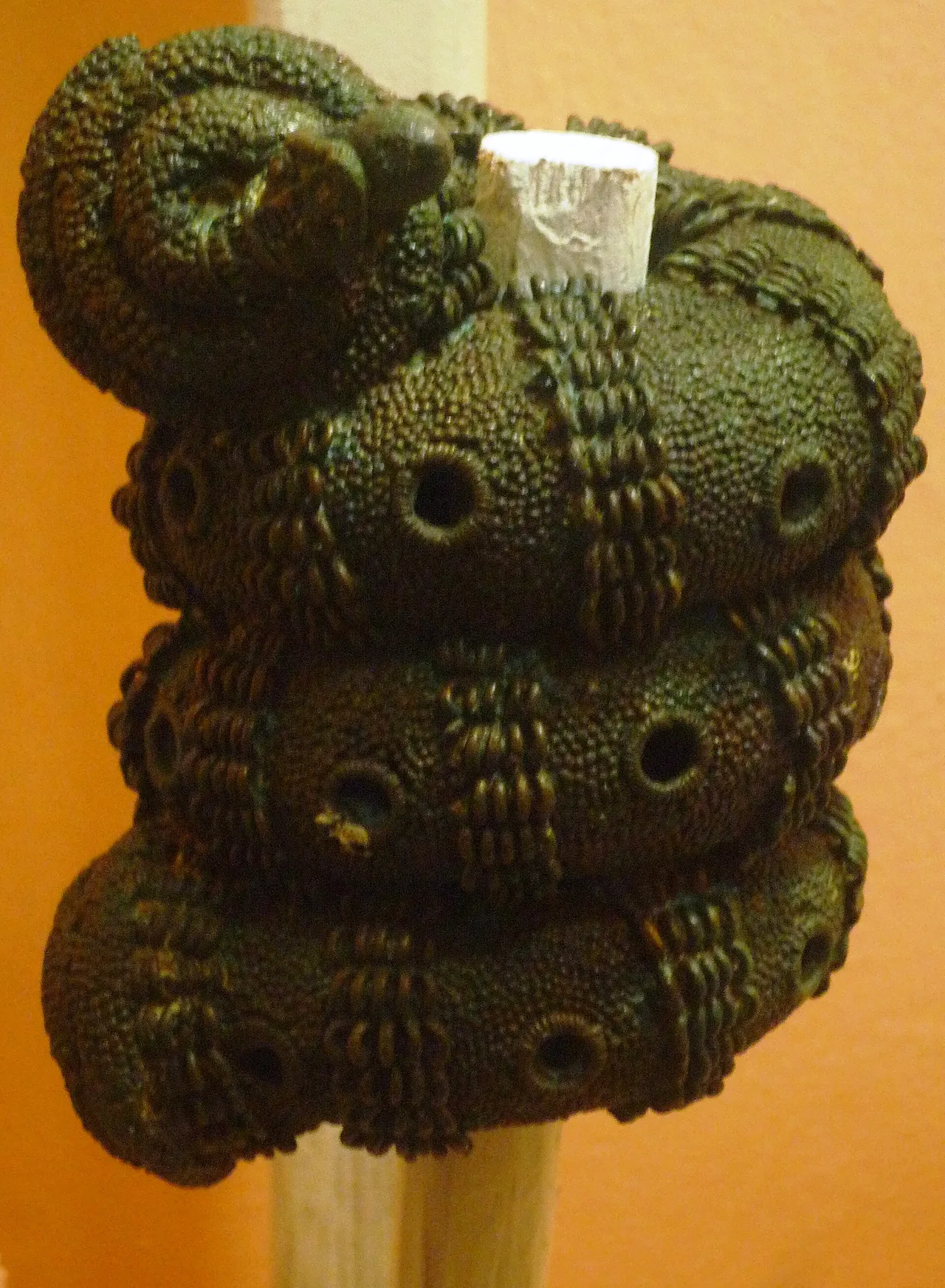
Igbo Isaiah, discovered in 1938 when a local resident digging a cistern struck buried objects, proved to be a shrine or ritual storehouse containing several hundred bronze, copper, and iron objects of remarkable intricacy: ceremonial vessels, staff ornaments, pendants, and crowns, cast using the lost-wax technique with a level of detail and technical control — including a famous vessel cast in the form of a knotted rope, its surface texture replicating actual cord with startling naturalism — that places Igbo-Ukwu bronze-casters among the most accomplished metalworkers of the early medieval world, in any region.
Igbo Richard, excavated in 1959, proved to be a burial chamber: an elite individual, seated on a stool with legs crossed, was interred wearing an elaborate beaded costume, holding a fly-whisk and ceremonial staff, and surrounded by tens of thousands of glass and stone beads along with bronze regalia — one of the richest single burials documented anywhere in sub-Saharan Africa from this period, strongly suggestive of a figure of high political or religious authority, possibly an early precursor to the priest-king (Eze Nri) tradition later associated with the Nri Kingdom of Igbo political and religious history.
Igbo Jonah, a smaller associated deposit, added further bronze and ceramic material to the corpus. Together, the three sites were systematically excavated by British archaeologist Thurstan Shaw between 1959 and 1964, whose radiocarbon dating placed the material firmly in the 9th century CE — a date initially met with considerable scholarly skepticism, since it implied a sophisticated bronze-casting tradition in this specific part of West Africa predating the famous Ife bronzes by roughly three to five centuries. Subsequent dating studies have broadly confirmed Shaw's original chronology.
The sheer quantity of glass beads recovered — an estimated 165,000 at Igbo Richard alone — has driven extensive compositional analysis aimed at determining their origin, since glass beadmaking was not a locally established craft at Igbo-Ukwu at this date. Various studies have proposed sourcing from North Africa, Egypt, the Islamic world, and even further afield via trans-Saharan trade networks, though the exact routes and trading partners remain a matter of ongoing research and some disagreement. Whatever their precise origin, the beads confirm that Igbo-Ukwu was integrated into long-distance exchange networks reaching well beyond West Africa considerably earlier than the trans-Saharan gold trade most commonly associated with medieval West African wealth.