Overview
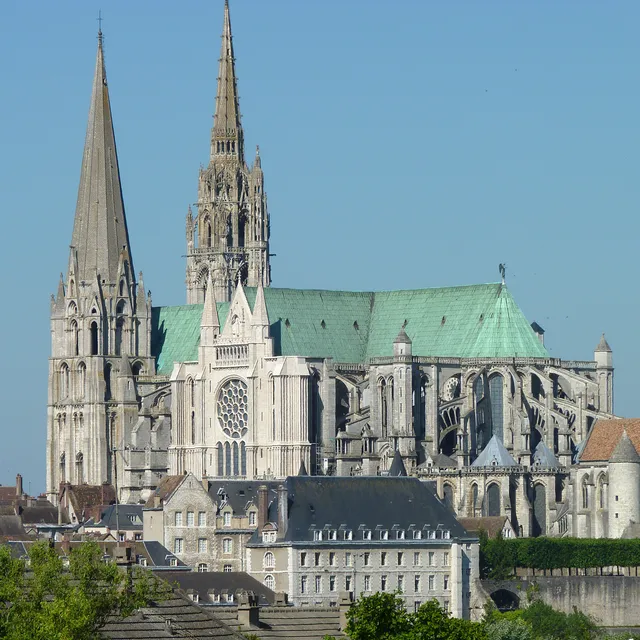
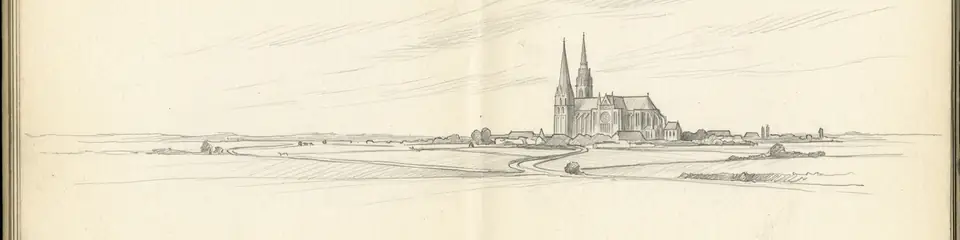
Chartres Cathedral stands on a hill above the Eure River in Chartres, Centre-Val de Loire, France. A bishopric from the Roman period, the site attracted Marian pilgrimage; a fire in 1194 destroyed much of the earlier Romanesque church while the western façade and towers survived. Reconstruction in the new Gothic style proceeded with unusual speed — the choir by 1221, the whole church by about 1250 — producing one of the most coherent High Gothic interiors in existence.
The cathedral houses the Sancta Camisa, a relic believed to be the tunic Mary wore at the Nativity, which fueled medieval pilgrimage. The stone floor labyrinth (c. 1200) survives for ritual walking. Stained-glass windows — including three great rose windows and the "Blue Virgin" window — retain extensive 13th-century glass, rare among European cathedrals after wars and iconoclasm.
UNESCO inscribed Chartres in 1979. The cathedral remains an active Catholic church and a touchstone for Gothic architecture studies from Viollet-le-Duc to modern sacred-geometry theories.