
Перейти к содержанию
Atlas Anatolia
НовостиЗубы ледникового периода на Сулавеси отодвигают использование бетеля на 25 000 лет назадРимская мозаика и голова Эрота обнаружены в базилике Помпейополиса, Кастамону
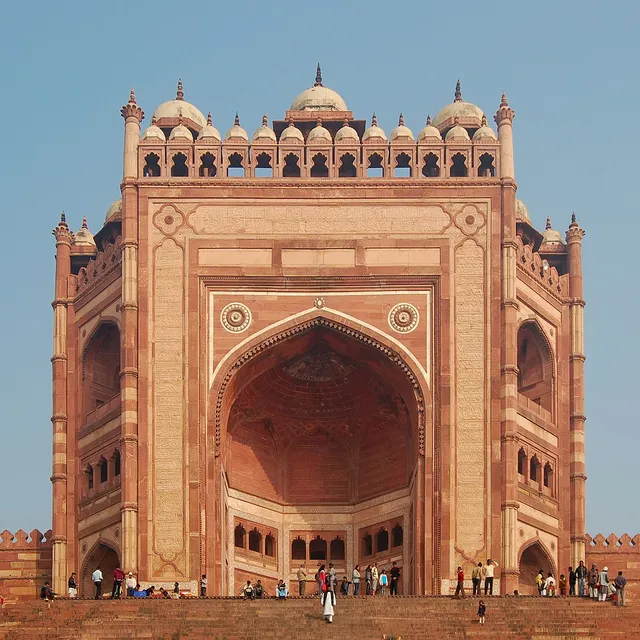
The Buland Darwaza victory gate at Fatehpur Sikri, India

Wikimedia Commons

ГородЮНЕСКО

Fatehpur Sikri

Seyfi Cem Baskin

फ़तेहपुर सीकरी1571 н. э. – 1586 н. э.

The red-sandstone Mughal capital Akbar built near Agra in the 1570s–1580s — a planned imperial city with the Buland Darwaza, Diwan-i-Khas, and Panch Mahal — abandoned after only a generation yet preserved as one of India's great UNESCO ensembles.

21
Интерес 74

Местоположение

Индия

27.09°N · 77.67°E · Азия

Patron

Emperor Akbar (r. 1556–1605)

Capital period

c. 1571–1586 CE, then largely abandoned

Landmark

Buland Darwaza — 54 m high victory gate

UNESCO

World Heritage Site (1986)

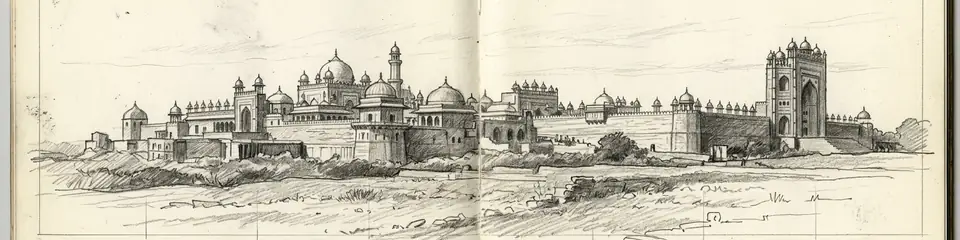
Graphite pencil sketch banner of Fatehpur Sikri

“Fatehpur Sikri is Akbar's most ambitious built statement — a capital designed to embody imperial universalism in stone, at the moment the Mughal Empire consolidated northern India.”

Местоположение

Обзор

Fatehpur Sikri stands on a rocky ridge west of Agra in Uttar Pradesh, India. The emperor Akbar (r. 1556–1605) began construction here in the 1570s after the Sufi saint Shaikh Salim Chishti of Sikri reportedly foretold the birth of his heir Jahangir. The city served as Akbar's principal capital from about 1571 until he relocated the court back to Agra in 1585–1586; reasons for abandonment are debated (water shortage, strategic shift to the northwest, completion of symbolic programme) but the site was never wholly depopulated.

The city is built chiefly of red sandstone with white marble accents, synthesising Persian, Hindu, and Jain architectural elements in a court that pursued religious dialogue. The Buland Darwaza ("Lofty Gate") — approached by a monumental stair — commemorates Akbar's Gujarat campaign (1573). The Diwan-i-Khas (Hall of Private Audience) contains the central pillar with serpentine bracketed balcony where Akbar is said to have received scholars of many faiths. The Panch Mahal is a five-storey pavilion of decreasing size; the Jama Masjid and Shaikh Salim Chishti's white marble tomb remain active pilgrimage destinations.
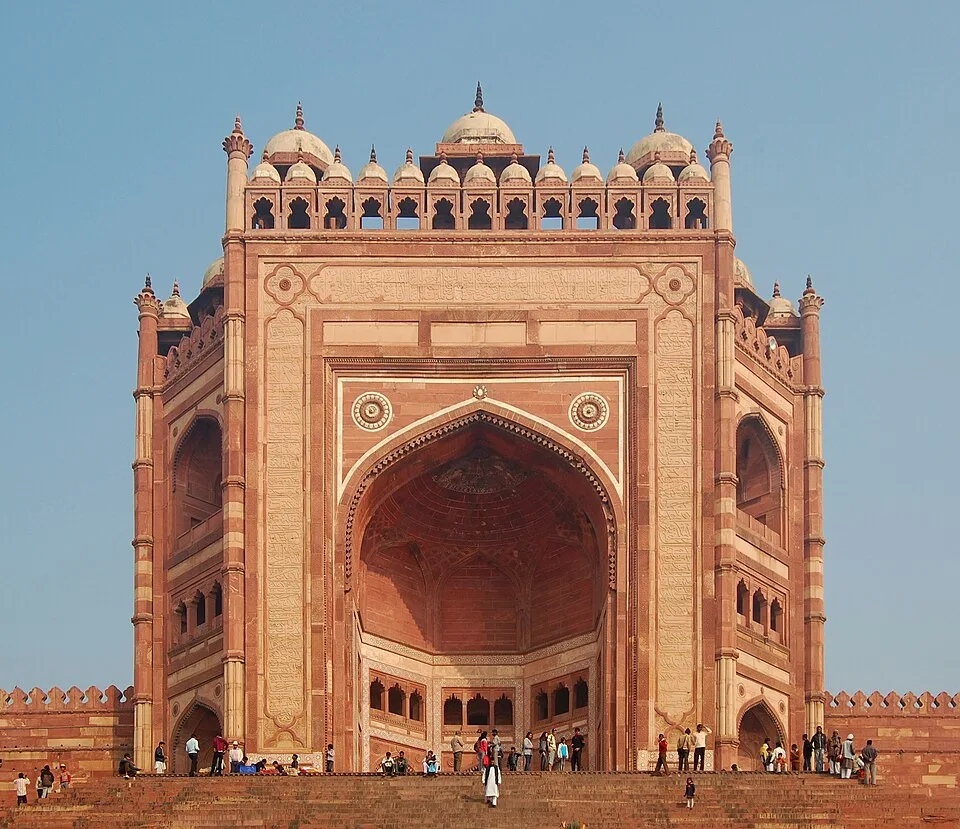
Fatehput Sikiri Buland Darwaza gate 2010
Fatehput Sikiri Buland Darwaza gate 2010 | Marcin Białek (CC BY-SA 3.0)
"His Majesty gives audience to all sorts and conditions of men, and holds disputations on religion with learned men of every faith."
— Abu'l-Fazl, Akbarnama, on Akbar's court at Fatehpur Sikri (c. 1590s)

Fatehpur Sikri forms part of the Golden Triangle tourist circuit with Agra (Taj Mahal) and Delhi. The Archaeological Survey of India administers the ruins; UNESCO inscribed it in 1986. Despite its short occupation, the city is indispensable for understanding Akbar's statecraft, syncretic court culture, and Mughal urban design.

Почему это важно

Fatehpur Sikri is Akbar's most ambitious built statement — a capital designed to embody imperial universalism in stone, at the moment the Mughal Empire consolidated northern India. Its abrupt abandonment makes it a rare near-intact Mughal ghost city, preserving court architecture that at Agra and Delhi was repeatedly rebuilt or overlaid.

Свидетельства и интерпретация

Различать, что хорошо установлено, а что остаётся предметом дискуссий.

Хорошо установленные факты

2
  • Mughal chronicles (Abu'l-Fazl's Akbarnama) and inscriptions document construction phases, court ceremonies, and Akbar's presence at Sikri.
  • Standing architecture preserves Akbar-period red sandstone and marble craft, including the Diwan-i-Khas pillar and Panch Mahal.

Спорные интерпретации

1
  • Whether chronic water stress or political strategy primarily caused abandonment remains unresolved in specialist literature.

Фотографии сообщества

Поделитесь своими впечатлениями

Вы посещали это место? Загрузите свои фотографии, чтобы помочь другим открыть его для себя.

Как цитировать эту страницу

Atlas Anatolia. (1571). Fatehpur Sikri. Atlas Anatolia. https://atlasanatolia.com/ru/site/fatehpur-sikri

Материалы распространяются по лицензии CC BY-SA 4.0 — при повторном использовании указание авторства обязательно.

Источники

  • Mughal Architecture — Koch, Ebba (1991)
  • UNESCO — Fatehpur SikriСсылка

Часто задаваемые вопросы

Где находится Fatehpur Sikri?

Fatehpur Sikri находится в India.

Сколько лет Fatehpur Sikri?

Fatehpur Sikri датируется приблизительно 1571 н. э. – 1586 н. э..

С какими цивилизациями связано место Fatehpur Sikri?

Fatehpur Sikri связано с цивилизацией: Mughal.

Почему Fatehpur Sikri имеет важное значение?

Fatehpur Sikri is Akbar's most ambitious built statement — a capital designed to embody imperial universalism in stone, at the moment the Mughal Empire consolidated northern India.

Входит ли Fatehpur Sikri в список Всемирного наследия ЮНЕСКО?

Да — Fatehpur Sikri включено в список Всемирного наследия ЮНЕСКО.