
Перейти к содержанию
Atlas Anatolia
НовостиЗубы ледникового периода на Сулавеси отодвигают использование бетеля на 25 000 лет назадРимская мозаика и голова Эрота обнаружены в базилике Помпейополиса, Кастамону
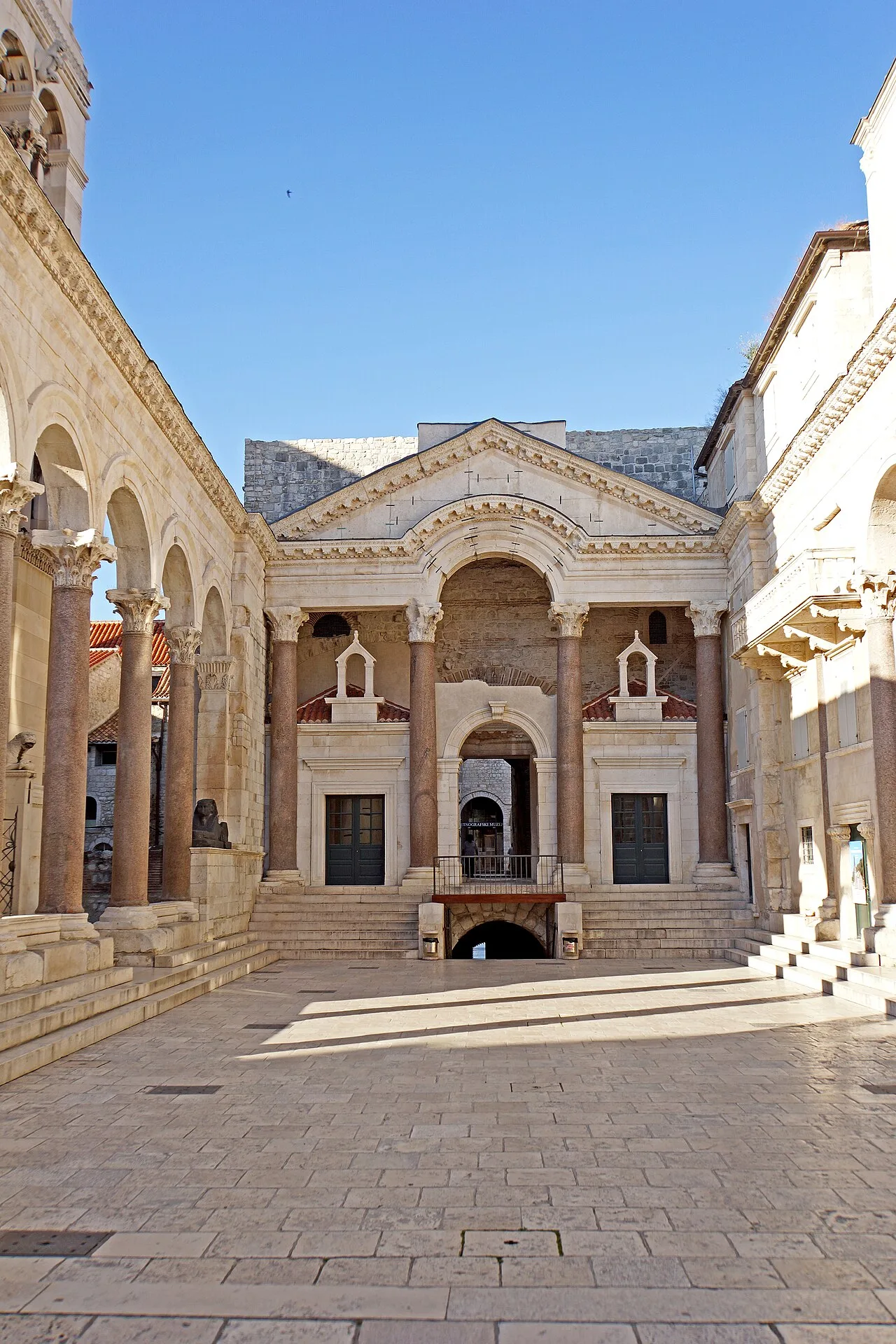
The Peristyle courtyard of Diocletian's Palace in Split, Croatia

Wikimedia Commons

Country Record

Known by the Most Names in Croatia

КомплексЮНЕСКО

Diocletian's Palace

Seyfi Cem Baskin

Dioklecijanova palača295 н. э. – 305 н. э.

The fortified seaside palace built around 300 CE for the Roman emperor Diocletian to retire to — half luxury villa, half military camp — on the Dalmatian coast of modern Croatia. Unlike most Roman monuments it was never abandoned: the medieval and modern city of Split grew up inside its walls, and people still live within the emperor's palace today.

311
Интерес 72

Местоположение

Хорватия

43.51°N · 16.44°E · Европа

Built

c. 295–305 CE for the emperor Diocletian's retirement

Form

Fortified palace-cum-camp, ~38,000 m², four gates, towered walls

Mausoleum

Diocletian's octagonal tomb — now the Cathedral of St Domnius

Still inhabited

Refugees from Salona settled inside; the city of Split grew within it

Studied by

Robert Adam (1764) — influenced European Neoclassicism

UNESCO

World Heritage Site 1979

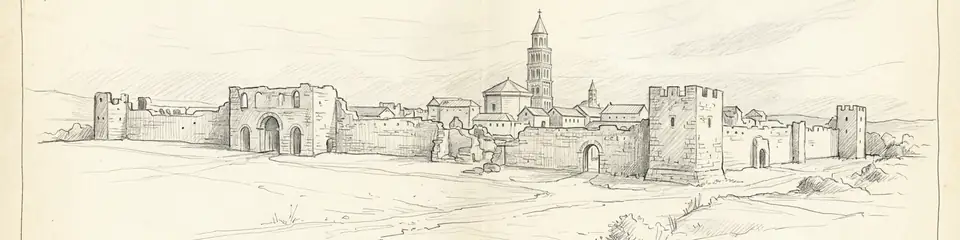
Graphite pencil sketch banner of Diocletian's Palace

“Diocletian's Palace is the most complete surviving example of a late Roman imperial palace and one of the most important monuments of late antique architecture.”

Местоположение

Обзор

Diocletian's Palace stands on a small peninsula on the Adriatic coast at the centre of present-day Split, Croatia. It was commissioned by Diocletian, the emperor who reorganised the late Roman state through the system of the Tetrarchy (rule by four), in preparation for his abdication. In 305 CE Diocletian did something no Roman emperor had voluntarily done before: he retired from power and withdrew to this palace near his birthplace of Salona, where he reportedly devoted himself to gardening until his death around 311 CE.

The complex is a hybrid of palatial villa and Roman military fortress. Roughly rectangular and covering about 38,000 square metres, it is enclosed by high stone walls reinforced with square and octagonal towers, pierced by four monumental gates — the Golden Gate (north), Silver Gate (east), Iron Gate (west), and the sea-facing Bronze Gate (south). Two colonnaded streets, the cardo and decumanus, divide the interior into quarters in the manner of a Roman legionary camp. The southern, seaward half contained the emperor's private apartments, raised over a series of vaulted substructures — among the best-preserved Roman cellars anywhere, now a major attraction — that supported the living quarters above.

At the heart of the palace lies the Peristyle, a colonnaded ceremonial courtyard where the emperor would have appeared before his subjects. Around it stand the Imperial Mausoleum — an octagonal domed building intended as Diocletian's tomb — and the Temple of Jupiter. In one of history's sharper ironies, the mausoleum of Diocletian, the emperor remembered for the last and most severe persecution of Christians, was converted in the early medieval period into the Cathedral of Saint Domnius, dedicated to a bishop martyred under his own persecution; it is among the oldest cathedral structures still in use.

After the nearby Roman city of Salona was sacked in the 7th century, refugees moved into the abandoned imperial palace, adapting its halls, walls, and substructures into homes. Over the following centuries a continuous living city — Split — developed within and around the Roman shell, building medieval, Renaissance, and Baroque structures against and on top of the ancient walls. The palace was studied and published by the Scottish architect Robert Adam in 1764, and his drawings profoundly influenced the Neoclassical movement in Britain.

Почему это важно

Diocletian's Palace is the most complete surviving example of a late Roman imperial palace and one of the most important monuments of late antique architecture. Its fortified, camp-like plan marks the transition from the open villas of the early empire to the defended residences of the troubled later empire, embodying the militarised character of the age of the Tetrarchy. It also preserves, in the Peristyle and mausoleum, the ceremonial architecture through which late Roman emperors presented themselves as semi-divine rulers. What makes the site exceptional is its continuous occupation: rather than being excavated as a ruin, it survives as the living heart of a modern city, its Roman streets still in daily use and its emperor's mausoleum still a functioning cathedral. Robert Adam's 18th-century study of the palace helped launch European Neoclassicism, giving the building an outsized influence on later Western architecture. It forms the core of the UNESCO World Heritage Site "Historical Complex of Split with the Palace of Diocletian," inscribed in 1979.

Свидетельства и интерпретация

Различать, что хорошо установлено, а что остаётся предметом дискуссий.

Хорошо установленные факты

3
  • Diocletian's voluntary abdication in 305 CE and his retirement to the palace are recorded by multiple late Roman sources, including Lactantius and later the historian Zosimus, providing a firm historical context for the building's purpose and date.
  • The conversion of Diocletian's mausoleum into the Cathedral of Saint Domnius is documented and confirmed archaeologically; the octagonal Roman structure with its original dome survives within the functioning cathedral, making it one of the oldest cathedral buildings in continuous use.
  • Robert Adam's detailed survey, published as "Ruins of the Palace of the Emperor Diocletian at Spalatro" (1764), records the state of the palace in the 18th century and is itself a documented influence on the Neoclassical style.

Научные выводы

1
  • The fortress-like design — high walls, defensive towers, and a camp-like internal street grid — is interpreted as reflecting both the insecurity of the late empire and Diocletian's military background, blending the forms of a legionary camp with those of an aristocratic villa.

Спорные интерпретации

1
  • The original function of several southern halls, and the degree to which the seaward range was purely residential versus also ceremonial, remain debated, as later medieval and modern construction within the palace has obscured or destroyed much of the original internal arrangement.

Фотографии сообщества

Поделитесь своими впечатлениями

Вы посещали это место? Загрузите свои фотографии, чтобы помочь другим открыть его для себя.

Как цитировать эту страницу

Atlas Anatolia. (295). Diocletian's Palace. Atlas Anatolia. https://atlasanatolia.com/ru/site/diocletians-palace

Материалы распространяются по лицензии CC BY-SA 4.0 — при повторном использовании указание авторства обязательно.

Источники

  • Diocletian's Palace, Split: Residence of a Retired Roman Emperor — Wilkes, J. J. (1993)
  • Ruins of the Palace of the Emperor Diocletian at Spalatro — Adam, Robert (1764)

Часто задаваемые вопросы

Где находится Diocletian's Palace?

Diocletian's Palace находится в Croatia.

Сколько лет Diocletian's Palace?

Diocletian's Palace датируется приблизительно 295 н. э. – 305 н. э..

С какими цивилизациями связано место Diocletian's Palace?

Diocletian's Palace связано с цивилизацией: Roman.

Почему Diocletian's Palace имеет важное значение?

Diocletian's Palace is the most complete surviving example of a late Roman imperial palace and one of the most important monuments of late antique architecture.

Входит ли Diocletian's Palace в список Всемирного наследия ЮНЕСКО?

Да — Diocletian's Palace включено в список Всемирного наследия ЮНЕСКО.