
Pular para o conteúdo
Atlas Anatolia
NotíciasIce Age teeth in Sulawesi push betel-nut use back as far as 25,000 yearsRoman mosaic and Eros head uncovered in the basilica at Pompeiopolis, Kastamonu
The Loftus mound at Uruk (Warka), southern Iraq, site of the world's first city

Wikimedia Commons

Country Record

Oldest City in Iraq

CidadeUNESCODestaque

Uruk

Seyfi Cem Baskin

وركاء5000 a.C. – 200 a.C.

The world's first city — a 6-kilometre urban complex on the Euphrates in southern Mesopotamia that pioneered writing, monumental public architecture, cylinder seals, and civic organization around 3200 BCE, and whose legendary king Gilgamesh inspired the oldest surviving work of literature.

311
Interesse 75

Localização

Iraque

31.32°N · 45.64°E · Ásia

Founded

c. 5000 BCE; Uruk period peak c. 3200–2900 BCE

City size

~550 hectares within Late Uruk walls — the world's largest city at its peak

Writing

Proto-cuneiform script invented here c. 3200 BCE — the world's first writing system

Population

Estimated 40,000–80,000 at peak; Uruk period (c. 3100 BCE)

UNESCO

Part of "Ahwar of Southern Iraq" WHS (2016)

Gilgamesh

Legendary king of Uruk; his epic is the world's oldest surviving literary work

Location

Warka (Varka), Dhi Qar Governorate, southern Iraq

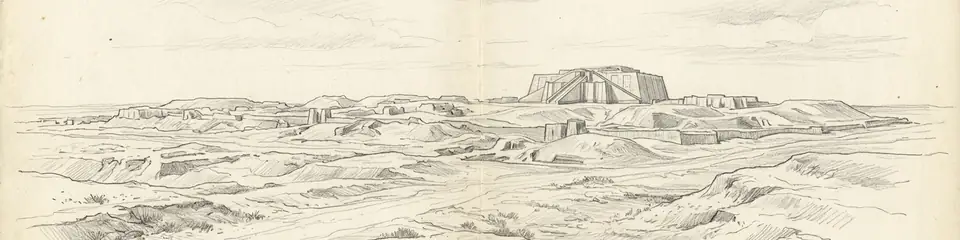
Graphite pencil sketch banner of Uruk

“Uruk is where writing began.”

Localização

Visão geral

Uruk (modern Warka) lies in the alluvial lowlands of southern Iraq, about 300 kilometres southeast of Baghdad, in a region now largely desert but once threaded by the channels of the ancient Euphrates. The site covers approximately 550 hectares within its Late Uruk city walls — walls that may have been built by Gilgamesh himself, according to the epic — making it at its height (c. 3100–2900 BCE) by far the largest settlement on Earth.

German excavations at Warka, conducted by the Deutsche Orient-Gesellschaft from 1912 with interruptions through to the present day, have revealed a deep stratigraphic sequence spanning the Ubaid period (c. 5500 BCE) through the Parthian era (c. 200 CE). The critical period is the "Uruk period" (c. 4100–2900 BCE), when the city experienced explosive growth that archaeologists call the "Urban Revolution." The city was organized around two principal cult precincts: the Eanna, dedicated to Inanna (goddess of love and war, the city's patron deity), and the Anu Ziggurat, a monumental stepped platform topped by the White Temple dedicated to the sky god Anu.

The innovations associated with the Uruk period are among the most consequential in human history. Writing — specifically proto-cuneiform script, the earliest writing system — appeared here around 3200 BCE, initially as an administrative tool to track grain rations, cattle counts, and temple property. Cylinder seals (engraved stone cylinders rolled into clay to create unique impressions) were invented as a bureaucratic identity marker. Monumental public buildings with specialized functions (storage, administration, temple ritual) were constructed on a scale requiring centralized direction of labor. Long-distance trade networks linked Uruk to Anatolia, Iran, Egypt, and the Indus Valley.

Uruk's population during the Uruk period has been estimated at 40,000–80,000, with a surrounding territory of dependent villages. Its influence extended across a vast region: "Uruk colonies" — settlements with Uruk-style material culture — have been identified as far north as Arslantepe in Turkey and Habuba Kabira in Syria, suggesting a sphere of economic and cultural influence unprecedented in pre-history.
Por que isso importa

Uruk is where writing began. The approximately 5,000 proto-cuneiform tablets from the Eanna precinct, dating to c. 3200–3000 BCE, are the earliest written documents on Earth — administrative records from a complex bureaucratic society. The city is also the setting of the Epic of Gilgamesh, the world's oldest literary work, which describes its walls and temple as the city's defining achievements. No other site represents such a concentration of "firsts": first city, first writing, first cylinder seals, first monumental public architecture organized around institutional functions. Understanding Uruk is foundational to understanding why human civilization took the form it did. The site was inscribed as a UNESCO World Heritage Site in 2016 as part of the Ahwar of Southern Iraq.

Evidências e interpretação

Distinguir o que está bem estabelecido do que permanece em debate.

Fatos bem estabelecidos

3
  • Approximately 5,000 proto-cuneiform tablets from the Eanna precinct, dated to c. 3200–3000 BCE, are the earliest writing in the world. They record rations, livestock, and commodities using pictographic signs that are the direct precursors of cuneiform script.
  • The Anu Ziggurat White Temple, excavated by German teams, dates to the Late Uruk period (c. 3200 BCE). It stands on a platform approximately 13 metres high and is one of the earliest monumental public buildings in the world. The White Temple itself was dedicated to the sky god Anu.
  • "Uruk colonies" — settlements outside Mesopotamia with Uruk-style pottery, cylinder seals, and architectural forms — have been documented at Habuba Kabira (Syria), Arslantepe (Turkey), Godin Tepe (Iran), and other sites, demonstrating the city's far-reaching economic influence.

Inferências acadêmicas

1
  • The Epic of Gilgamesh credits the legendary king with building Uruk's walls and founding its temple precinct. Some scholars associate a historical Gilgamesh with the Early Dynastic I period (c. 2800–2600 BCE) on the basis of the Sumerian King List, which places him as the fifth king of Uruk. Whether the historical person and the literary figure are connected is unknown.

Interpretações debatidas

1
  • The mechanisms of the Uruk Expansion — whether the colonies represent trade outposts, colonies, or the spread of material culture through exchange networks — is actively debated. Some scholars favor a model of Uruk merchants establishing outposts; others argue for indigenous adoption of Uruk material culture by local elites. The available evidence supports both interpretations.

Fotos da comunidade

Compartilhe sua experiência

Você visitou este sítio? Envie suas fotos para ajudar outros a descobri-lo.

Histórias relacionadas

Como citar esta página

Atlas Anatolia. (5000). Uruk. Atlas Anatolia. https://atlasanatolia.com/pt/site/uruk

Conteúdo licenciado sob CC BY-SA 4.0 — atribuição necessária ao reutilizar.

Gráfico

Conexões com sítios e histórias relacionados.

Fontes

  • The Uruk World System: The Dynamics of Expansion of Early Mesopotamian Civilization — Algaze, Guillermo (2005)
  • Uruk: The First City — Liverani, Mario (2006)
  • A History of the Ancient Near East — Van De Mieroop, Marc (2007)

Perguntas frequentes

Onde fica Uruk?

Uruk está localizado em Iraq.

Qual é a antiguidade de Uruk?

Uruk data de aproximadamente 5000 a.C. – 200 a.C..

Quais civilizações estão associadas a Uruk?

Uruk está associado à civilização Sumerian.

Por que Uruk é importante?

Uruk is where writing began.

Uruk é um Patrimônio Mundial da UNESCO?

Sim — Uruk está inscrito na Lista do Patrimônio Mundial da UNESCO.