
Pular para o conteúdo
Atlas Anatolia
NotíciasIce Age teeth in Sulawesi push betel-nut use back as far as 25,000 yearsRoman mosaic and Eros head uncovered in the basilica at Pompeiopolis, Kastamonu
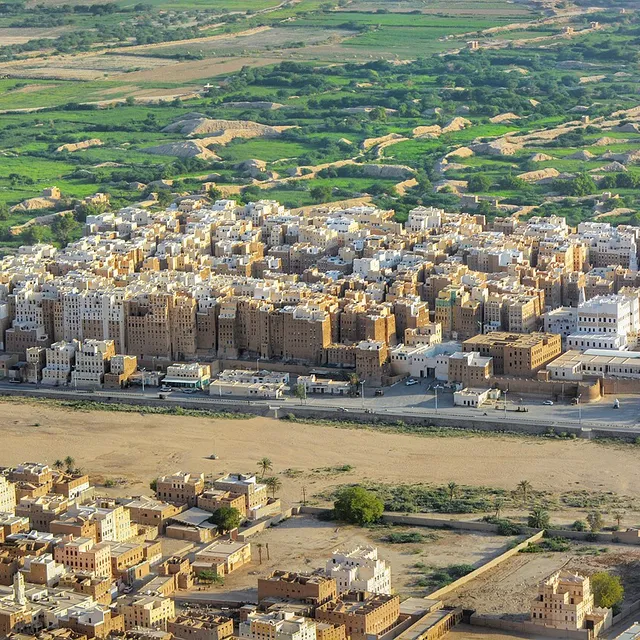
Dense mud-brick tower houses of the walled city of Shibam in Wadi Hadramawt

Wikimedia Commons

Country Record

Longest Continuously Occupied Site in Yemen

CidadeUNESCODestaque

Shibam

Seyfi Cem Baskin

شبام500 d.C. – 1800 d.C.

A walled city of towering mud-brick tower houses in Yemen’s Wadi Hadramawt — often called the "Manhattan of the Desert" — where medieval Hadrami urbanism perfected vertical densification as a response to floodplain limits and defensive needs.

21
Interesse 67

Localização

Iêmen

15.93°N · 48.63°E · Ásia

Nickname

"Manhattan of the Desert" — multi-storey mud-brick tower houses

Setting

Walled city on the floodplain of Wadi Hadramawt

UNESCO

Old Walled City of Shibam — World Heritage 1982

Material

Sun-dried mud brick (adobe) on stone foundations

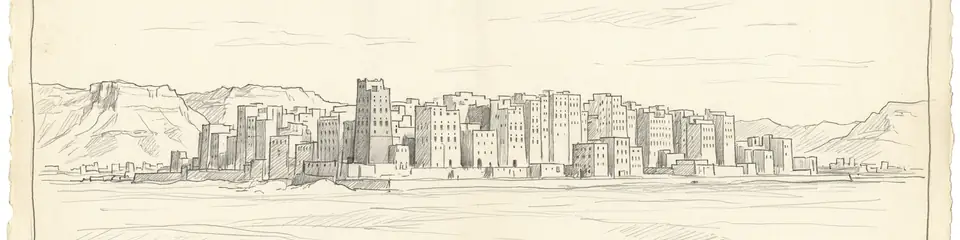
Graphite pencil sketch banner of Shibam

“Shibam demonstrates a fully realised pre-modern high-rise urbanism using earth architecture — a technological and social achievement paralleling, in different materials, later vertical cities.”

Localização

Visão geral

Shibam rises from the floor of Wadi Hadramawt in eastern Yemen as a dense cluster of multi-storey mud-brick buildings — some reaching seven or more floors — packed inside a rectangular defensive wall. Continuously inhabited for centuries and rebuilt after floods and fires, the present skyline largely reflects medieval and early modern Hadrami architectural practice rooted in much older South Arabian oasis urban traditions.

The tower houses use sun-dried brick (adobe) on stone foundations, with wooden floors, whitewashed tops, and careful waterproofing against rare but destructive flash floods. Streets are narrow; commerce and family life are stacked vertically. Shibam’s form is not mere spectacle: limited arable land on the wadi floor and the need for security produced a highly compact, vertical city unique in scale among surviving Arabian mud-brick settlements.
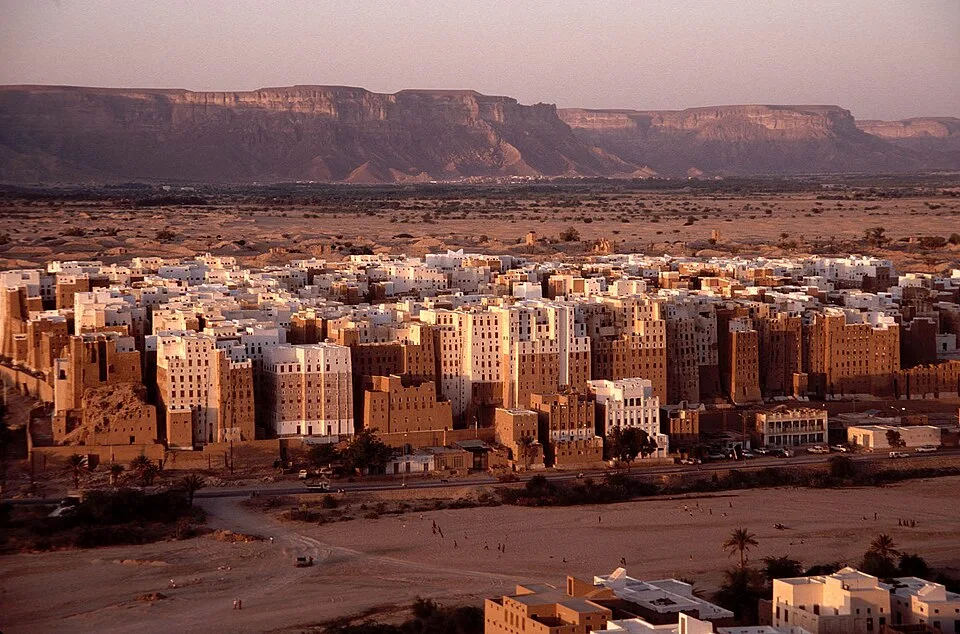
Shibam Wadi Hadhramaut Yemen
Shibam Wadi Hadhramaut Yemen | Jialiang Gao www.peace-on-earth.org [dead link] (CC BY-SA 3.0)
"In Wadi Hadramawt the city rises like a cliff of houses — storey upon storey of mud brick — a fortress of families against flood and foe."
— Traditional Hadrami description of Shibam (paraphrase of vernacular urban lore)

UNESCO inscribed the Old Walled City of Shibam in 1982 as an outstanding example of traditional Islamic urban planning and architecture in the Hadramawt. Despite conflict and conservation challenges, it remains a living museum of Arabian vertical vernacular architecture — often photographed as the desert counterpart to early skyscraper cities.
Por que isso importa

Shibam demonstrates a fully realised pre-modern high-rise urbanism using earth architecture — a technological and social achievement paralleling, in different materials, later vertical cities. It also stands for Hadramawt’s role as an Indian Ocean–desert interface: trade diasporas from this valley reached East Africa, India, and Southeast Asia, carrying architectural memory and mercantile networks far from Yemen.

Evidências e interpretação

Distinguir o que está bem estabelecido do que permanece em debate.

Fatos bem estabelecidos

2
  • Standing urban fabric of walled multi-storey mud-brick houses constitutes a continuous living architectural tradition of the Hadramawt.
  • UNESCO listing recognises Shibam as outstanding traditional Islamic urbanism in an arid valley setting.

Inferências acadêmicas

1
  • Vertical densification responded to limited arable land and flood/defence constraints on the wadi floor.

Fotos da comunidade

Compartilhe sua experiência

Você visitou este sítio? Envie suas fotos para ajudar outros a descobri-lo.

Histórias relacionadas

Como citar esta página

Atlas Anatolia. (500). Shibam. Atlas Anatolia. https://atlasanatolia.com/pt/site/shibam

Conteúdo licenciado sob CC BY-SA 4.0 — atribuição necessária ao reutilizar.

Gráfico

Conexões com sítios e histórias relacionados.

Fontes

  • The Valley of Mud Brick Architecture: Shibam — Damluji, Salma Samar (1992)
  • UNESCO — Old Walled City of ShibamLink

Perguntas frequentes

Onde fica Shibam?

Shibam está localizado em Yemen.

Qual é a antiguidade de Shibam?

Shibam data de aproximadamente 500 d.C. – 1800 d.C..

Quais civilizações estão associadas a Shibam?

Shibam está associado à civilização Islamic / Medieval.

Por que Shibam é importante?

Shibam demonstrates a fully realised pre-modern high-rise urbanism using earth architecture — a technological and social achievement paralleling, in different materials, later vertical cities.

Shibam é um Patrimônio Mundial da UNESCO?

Sim — Shibam está inscrito na Lista do Patrimônio Mundial da UNESCO.