
Pular para o conteúdo
Atlas Anatolia
NotíciasIce Age teeth in Sulawesi push betel-nut use back as far as 25,000 yearsRoman mosaic and Eros head uncovered in the basilica at Pompeiopolis, Kastamonu
Pompeii — Italy

Wikimedia Commons (CC BY-SA)

Country Record

Oldest City in Italy

CidadeUNESCODestaque

Pompeii

Seyfi Cem Baskin

700 a.C. – 79 d.C.

The Roman city of Pompeii was buried in the catastrophic eruption of Mount Vesuvius in 79 CE, its extraordinary preservation offering an unparalleled window into ancient daily life.

521
Interesse 90

Localização

Naples · Campania · Itália

40.75°N · 14.49°E · Europa

Built

circa 7th century BCE (Oscan settlement, later Roman colony)

Civilization

Oscan, Samnite, then Roman

Discovered

1599 (accidental), systematic excavations from 1748

Status

UNESCO World Heritage Site (1997, inscribed as 'Archaeological Areas of Pompeii, Herculaneum and Torre Annunziata')

Area

66 hectares (within walls)

Population

Estimated 11,000–15,000 at time of destruction

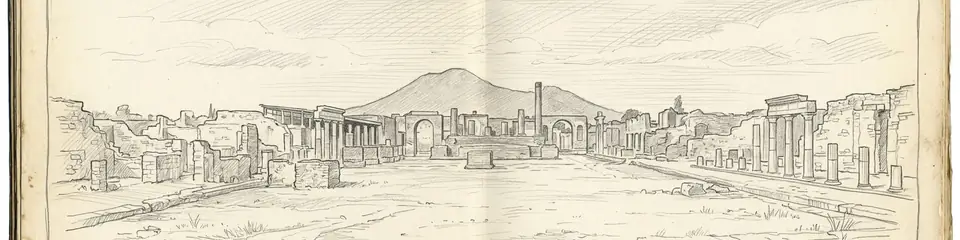
Graphite pencil sketch banner of Pompeii

“Pompeii’s unparalleled state of preservation provides a direct portal into the routines, architecture, and artistry of a Roman city, illuminating social classes, economic networks, and daily practices that are rarely recoverable elsewhere.”

Localização

Visão geral

Discovery

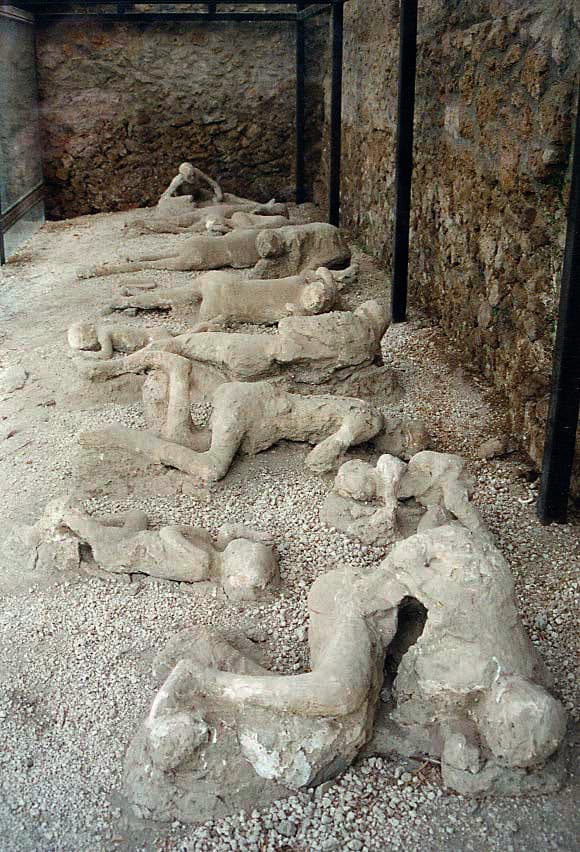
The ruins of Pompeii were accidentally rediscovered in 1599 during the digging of an underground channel, but systematic exploration began in 1748 under the patronage of Charles of Bourbon, King of Naples. Early excavations were haphazard, focused on treasure-hunting and removal of artifacts for the royal collection. It was not until the 19th century that more scientific methods were applied, notably by Giuseppe Fiorelli, who introduced systematic stratigraphic excavation and the famous technique of creating plaster casts of the victims.

Significance

Pompeii offers an unparalleled snapshot of Roman urban life in the 1st century CE, frozen in time by the catastrophic eruption of Vesuvius. Its exceptional preservation allows scholars to study aspects rarely accessible in other archaeological sites: complete streetscapes, intact domestic architecture, vibrant wall paintings, graffiti, and even organic remains. The city serves as a primary source for understanding Roman social structure, economy, religion, and daily habits, making it one of the most important archaeological sites in the world.
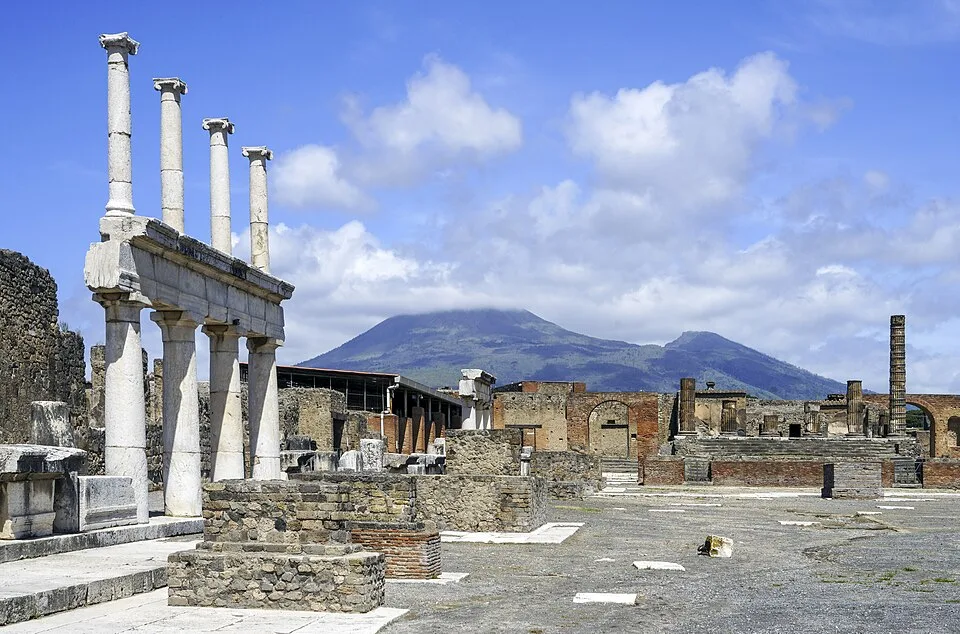
Forum (Pompeii) and the Vesuvio
Forum (Pompeii) and the Vesuvio | Commonists (CC BY-SA 4.0)
"A black and dreadful cloud, broken with rapid, zigzag flashes, revealed behind it variously shaped masses of flame: these last were like sheet-lightning, but much larger."
— Pliny the Younger, Letter to Tacitus VI.16, on the eruption of Vesuvius, 79 CE
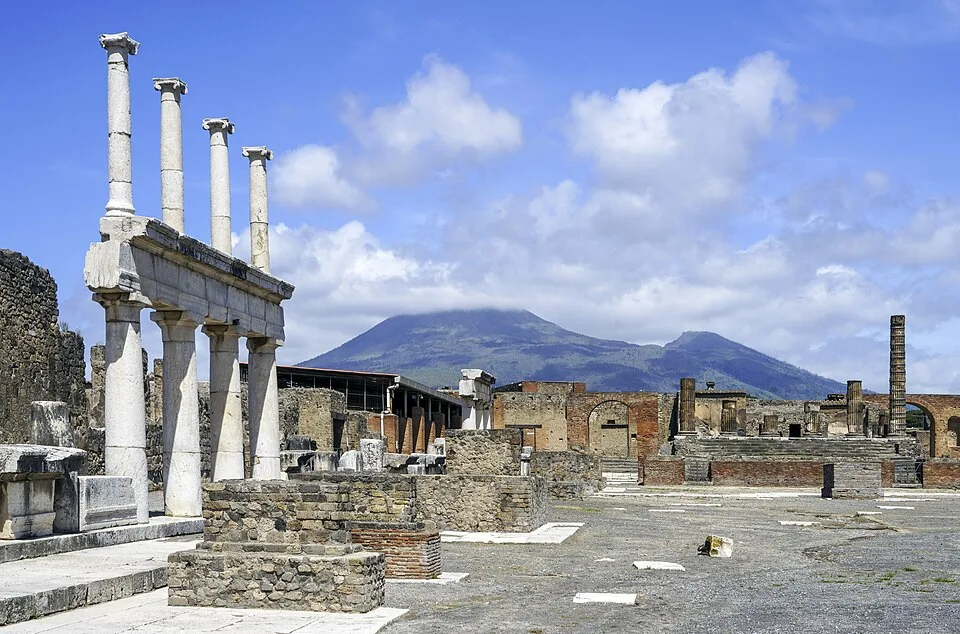
Forum Pompeii and the Vesuvio
Forum Pompeii and the Vesuvio | Commonists (CC BY-SA 4.0)

Urban Layout and Architecture

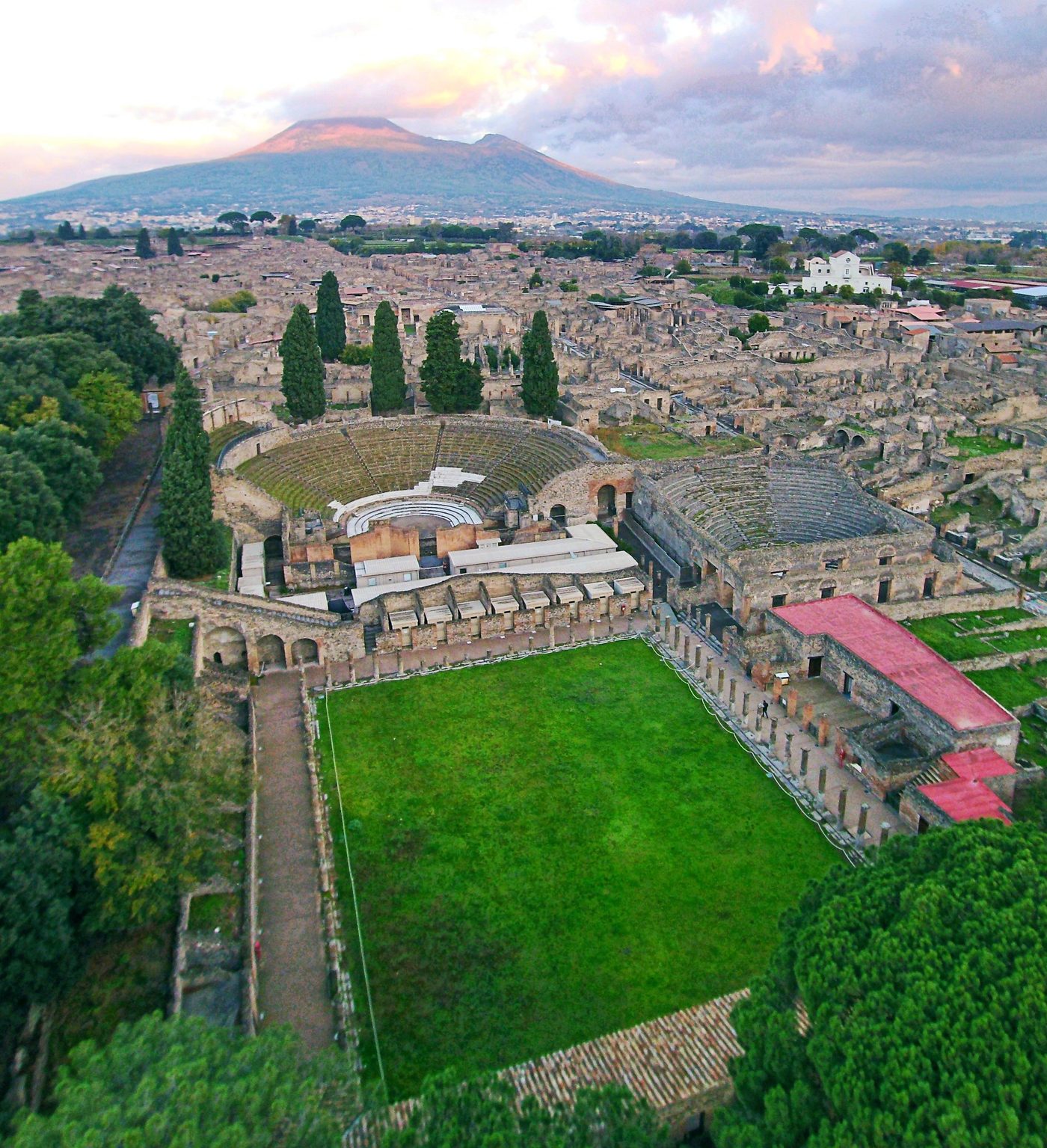
The city, covering approximately 66 hectares, was surrounded by walls with several gates. Its grid-like street plan reflects a mix of original Oscan settlement and Roman rationalization. Public buildings include a forum, basilica, temples, theaters, and an amphitheater. Domestic architecture ranges from modest dwellings to lavish atrium-peristyle houses such as the House of the Faun and the Villa of Mysteries. Pompeii’s architecture demonstrates a blend of Italic traditions and Hellenistic influences, providing insights into the evolution of Roman urbanism.
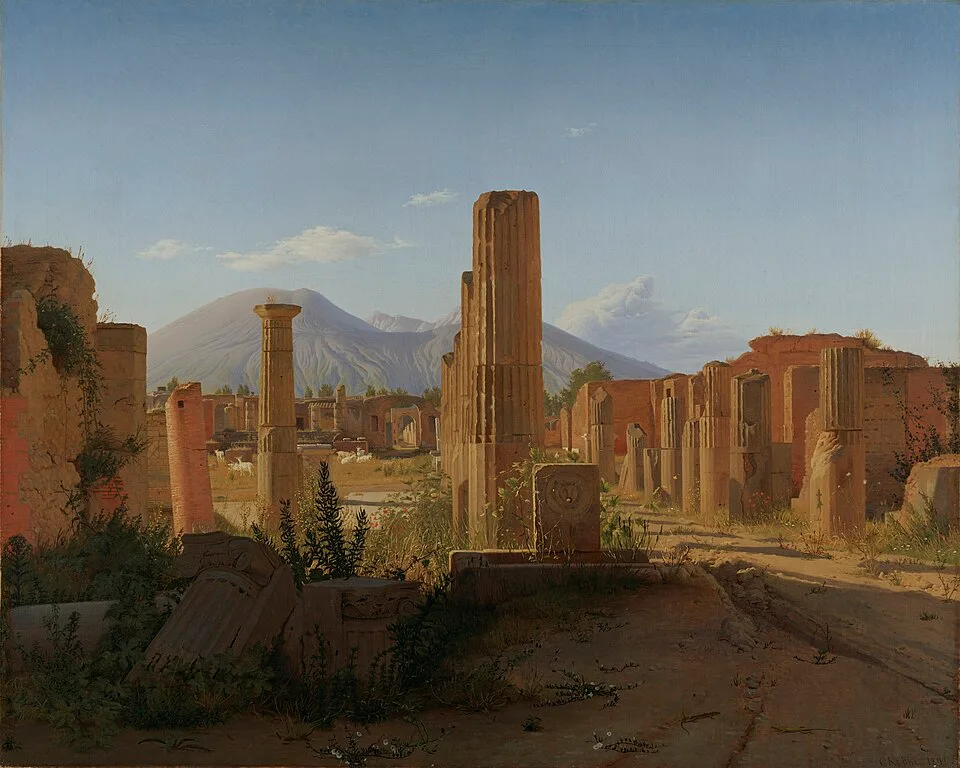
The Forum, Pompeii, with Vesuvius in the Distance

*The Forum, Pompeii, with Vesuvius in the Distance |

Christen Schjellerup Købke (Public domain)*

"The cities are buried — they are not destroyed. Dig, and you find the life of a Roman day interrupted mid-gesture."
— Paraphrase of early excavators' surprise at Pompeii's preservation

Art and Daily Life

Pompeii’s walls are adorned with a remarkable array of frescoes, from mythological scenes to still lifes and explicit erotic art. These paintings, categorized into four Pompeian Styles, reveal changing tastes and techniques over centuries. Graffiti and electoral notices scratched on walls offer direct evidence of popular literacy and political life. Shops, taverns, and bakeries line the streets, illustrating a vibrant commercial economy. Household objects, food remains, and even the contents of drains paint a vivid picture of daily routines and social hierarchy.

The Eruption and Preservation

On an autumn day in 79 CE, Mount Vesuvius erupted catastrophically, burying Pompeii under a thick blanket of pumice and ash. The sequence of events—initial pumice fall collapsing roofs, followed by pyroclastic surges—killed inhabitants who had not fled and led to extraordinary preservation of organic materials. The city remained sealed for centuries, protecting it from weathering and looting. This sudden burial created a unique archaeological time capsule, the excavation of which continues to yield discoveries about ancient life.
Por que isso importa

Pompeii’s unparalleled state of preservation provides a direct portal into the routines, architecture, and artistry of a Roman city, illuminating social classes, economic networks, and daily practices that are rarely recoverable elsewhere. Its continuous study reshapes our understanding of the Roman world, making it a cornerstone of classical archaeology and a universal symbol of the fragility of human civilization.

Evidências e interpretação

Distinguir o que está bem estabelecido do que permanece em debate.

Fatos bem estabelecidos

5
  • The city was buried by up to 4–6 meters of volcanic material from the eruption of Vesuvius in 79 CE.
  • Giuseppe Fiorelli pioneered the technique of creating plaster casts of victims by pouring plaster into voids left by decomposed bodies.
  • The amphitheater at Pompeii is the oldest known surviving permanent stone amphitheater in the Roman world, built around 70 BCE.
  • Carbonized remains of food, such as bread and fruit, have been preserved in shops and homes, offering direct evidence of Roman diet.
  • The sudden burial led to the exceptional preservation of perishable materials, including wooden furniture, textiles, and even the upper floors of some buildings.

Inferências acadêmicas

2
  • Graffiti found throughout the city attest to widespread literacy among all classes, including women and slaves, inferred from the sheer volume and diversity of inscriptions.
  • The high number of casualties (over 1,000 victims found) implies that many residents did not evacuate despite warning signs, possibly due to underestimating the danger.

Interpretações debatidas

1
  • The exact date of the eruption is contested: traditional accounts place it on 24 August 79 CE, but archaeological finds like autumnal fruits and braziers suggest a later date in October or November.

Descoberta e escavação

Modern interdisciplinary projects

Dirigido por Various (Soprintendenza Pompeii, universities, etc.)

Since the late 20th century, excavations have been limited and targeted, emphasizing conservation, non-invasive surveys, and multidisciplinary research led by the Pompeii Archaeological Park and international teams.

1748–1799

Bourbon excavations

Dirigido por Roque Joaquín de Alcubierre & Karl Weber

Initial large-scale excavations under Charles VII of Naples, focused on retrieving artworks and treasures, often destructive but revealed major buildings like the amphitheater and the Villa of the Papyri.

1860–1875

Fiorelli’s systematic excavations

Dirigido por Giuseppe Fiorelli

Giuseppe Fiorelli introduced a scientific approach, divided the site into regions and insulae, and developed the plaster cast technique, recovering the shapes of victims and organic artifacts.

1924–1961

Maiuri’s extensive excavation & conservation

Dirigido por Amedeo Maiuri

Amedeo Maiuri directed large-scale excavations and restored many buildings, revealing extensive residential and commercial districts and shaping the modern visitor experience.

Fotos da comunidade

Compartilhe sua experiência

Você visitou este sítio? Envie suas fotos para ajudar outros a descobri-lo.

Histórias relacionadas

Como citar esta página

Atlas Anatolia. (700). Pompeii. Atlas Anatolia. https://atlasanatolia.com/pt/site/pompeii

Conteúdo licenciado sob CC BY-SA 4.0 — atribuição necessária ao reutilizar.

Gráfico

Conexões com sítios e histórias relacionados.

Fontes

  • Beard, M. (2008) Pompeii: The Life of a Roman Town — Mary Beard (2008)
  • Wallace-Hadrill, A. (1994) Houses and Society in Pompeii and Herculaneum — Andrew Wallace-Hadrill (1994)
  • Zanker, P. (1998) Pompeii: Public and Private Life — Paul Zanker (1998)
  • Sigurdsson, H. et al. (1985) The Eruption of Vesuvius in A.D. 79 — Haraldur Sigurdsson et al. (1985)
  • UNESCO World Heritage entry: Archaeological Areas of Pompei, Herculaneum and Torre AnnunziataLink
  • Ciarallo, A. (2001) Gardens of Pompeii — Annamaria Ciarallo (2001)

Perguntas frequentes

Onde fica Pompeii?

Pompeii está localizado em Naples, Campania, Italy.

Qual é a antiguidade de Pompeii?

Pompeii data de aproximadamente 700 a.C. – 79 d.C..

Quais civilizações estão associadas a Pompeii?

Pompeii está associado à civilização Roman, Etruscan.

Por que Pompeii é importante?

Pompeii’s unparalleled state of preservation provides a direct portal into the routines, architecture, and artistry of a Roman city, illuminating social classes, economic networks, and daily practices that are rarely recoverable elsewhere.

Pompeii é um Patrimônio Mundial da UNESCO?

Sim — Pompeii está inscrito na Lista do Patrimônio Mundial da UNESCO.