
Pular para o conteúdo
Atlas Anatolia
NotíciasIce Age teeth in Sulawesi push betel-nut use back as far as 25,000 yearsRoman mosaic and Eros head uncovered in the basilica at Pompeiopolis, Kastamonu
The Leaning Tower of Pisa beside the cathedral, Tuscany

Wikimedia Commons (CC BY-SA 4.0)

PatrimônioMonumentoUNESCODestaque

Leaning Tower of Pisa

Seyfi Cem Baskin

Torre pendente di Pisa1173 d.C. – 1372 d.C.

The white-marble campanile beside Pisa Cathedral — famous for its four-degree lean caused by soft subsoil — is among the most searched Italian monuments worldwide and complements the [Piazza dei Miracoli](/site/pisa-cathedral) ensemble.

21
Interesse 88

Localização

Itália

43.72°N · 10.40°E · Europa

Begun

1173; lean visible by third storey

Height

~56 m on low side; ~57 m on high side

Stabilization

1990–2001 and 2008 works reduced tilt

UNESCO

Piazza del Duomo, Pisa (1987)

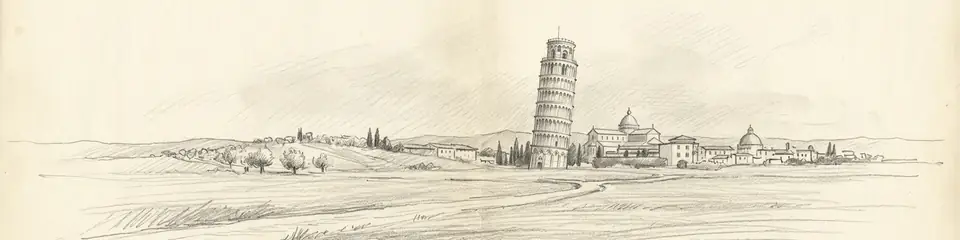
Graphite pencil sketch banner of Leaning Tower of Pisa

“The Leaning Tower is a case study in engineering failure turned icon — soft ground, interrupted construction, and modern stabilization science.”

Localização

Visão geral

The Leaning Tower of Pisa is the freestanding bell tower (campanile) of Pisa Cathedral in the Piazza del Duomo (Campo dei Miracoli), Tuscany, Italy. Construction began in 1173; by the time workers reached the third storey the tower had begun to tilt on unstable alluvial soil. Work stopped and resumed across centuries; the cylindrical structure of white marble wraps eight storeys with a spiral staircase of 294 steps.

The lean reached more than 5 degrees before 20th–21st-century stabilization injected soil and adjusted mass, reducing tilt to safer levels while preserving the signature angle tourists expect. Ghiberti and other Renaissance masters referenced Pisa's marble ensemble as a benchmark of Tuscan Romanesque.

The tower is not separate from the cathedral complex UNESCO inscribed in 1987 — it is the most photographed element. Climbing the tilted stairs remains a bucket-list ritual; the view encompasses the Arno plain and Tuscan coast.

Por que isso importa

The Leaning Tower is a case study in engineering failure turned icon — soft ground, interrupted construction, and modern stabilization science. Its search volume dwarfs many authentic Roman ruins because the lean makes it instantly legible in photographs and popular culture.

Evidências e interpretação

Distinguir o que está bem estabelecido do que permanece em debate.

Fatos bem estabelecidos

2
  • Building phases and pause/resume cycles documented in Pisan archives and fabric joints.
  • Soil extraction and counterweight engineering (1990s–2000s) measured tilt reduction geodetically.

Inferências acadêmicas

1
  • Original intended vertical height unknown due to centuries of corrective building.

Fotos da comunidade

Compartilhe sua experiência

Você visitou este sítio? Envie suas fotos para ajudar outros a descobri-lo.

Como citar esta página

Atlas Anatolia. (1173). Leaning Tower of Pisa. Atlas Anatolia. https://atlasanatolia.com/pt/site/leaning-tower-pisa

Conteúdo licenciado sob CC BY-SA 4.0 — atribuição necessária ao reutilizar.

Fontes

  • The Tower of Pisa — Pieroni, Daniele (2001)
  • UNESCO — Piazza del Duomo, PisaLink

Perguntas frequentes

Onde fica Leaning Tower of Pisa?

Leaning Tower of Pisa está localizado em Italy.

Qual é a antiguidade de Leaning Tower of Pisa?

Leaning Tower of Pisa data de aproximadamente 1173 d.C. – 1372 d.C..

Quais civilizações estão associadas a Leaning Tower of Pisa?

Leaning Tower of Pisa está associado à civilização Roman, Renaissance Italian.

Por que Leaning Tower of Pisa é importante?

The Leaning Tower is a case study in engineering failure turned icon — soft ground, interrupted construction, and modern stabilization science.

Leaning Tower of Pisa é um Patrimônio Mundial da UNESCO?

Sim — Leaning Tower of Pisa está inscrito na Lista do Patrimônio Mundial da UNESCO.