
콘텐츠로 건너뛰기
Atlas Anatolia
디그
뉴스술라웨시 빙하기 치아에서 빈랑 사용 25,000년 전까지 소급카스타모누 폼페이오폴리스 바실리카에서 로마 모자이크와 에로스 두상 발견
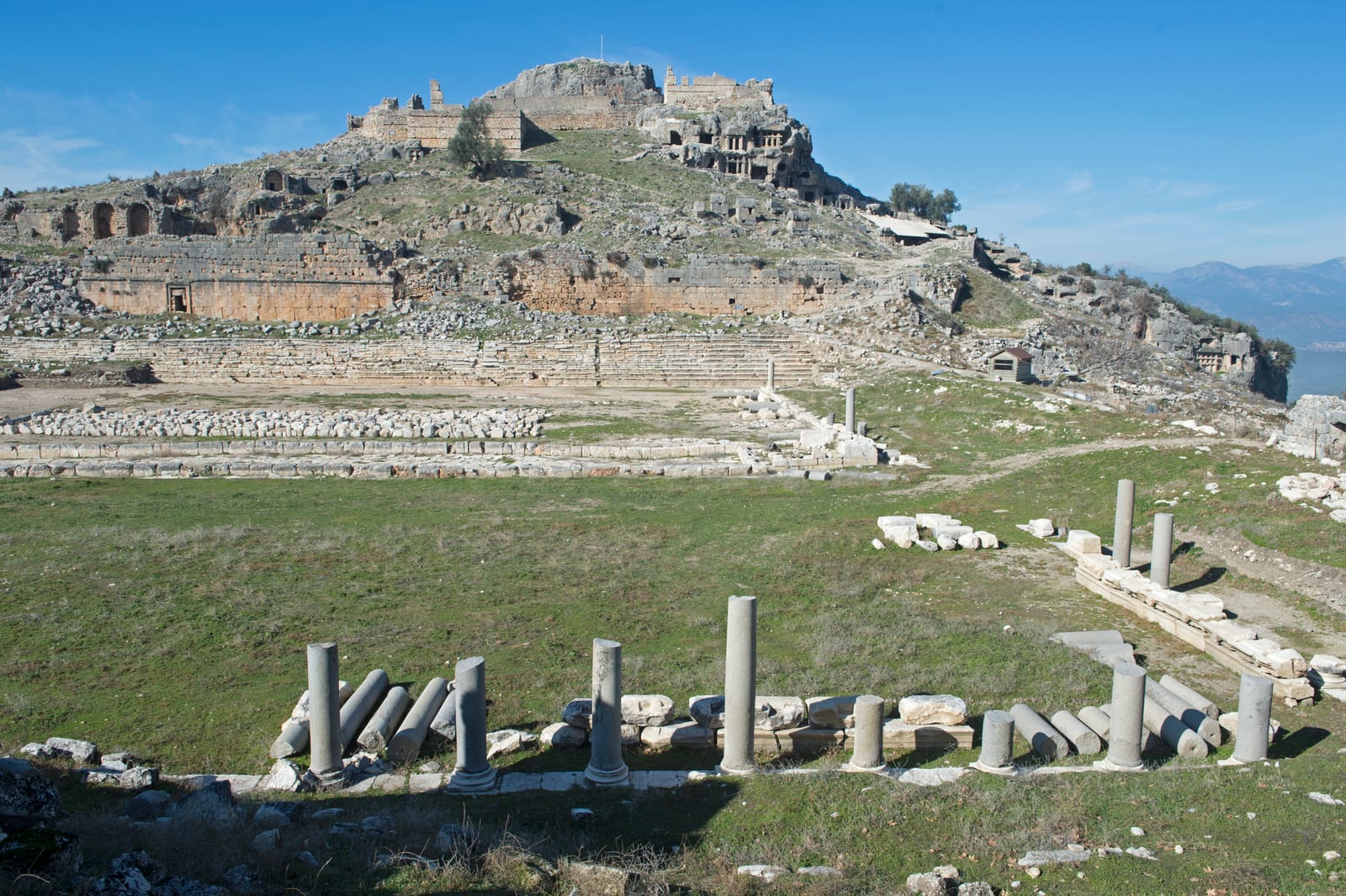
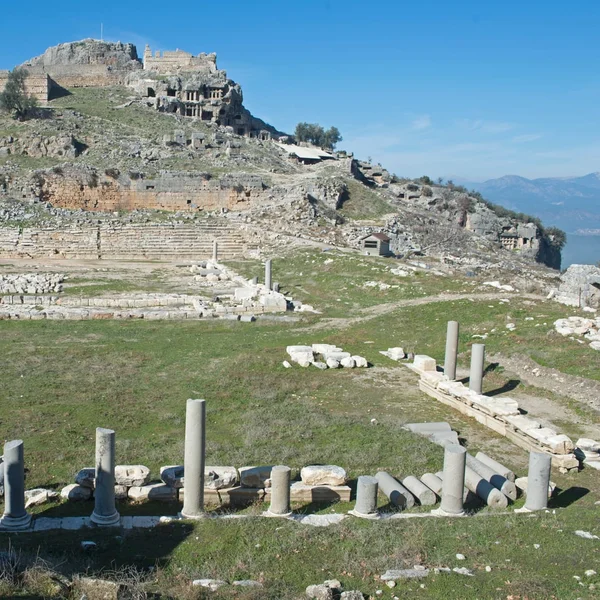
Stadium and fortress ruins at Tlos

Wikimedia Commons (CC BY-SA)

도시

Tlos

Seyfi Cem Baskin

2000 기원전 – 1400 서기

One of the oldest and most important cities of Lycia, dominated by a dramatic rocky acropolis with Lycian rock tombs, a Roman theatre, and an Ottoman fortress crowning its summit.

411
관심 45

위치

Mugla · Mediterranean · 튀르키예

36.55°N · 29.42°E · 아시아

Hittite Name

Dalawa/Tlawa (attested in Bronze Age texts)

Famous Tomb

Tomb of Bellerophon with Pegasus relief

Lycian League

One of six principal cities (3 votes)

Occupation Span

~4,000 years (Bronze Age to Ottoman)

Roman Stadium

A well-preserved stadium, built in the 2nd century CE, located at the base of the acropolis.

Byzantine Basilica

Remains of a large 5th-6th century CE three-aisled basilica with mosaic floors.

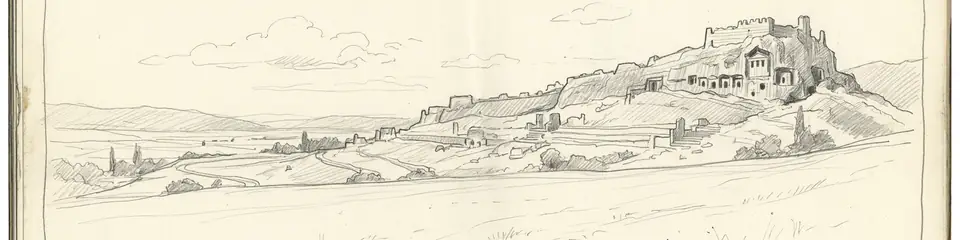
Graphite pencil sketch banner of Tlos

“Tlos demonstrates continuous human occupation from the Bronze Age through the Ottoman period — roughly four thousand years of layered habitation on a single dramatic hilltop.”

위키백과에서

Tlos is an ancient Lycian city in southwestern Turkey, one of the oldest and most important settlements in Lycia, known for its rock tombs and dramatic acropolis.

위키백과에서 전체 기사 읽기 →

위치

개요

Tlos is one of the six principal cities of the Lycian League and among the oldest continuously inhabited settlements in Lycia. Its rocky acropolis rises dramatically above the Xanthos Valley, offering commanding views of the surrounding mountains and fertile plain. The site bears witness to nearly four millennia of occupation, from Bronze Age beginnings through Ottoman times.

The acropolis cliff face is carved with elaborate Lycian rock tombs, including the celebrated Tomb of Bellerophon — decorated with a relief depicting the mythological hero riding Pegasus. Below the acropolis, a well-preserved Roman theatre with seating for 3,400 spectators faces the valley. Nearby stand the remains of Roman baths, an agora, and a colonnaded street.

"Tlos, a city of the Lycians, is situated on a lofty mountain."
— Strabo, c. 7 BCE - 23 CE

Tlos appears in Hittite records as "Dalawa" or "Tlawa," confirming its antiquity. It was among the cities that formed the Lycian League, and inscriptions attest to its status as one of Lycia's most honored members with three votes in the federal assembly.

An Ottoman fortress crowns the summit of the acropolis, built over earlier fortifications. The warlord Kanli Ali Aga made Tlos his stronghold in the 19th century, adding to the already layered archaeological landscape. The site's setting — surrounded by forested mountains with the Saklikent Gorge nearby — is among the most scenic in Lycia.
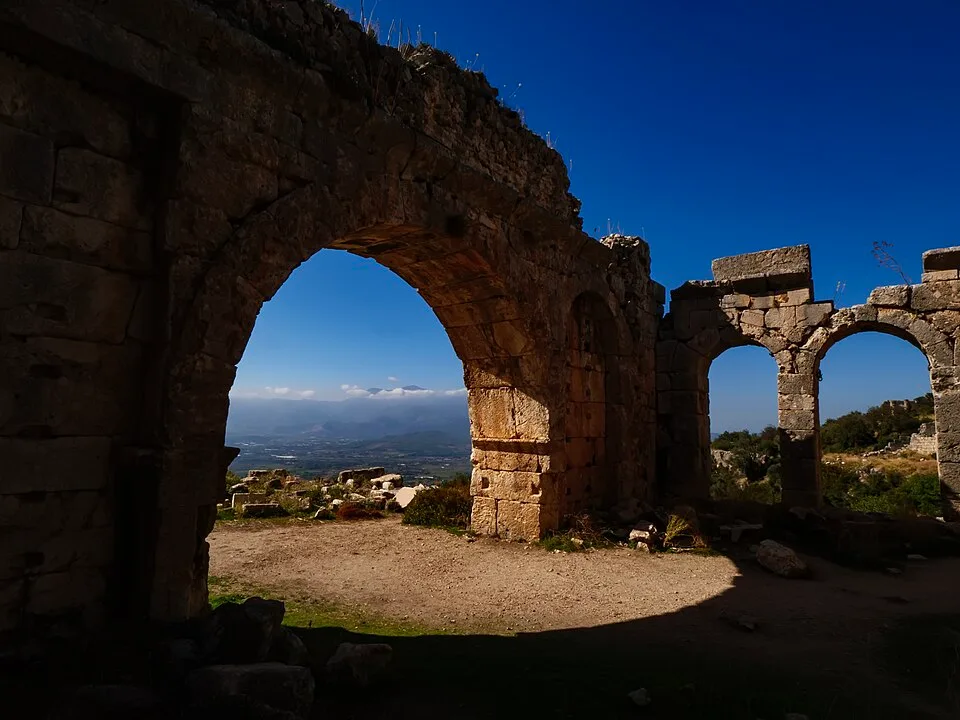
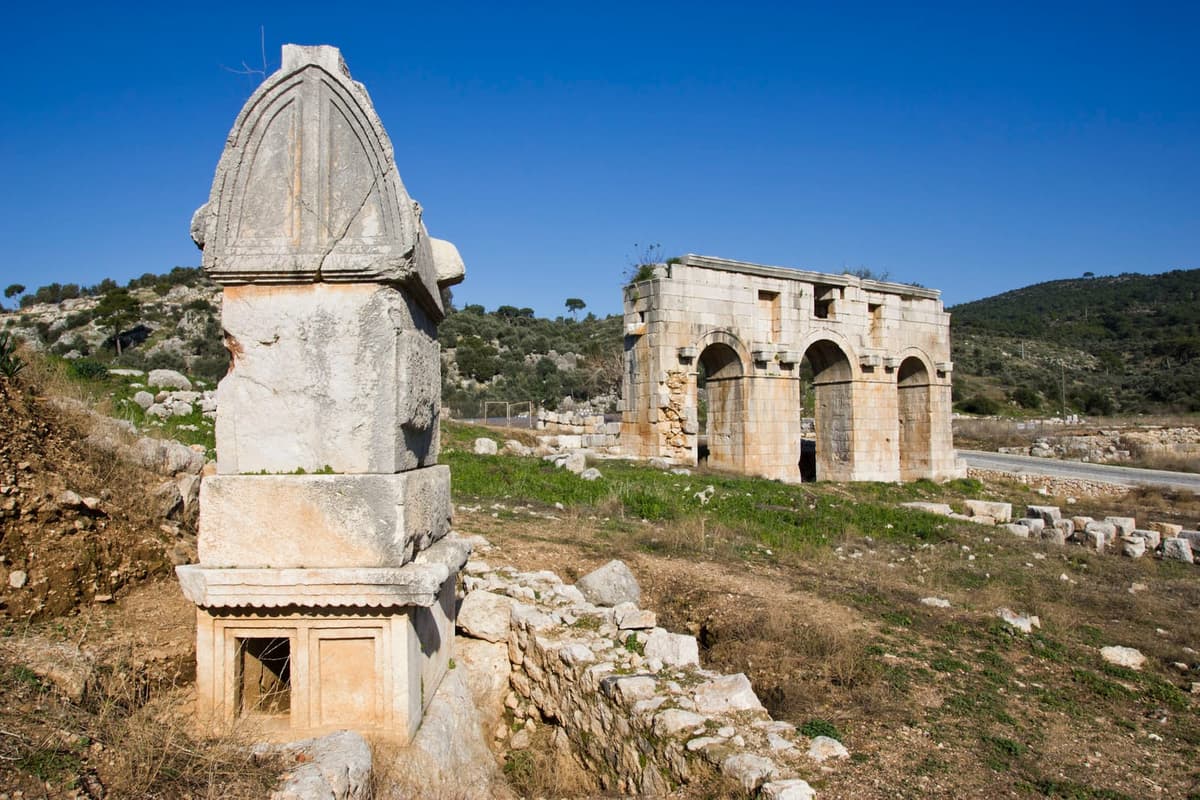
Arched ruins of the ancient city of Tlos
Arched ruins of the ancient city of Tlos | Buğra Kaan Ersoy (CC BY-SA 4.0)

Beyond the acropolis, the lower city reveals the scale of Roman Tlos. A large bath complex, with intact hypocaust systems, and a stadium capable of hosting athletic contests and spectacles, speak to its status as a major urban center. A colonnaded street likely formed the city's commercial spine. In the Byzantine era, the city's character shifted; the Roman theatre was repurposed into a fortified residential quarter, with dwellings constructed directly into the seating area, a vivid testament to changing needs and security concerns. The site's decline as a significant urban center accelerated in the later Byzantine period, though a small settlement persisted into the Ottoman era, culminating in the construction of a fortress atop the ancient acropolis, adding the final layer to this millennia-long palimpsest.
중요성

Tlos demonstrates continuous human occupation from the Bronze Age through the Ottoman period — roughly four thousand years of layered habitation on a single dramatic hilltop. Its mention in Hittite texts as Tlawa makes it one of the few Lycian cities whose ancient name can be traced back to the Late Bronze Age. The Tomb of Bellerophon connects the site to deep mythological traditions. Lycia was the homeland of Bellerophon in Greek mythology, and the presence of his image at Tlos underscores how ancient communities used mythological narratives to assert local identity and prestige.

증거와 해석

확립된 사실과 논쟁 중인 사항을 구분합니다.

잘 확립된 사실

4
  • Tlos appears as "Dalawa" in Hittite texts from the Late Bronze Age, confirming settlement before the Iron Age Lycian period.
  • The Tomb of Bellerophon features a carved relief of the mythological hero on Pegasus, one of the finest Lycian funerary reliefs extant.
  • Inscriptions confirm Tlos held three votes in the Lycian League assembly, designating it among the league's six most important cities.
  • Archaeological excavations have uncovered a Roman-era bath-gymnasium complex (palaestra) with inscriptions dating its construction to the reign of Emperor Vespasian (69-79 CE).

학술적 추론

1
  • The strategic position of the acropolis, commanding views of the Xanthos Valley, suggests the site was chosen primarily for defensive purposes in its earliest phase.

논쟁 중인 해석

1
  • Whether the "Bellerophon" relief actually depicts Bellerophon or a local Lycian dynast represented as a heroic horseman remains a point of scholarly discussion.

발견과 발굴

1838

First European survey

지휘 Charles Fellows

Charles Fellows visited and recorded the Lycian rock tombs during his survey of Lycia.

1989–2010

Turkish excavations

지휘 Havva Iskan

Havva Iskan of Akdeniz University led systematic excavations of the stadium, baths, and agora.

2005

Systematic Excavations Begin

지휘 Professor Taner Korkut (Akdeniz University)

Large-scale, systematic archaeological excavations and restoration work at Tlos were initiated under the direction of Professor Taner Korkut of Akdeniz University.

2010

Continuing research

지휘 Taner Korkut

Taner Korkut continued excavation and conservation work, focusing on the Roman-period structures.

커뮤니티 사진

당신의 경험을 공유하세요

이 유적지를 방문하셨나요? 다른 탐험가들을 위해 사진을 업로드해 보세요.

관련 이야기

이 페이지 인용 방법

Atlas Anatolia. (2000). Tlos. Atlas Anatolia. https://atlasanatolia.com/ko/site/tlos

콘텐츠는 CC BY-SA 4.0 라이선스에 따라 제공됩니다 — 재사용 시 출처 표시가 필요합니다.

그래프

관련 유적지와 스토리로의 연결.

World History Encyclopedia에서 전체 기사 읽기
World History Encyclopedia · CC BY-NC-SA

출처

  • The Lycians: A Study of Lycian History and Civilisation to the Conquest of Alexander the Great — Trevor Bryce (1986)
  • Tlos: A Lycian City in the Light of New Research — Havva Iskan (2005)
  • Wikipedia — Tlos링크

자주 묻는 질문

Tlos은(는) 어디에 위치해 있나요?

Tlos은(는) Mugla, Mediterranean, Türkiye에 위치해 있습니다.

Tlos의 연대는 언제인가요?

Tlos의 연대는 대략 2000 기원전 – 1400 서기로 거슬러 올라갑니다.

Tlos과(와) 관련된 고대 문명은 무엇인가요?

Tlos은(는) Lycian, Greek, Roman, Byzantine, Ottoman 문명과 관련이 있습니다.

Tlos이(가) 중요한 이유는 무엇인가요?

Tlos demonstrates continuous human occupation from the Bronze Age through the Ottoman period — roughly four thousand years of layered habitation on a single dramatic hilltop.

Tlos은(는) 유네스코 세계유산인가요?

Tlos은(는) 현재 유네스코 세계유산 목록에 등재되어 있지 않습니다.