
콘텐츠로 건너뛰기
Atlas Anatolia
디그
뉴스술라웨시 빙하기 치아에서 빈랑 사용 25,000년 전까지 소급카스타모누 폼페이오폴리스 바실리카에서 로마 모자이크와 에로스 두상 발견
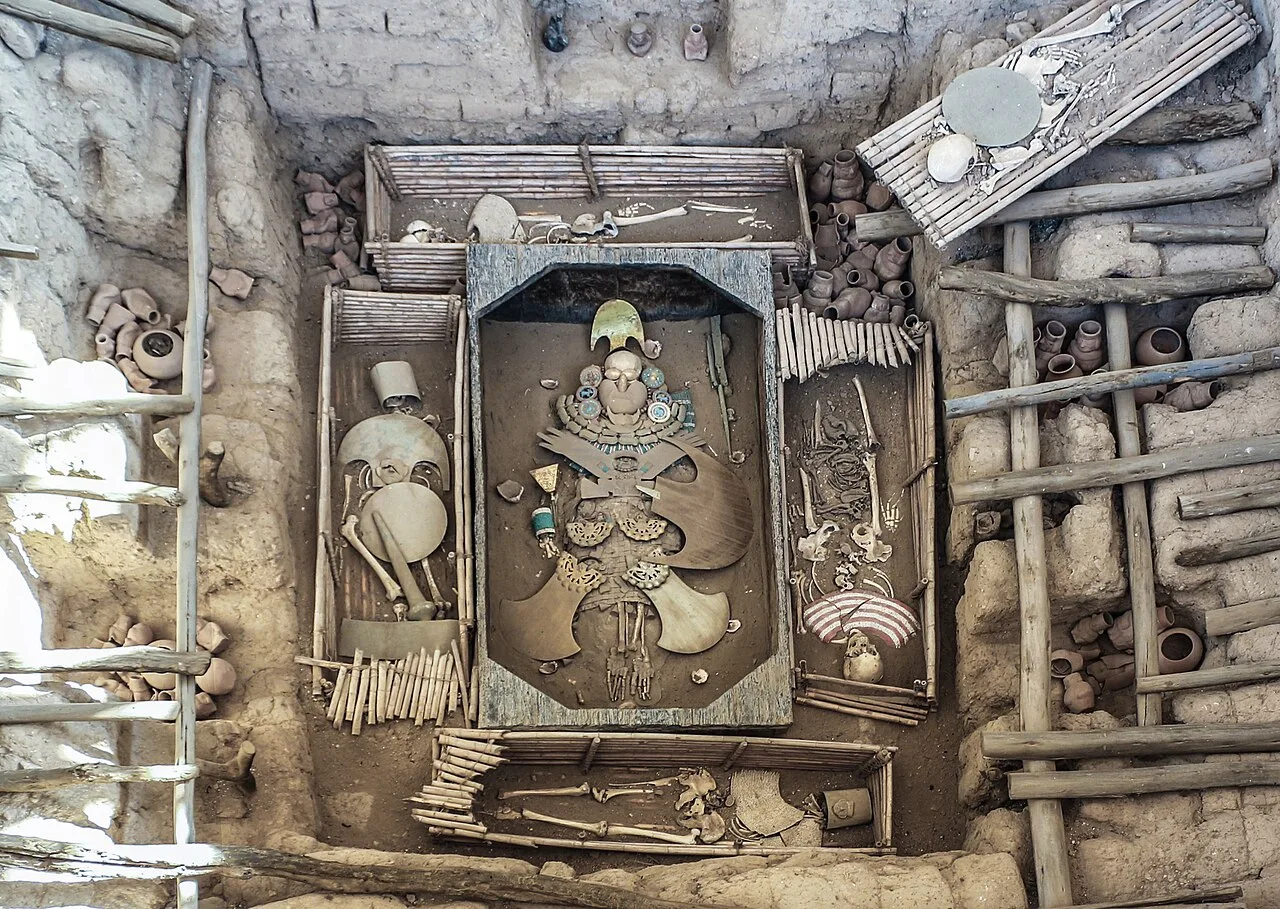
Reconstruction of the tomb of the Lord of Sipán with golden regalia, Peru

Wikimedia Commons

Country Record

Oldest Necropolis in Peru

네크로폴리스주요

Sipán

Seyfi Cem Baskin

Huaca Rajada100 서기 – 700 서기

A complex of adobe pyramids on the north coast of Peru where, in 1987, archaeologists discovered the undisturbed tomb of the Lord of Sipán — a Moche ruler buried around 250 CE with a dazzling array of gold, silver, and turquoise regalia. It is one of the richest and most important intact tombs ever excavated in the Americas.

311
관심 48

위치

페루

6.80°S · 79.60°W · 남아메리카

Culture

Moche (Mochica), north coast of Peru

Lord of Sipán burial

c. 250 CE; intact elite tomb

Discovered

1987 by Walter Alva, after looters broke in

Grave goods

Gold, silver, turquoise regalia; peanut-bead necklace, sceptre

Companions

Attendants, women, a child, and a dog buried with the Lord

Museum

Museo Tumbas Reales de Sipán, Lambayeque (opened 2002)

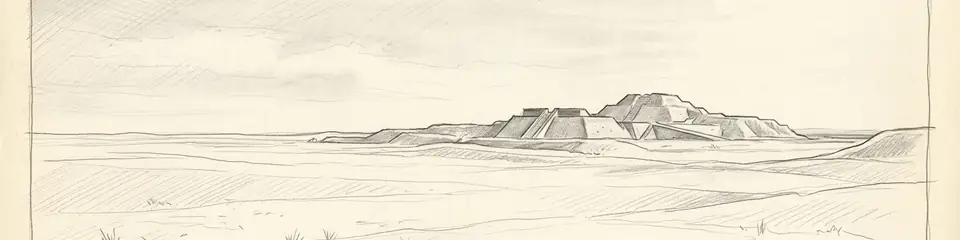
Graphite pencil sketch banner of Sipán

“The tomb of the Lord of Sipán is frequently described as the richest and most important unlooted burial ever found in the Western Hemisphere — the Americas' equivalent in significance to the discovery of Tutankhamun's tomb.”

위치

개요

Sipán, locally known as Huaca Rajada ("cracked or split mound"), lies in the Lambayeque Valley near Chiclayo on the arid north coast of Peru. The site consists of two large eroded adobe pyramids and a lower platform mound, built by the Moche (or Mochica) civilisation, which flourished along the northern Peruvian coast from roughly 100 to 700 CE. The Moche left no writing, but they were master metallurgists and produced some of the most technically and artistically accomplished ceramics and goldwork of the ancient Americas.

In early 1987, the platform mound was being plundered by looters, who broke into a rich tomb and flooded the local market with gold artefacts. Alerted by the sudden appearance of these objects, the Peruvian archaeologist Walter Alva, then director of the Brüning Museum, intervened with police and began an emergency scientific excavation. What followed was one of the most significant archaeological discoveries of the 20th century. Alva's team uncovered a series of intact elite burials, the most spectacular of which was the tomb of an adult male, around 35 to 45 years old, who became known as the Lord of Sipán (El Señor de Sipán).

The Lord of Sipán was buried in a wooden coffin around 250 CE, accompanied by a wealth of grave goods that had never been seen intact for a Moche ruler. He wore gold and silver ornaments, turquoise and gilded-copper jewellery, banners sewn with gilded plaques, and an array of headdresses, necklaces, nose ornaments, ear spools, and a gold-and-silver sceptre. Among the most famous objects is a necklace of large beads in the form of peanuts — ten of gold for the right side, ten of silver for the left. He was accompanied in death by other individuals — including women, a military attendant, a child, and a dog — and by hundreds of ceramic vessels. Nearby tombs included the "Old Lord of Sipán," an earlier and even older ruler, and a priest.

Crucially, because the tomb was excavated scientifically rather than looted, the precise position of every object was recorded, allowing the regalia to be matched to figures depicted in Moche art — particularly the central figure of the "Sacrifice Ceremony," a ritual repeatedly portrayed on Moche pottery. This made it possible to identify the Lord of Sipán not merely as a rich man but as a specific kind of priest-ruler who enacted a known religious role. The finds are displayed in the purpose-built Royal Tombs of Sipán Museum (Museo Tumbas Reales de Sipán) in Lambayeque, opened in 2002.

중요성

The tomb of the Lord of Sipán is frequently described as the richest and most important unlooted burial ever found in the Western Hemisphere — the Americas' equivalent in significance to the discovery of Tutankhamun's tomb. Because it was excavated scientifically after looters were stopped, it preserved its full context, transforming understanding of the Moche civilisation, their social hierarchy, religion, and extraordinary metallurgical skill. The ability to match the regalia buried with the Lord to the figures shown performing the "Sacrifice Ceremony" in Moche art was a breakthrough: it demonstrated that scenes long thought to be mythological depicted real rituals performed by real rulers, allowing the iconography of a non-literate civilisation to be read against its archaeology. The discovery also dramatically raised global awareness of the damage done by looting and the value of controlled excavation, and it remains a cornerstone of Andean archaeology.

증거와 해석

확립된 사실과 논쟁 중인 사항을 구분합니다.

잘 확립된 사실

3
  • The tomb of the Lord of Sipán was excavated scientifically by Walter Alva's team beginning in 1987, with the position of every object recorded in situ — a fully documented, intact elite Moche burial, exceptional in a region where most rich tombs were destroyed by looting.
  • The regalia recovered from the tomb match, in detail, the ornaments worn by the principal figure in the "Sacrifice Ceremony" depicted on Moche painted ceramics, confirming that the scene represents an actual ritual performed by elite individuals.
  • Multiple tombs at the site, including the earlier "Old Lord of Sipán" and a priest's burial, establish a sequence of elite interments and demonstrate a hierarchical Moche society with hereditary or ranked leadership.

학술적 추론

1
  • The accompanying individuals — including women and a military retainer — are interpreted as sacrificed companions or attendants buried to serve the Lord in the afterlife, inferred from their placement around the principal coffin and from comparable practices in other Andean elite burials.

논쟁 중인 해석

1
  • Precise dating and the exact political relationship between the successive lords buried at Sipán — and how Sipán related to other Moche centres along the coast — remain debated, as the Moche left no written records and chronologies rely on radiocarbon dating and ceramic seriation.

커뮤니티 사진

당신의 경험을 공유하세요

이 유적지를 방문하셨나요? 다른 탐험가들을 위해 사진을 업로드해 보세요.

이 페이지 인용 방법

Atlas Anatolia. (100). Sipán. Atlas Anatolia. https://atlasanatolia.com/ko/site/sipan

콘텐츠는 CC BY-SA 4.0 라이선스에 따라 제공됩니다 — 재사용 시 출처 표시가 필요합니다.

출처

  • Royal Tombs of Sipán — Alva, Walter; Donnan, Christopher B. (1993)
  • Discovering the New World's Richest Unlooted Tomb — Alva, Walter (1988)

자주 묻는 질문

Sipán은(는) 어디에 위치해 있나요?

Sipán은(는) Peru에 위치해 있습니다.

Sipán의 연대는 언제인가요?

Sipán의 연대는 대략 100 서기 – 700 서기로 거슬러 올라갑니다.

Sipán과(와) 관련된 고대 문명은 무엇인가요?

Sipán은(는) Moche 문명과 관련이 있습니다.

Sipán이(가) 중요한 이유는 무엇인가요?

The tomb of the Lord of Sipán is frequently described as the richest and most important unlooted burial ever found in the Western Hemisphere — the Americas' equivalent in significance to the discovery of Tutankhamun's tomb.

Sipán은(는) 유네스코 세계유산인가요?

Sipán은(는) 현재 유네스코 세계유산 목록에 등재되어 있지 않습니다.