
콘텐츠로 건너뛰기
Atlas Anatolia
디그
뉴스술라웨시 빙하기 치아에서 빈랑 사용 25,000년 전까지 소급카스타모누 폼페이오폴리스 바실리카에서 로마 모자이크와 에로스 두상 발견
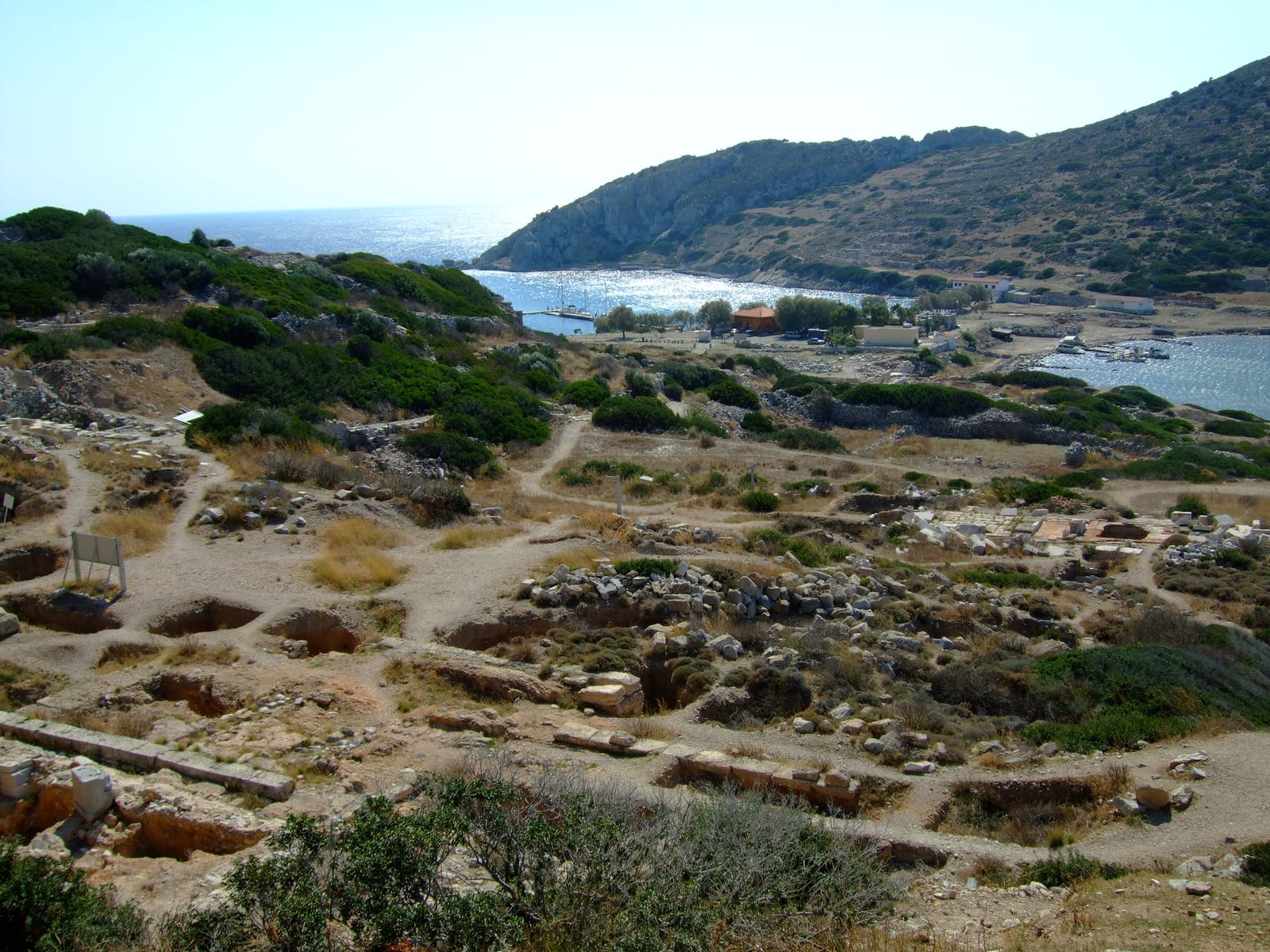
Twin harbors of Knidos at the tip of the Datça Peninsula

Wikimedia Commons

도시

Knidos

Seyfi Cem Baskin

700 기원전 – 600 서기

A famous ancient Greek city at the tip of the Datca Peninsula, renowned for the Aphrodite of Knidos — the first life-size nude female statue — its twin harbors, sundial, and contributions to mathematics and astronomy.

312
관심 50

위치

Mugla · Aegean · 튀르키예

36.69°N · 27.38°E · 아시아

Famous Statue

Aphrodite of Knidos by Praxiteles (c. 350 BCE)

Twin Harbors

Military and commercial harbors flanking an isthmus

Famous Citizens

Eudoxus (mathematician), Sostratus (architect)

Position

Tip of Datca Peninsula, where Aegean meets Mediterranean

Notable Monument

The Knidos Sundial, a monumental marble sundial from the 2nd century BCE, is one of the largest and best-preserved ancient sundials in the world.

Major Public Structure

A large, well-preserved theater built into the hillside, with a capacity for approximately 5,000 spectators, dating primarily to the Hellenistic period.

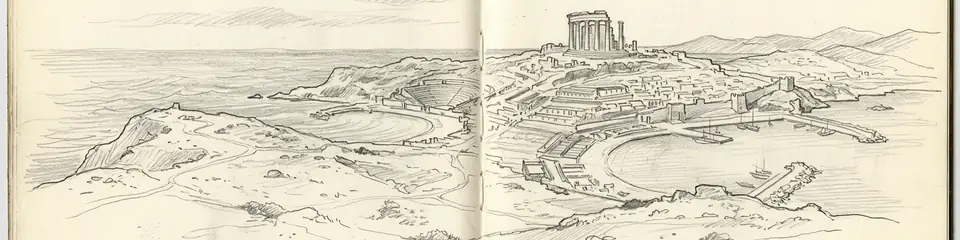
Graphite pencil sketch banner of Knidos

“The Aphrodite of Knidos was a watershed moment in the history of art — the first time the female nude was presented as a monumental subject, establishing a tradition that would dominate Western art for millennia.”

위키백과에서

Knidos was a famous ancient Greek city at the tip of the Datca Peninsula, renowned for the Aphrodite of Knidos by Praxiteles and its twin harbors.

위키백과에서 전체 기사 읽기 →

위치

개요

Knidos occupies a spectacular position at the very tip of the Datca (Resadiye) Peninsula, where the Aegean and Mediterranean seas meet. The city's twin harbors — one military, one commercial — flank a narrow isthmus connecting the mainland to a small island (now a peninsula), creating one of the most distinctive ancient city plans in the Mediterranean.

Knidos was one of the six cities of the Dorian Hexapolis and achieved lasting fame through the Aphrodite of Knidos, sculpted by Praxiteles around 350 BCE. This was the first monumental nude female statue in Greek art history, and it became one of the most celebrated works of antiquity. Pilgrims traveled from across the Mediterranean to view it, and numerous ancient copies attest to its fame. The original has never been found.

"Knidos is a city of the Dorians, built partly on the mainland and partly on an island. It has two harbors."
— Strabo, c. 7 BCE - 23 CE

Beyond the Aphrodite, Knidos was home to Eudoxus, the mathematician and astronomer who developed the theory of proportion and proposed a model of concentric spheres to explain planetary motion. Sostratus of Knidos is traditionally credited with building the Lighthouse of Alexandria, one of the Seven Wonders. The city also possessed a famous sundial and a medical school associated with the Hippocratic tradition.

The ruins spread across terraced hillsides overlooking both harbors, including a large theatre, two smaller theatres, temples (including the round temple that housed the Aphrodite), an agora, stoas, and a well-preserved Corinthian temple. The dramatic seaside setting, accessible primarily by boat or a long drive down the Datca Peninsula, has preserved the site from overdevelopment.
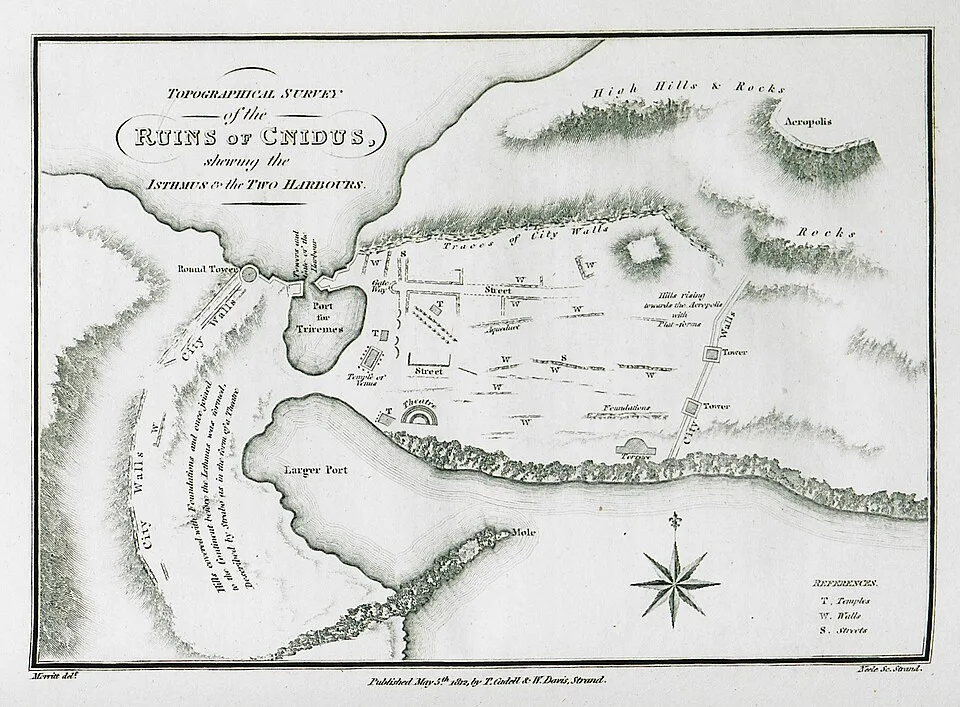
Topographic survey of the ruins of Cnidus showing the isthmus and the two harbours - Clarke Edward Daniel - 1824
Topographic survey of the ruins of Cnidus showing the isthmus and the two harbours - Clarke Edward Daniel - 1824 | Edward Daniel Clarke (Public domain)

중요성

The Aphrodite of Knidos was a watershed moment in the history of art — the first time the female nude was presented as a monumental subject, establishing a tradition that would dominate Western art for millennia. Knidos's contributions through Eudoxus and Sostratus place it among the most intellectually productive cities of the ancient world. The city's twin-harbor plan represents an engineering achievement in ancient urban design, and its position at the meeting point of two seas gave it strategic and symbolic significance. Knidos connects art history, mathematics, astronomy, and maritime architecture in a single site.

증거와 해석

확립된 사실과 논쟁 중인 사항을 구분합니다.

잘 확립된 사실

3
  • Pliny the Elder (Natural History 36.20-21) provides a detailed account of the Aphrodite of Knidos by Praxiteles, describing it as the finest statue in the world.
  • The round temple on the upper terrace matches ancient descriptions of the building that housed the Aphrodite, designed to allow viewing from all sides.
  • Diogenes Laertius records that Eudoxus of Knidos developed the mathematical theory of proportion and proposed a model of concentric celestial spheres.

학술적 추론

1
  • The twin harbor system was likely created by connecting the island to the mainland with an artificial isthmus, based on underwater survey evidence.

논쟁 중인 해석

2
  • Whether the original Aphrodite of Knidos survives in any form, or whether any ancient copy faithfully reproduces it, remains debated among art historians.
  • Iris Love's identification of a marble head found near the round temple as belonging to the original Aphrodite has not been accepted by most scholars.

발견과 발굴

1857

Charles Newton excavations

지휘 Charles Newton

British Museum expedition under Newton excavated the site, discovering the Lion of Knidos and temple remains.

1967–1977

Iris Love excavations

지휘 Iris Love

Iris Love led excavations of the round temple believed to have housed the Aphrodite of Knidos, generating worldwide media attention.

1990–2010

Turkish-American excavations

Long-running excavations uncovering the agora, residential quarters, harbor installations, and Corinthian temple.

2014

Ongoing Turkish excavations

Continued excavations focusing on the harbor structures and underwater survey of the submerged portions of the ancient harbors.

커뮤니티 사진

당신의 경험을 공유하세요

이 유적지를 방문하셨나요? 다른 탐험가들을 위해 사진을 업로드해 보세요.

이 페이지 인용 방법

Atlas Anatolia. (700). Knidos. Atlas Anatolia. https://atlasanatolia.com/ko/site/knidos

콘텐츠는 CC BY-SA 4.0 라이선스에 따라 제공됩니다 — 재사용 시 출처 표시가 필요합니다.

World History Encyclopedia에서 전체 기사 읽기
World History Encyclopedia · CC BY-NC-SA

출처

  • The Aphrodite of Knidos and Her Successors — Christine Mitchell Havelock (1995)
  • Excavations at Cnidus — Iris C. Love (1970)
  • Wikipedia — Knidos링크

자주 묻는 질문

Knidos은(는) 어디에 위치해 있나요?

Knidos은(는) Mugla, Aegean, Türkiye에 위치해 있습니다.

Knidos의 연대는 언제인가요?

Knidos의 연대는 대략 700 기원전 – 600 서기로 거슬러 올라갑니다.

Knidos과(와) 관련된 고대 문명은 무엇인가요?

Knidos은(는) Greek, Roman, Byzantine 문명과 관련이 있습니다.

Knidos이(가) 중요한 이유는 무엇인가요?

The Aphrodite of Knidos was a watershed moment in the history of art — the first time the female nude was presented as a monumental subject, establishing a tradition that would dominate Western art for millennia.

Knidos은(는) 유네스코 세계유산인가요?

Knidos은(는) 현재 유네스코 세계유산 목록에 등재되어 있지 않습니다.