
콘텐츠로 건너뛰기
Atlas Anatolia
디그
뉴스술라웨시 빙하기 치아에서 빈랑 사용 25,000년 전까지 소급카스타모누 폼페이오폴리스 바실리카에서 로마 모자이크와 에로스 두상 발견
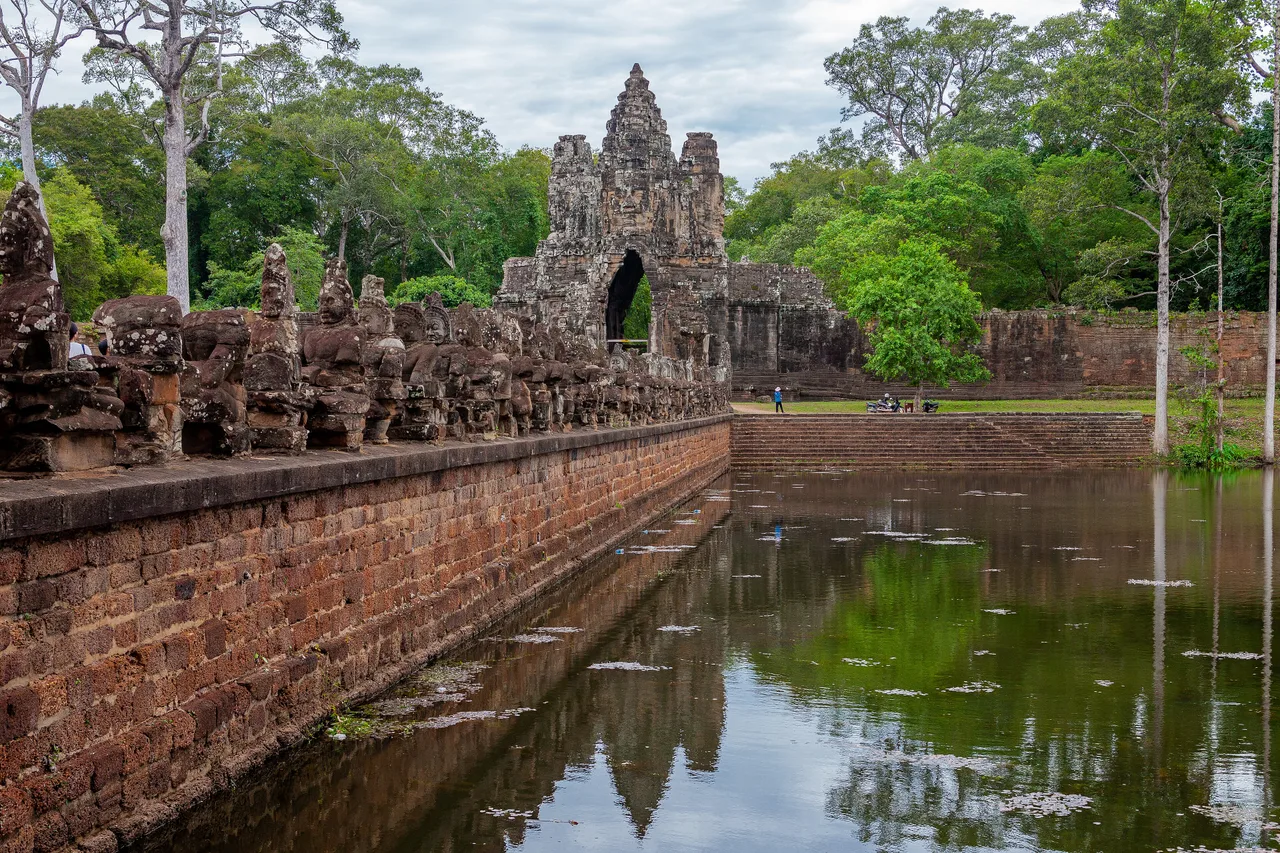
Giant carved stone faces on the towers of the Bayon Temple at the centre of Angkor Thom, Cambodia

Wikimedia Commons

Country Record

Longest Continuously Occupied Site in Cambodia

도시유네스코주요

Angkor Thom

Seyfi Cem Baskin

អង្គរធំ1181 서기 – 1431 서기

The last great walled capital of the Khmer Empire, built by King Jayavarman VII at the end of the 12th century CE as the centrepiece of a massive Buddhist building programme following decades of warfare. At its heart stands the Bayon Temple, its 54 towers carved with 216 enormous, serenely smiling stone faces — among the most instantly recognisable images in world archaeology — surrounded by the Terrace of the Elephants, the Terrace of the Leper King, and the royal palace precinct of Phimeanakas.

32
관심 66

위치

Siem Reap · Angkor · 캄보디아

13.44°N · 103.86°E · 아시아

Founded

c. 1181 CE by King Jayavarman VII, following the 1177 Cham sack of Angkor

Walls

Nearly perfect 3 km square, laterite walls up to 8 m high plus moat

Bayon Temple

54 towers, 216 carved stone faces widely identified with Avalokiteshvara / Jayavarman VII

Reliefs

Extensive carvings of everyday Khmer life and naval battles against the Cham

Decline

Major sack by Ayutthaya Kingdom in 1431 marks the end of Angkor as Khmer capital

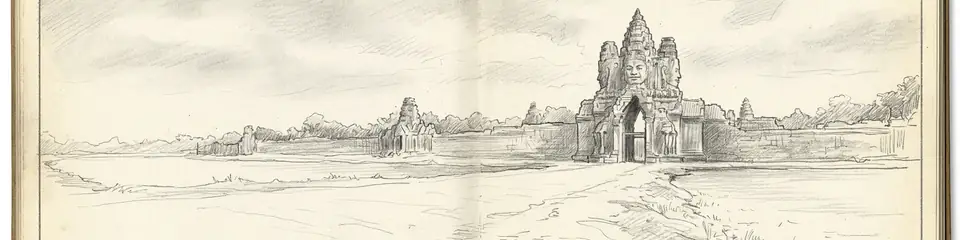
Graphite pencil sketch banner of Angkor Thom

“Angkor Thom represents one of history's most dramatic examples of an entire royal capital being rebuilt from the ground up as a coherent expression of a single ruler's religious and political vision.”

위치

개요

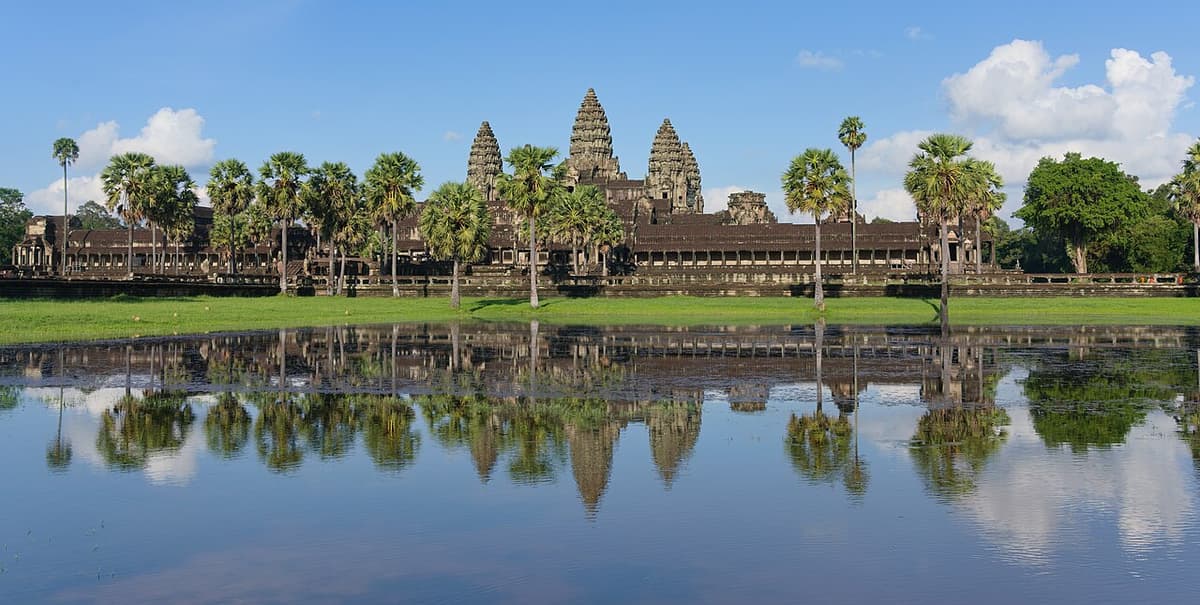
Angkor Thom ("Great City") lies immediately north of the earlier and more famous Angkor Wat within Cambodia's vast Angkor Archaeological Park, but the two monuments are architecturally, religiously, and chronologically distinct. Angkor Wat, built roughly fifty years earlier under King Suryavarman II, was conceived as a Hindu temple dedicated to Vishnu (later adapted to Buddhist use). Angkor Thom, by contrast, was built as a fortified royal capital city — the last and largest of several successive Khmer capitals at Angkor — explicitly as an expression of King Jayavarman VII's Mahayana Buddhist devotion following a turbulent period in which the Khmer capital had been sacked by the rival Cham kingdom in 1177.

Jayavarman VII, who seized the throne around 1181 after driving out the Cham occupiers, responded with an extraordinary programme of monumental construction. Angkor Thom was laid out as a nearly perfect three-kilometre square, enclosed by laterite walls up to eight metres high and a wide moat, with five monumental gates — one for each cardinal direction plus an additional Victory Gate — each surmounted by four giant stone faces facing the cardinal points, echoing the design of the city's central temple.

That central temple, the Bayon, is Angkor Thom's defining monument. Fifty-four towers, arranged across the temple's upper terraces, are each carved with four enormous serene faces — 216 in total — widely interpreted by scholars as representing the bodhisattva of compassion, Avalokiteshvara, though many also see in their features an idealised portrait of Jayavarman VII himself, blending royal and divine identity in a manner consistent with Khmer god-king (devaraja) tradition. The temple's outer galleries are covered with extensive relief carvings depicting not only mythological and religious scenes but unusually detailed images of everyday Khmer life and historical military campaigns, including vivid depictions of naval battles against the Cham fleet — a rare and valuable visual record of 12th-century Southeast Asian daily life rather than purely religious iconography.

Surrounding the Bayon, Angkor Thom preserves an extensive royal and ceremonial precinct. The Terrace of the Elephants, a 300-metre reviewing platform decorated with carved elephant reliefs, served as a base for royal audiences and public ceremonies. The adjacent Terrace of the Leper King takes its name from a moss-covered statue once thought to depict a king afflicted with leprosy, though it more likely represents Yama, the Hindu-Buddhist god of death and judgment. Phimeanakas, an earlier 10th-century step-pyramid temple predating Jayavarman VII's reign, sits within the former royal palace compound, incorporated into the later city.

Angkor Thom remained the functioning capital of the Khmer Empire for roughly two and a half centuries after its construction, through periods of continued prosperity and gradual decline, until the broader Angkor region was largely abandoned as a political capital following repeated conflict with the Ayutthaya Kingdom, most significantly a major sacking in 1431 that is conventionally, if not entirely precisely, treated as marking the end of Angkor's role as the Khmer imperial centre. Angkor Thom is included within the Angkor Archaeological Park, inscribed as a UNESCO World Heritage Site in 1992.
중요성

Angkor Thom represents one of history's most dramatic examples of an entire royal capital being rebuilt from the ground up as a coherent expression of a single ruler's religious and political vision. Jayavarman VII's decision to reconstruct the Khmer capital as an explicitly Buddhist city, complete with a temple whose towers merge his own likeness with that of a bodhisattva, is a striking case study in how monumental architecture can be deployed to fuse religious devotion with the legitimisation of royal authority. The Bayon's relief carvings of ordinary daily life — markets, cockfights, childbirth, food preparation — alongside its famous naval battle scenes, make it one of the richest surviving visual sources for everyday social history anywhere in the pre-modern world, offering historians a level of detail about non-elite Khmer life that religious or royal inscriptions alone could never provide. As the last great capital of the Khmer Empire before Angkor's political eclipse, Angkor Thom also marks a hinge point in mainland Southeast Asian history — its eventual abandonment as a political centre, following pressure from the rising Ayutthaya Kingdom, closes the chapter of Angkor-centred Khmer imperial power even as the wider Angkor region continued to hold deep religious significance for the Khmer people into the present day.

증거와 해석

확립된 사실과 논쟁 중인 사항을 구분합니다.

잘 확립된 사실

3
  • Inscriptions and architectural style securely date Angkor Thom's construction to the reign of Jayavarman VII, beginning around 1181 CE following his defeat of the occupying Cham forces recorded in contemporary Khmer inscriptions.
  • Bas-relief carvings on the Bayon's outer gallery depict a documented naval battle between Khmer and Cham forces, corroborated by the broader historical record of Cham-Khmer conflict in this period.
  • Historical records, including the account of Chinese diplomatic envoy Zhou Daguan who resided in Angkor Thom around 1296–1297 CE, provide a detailed contemporary eyewitness description of the functioning city, its population, and court life.

논쟁 중인 해석

2
  • Whether the 216 faces on the Bayon's towers represent the bodhisattva Avalokiteshvara, King Jayavarman VII himself, or a deliberate fusion of both identities remains a matter of art-historical interpretation rather than settled fact.
  • The statue on the Terrace of the Leper King was long popularly identified as a diseased Khmer king, but is now more widely, though not universally, interpreted by scholars as a depiction of Yama, the god of death and judgment.

발견과 발굴

1907

École française d'Extrême-Orient conservation programme

Beginning of sustained French-led documentation, conservation, and restoration work across the Angkor Thom complex, continuing in various forms to the present.

1993

Post-war international restoration

Renewed and expanded international conservation effort under UNESCO coordination following Cambodia's civil conflict, involving teams from multiple countries.

커뮤니티 사진

당신의 경험을 공유하세요

이 유적지를 방문하셨나요? 다른 탐험가들을 위해 사진을 업로드해 보세요.

관련 이야기

이 페이지 인용 방법

Atlas Anatolia. (1181). Angkor Thom. Atlas Anatolia. https://atlasanatolia.com/ko/site/angkor-thom

콘텐츠는 CC BY-SA 4.0 라이선스에 따라 제공됩니다 — 재사용 시 출처 표시가 필요합니다.

그래프

관련 유적지와 스토리로의 연결.

출처

  • A Record of Cambodia: The Land and Its People — Zhou Daguan (trans. Peter Harris) (2007)
  • The Khmer Empire: Cities and Sanctuaries, Fifth to Thirteenth Centuries — Jacques, Claude and Lafond, Philippe (2007)
  • UNESCO — Angkor링크

자주 묻는 질문

Angkor Thom은(는) 어디에 위치해 있나요?

Angkor Thom은(는) Siem Reap, Angkor, Cambodia에 위치해 있습니다.

Angkor Thom의 연대는 언제인가요?

Angkor Thom의 연대는 대략 1181 서기 – 1431 서기로 거슬러 올라갑니다.

Angkor Thom과(와) 관련된 고대 문명은 무엇인가요?

Angkor Thom은(는) Khmer 문명과 관련이 있습니다.

Angkor Thom이(가) 중요한 이유는 무엇인가요?

Angkor Thom represents one of history's most dramatic examples of an entire royal capital being rebuilt from the ground up as a coherent expression of a single ruler's religious and political vision.

Angkor Thom은(는) 유네스코 세계유산인가요?

예 — Angkor Thom은(는) 유네스코 세계유산으로 등재되어 있습니다.