

Vai al contenuto
Atlas Anatolia
NotizieIce Age teeth in Sulawesi push betel-nut use back as far as 25,000 yearsRoman mosaic and Eros head uncovered in the basilica at Pompeiopolis, Kastamonu
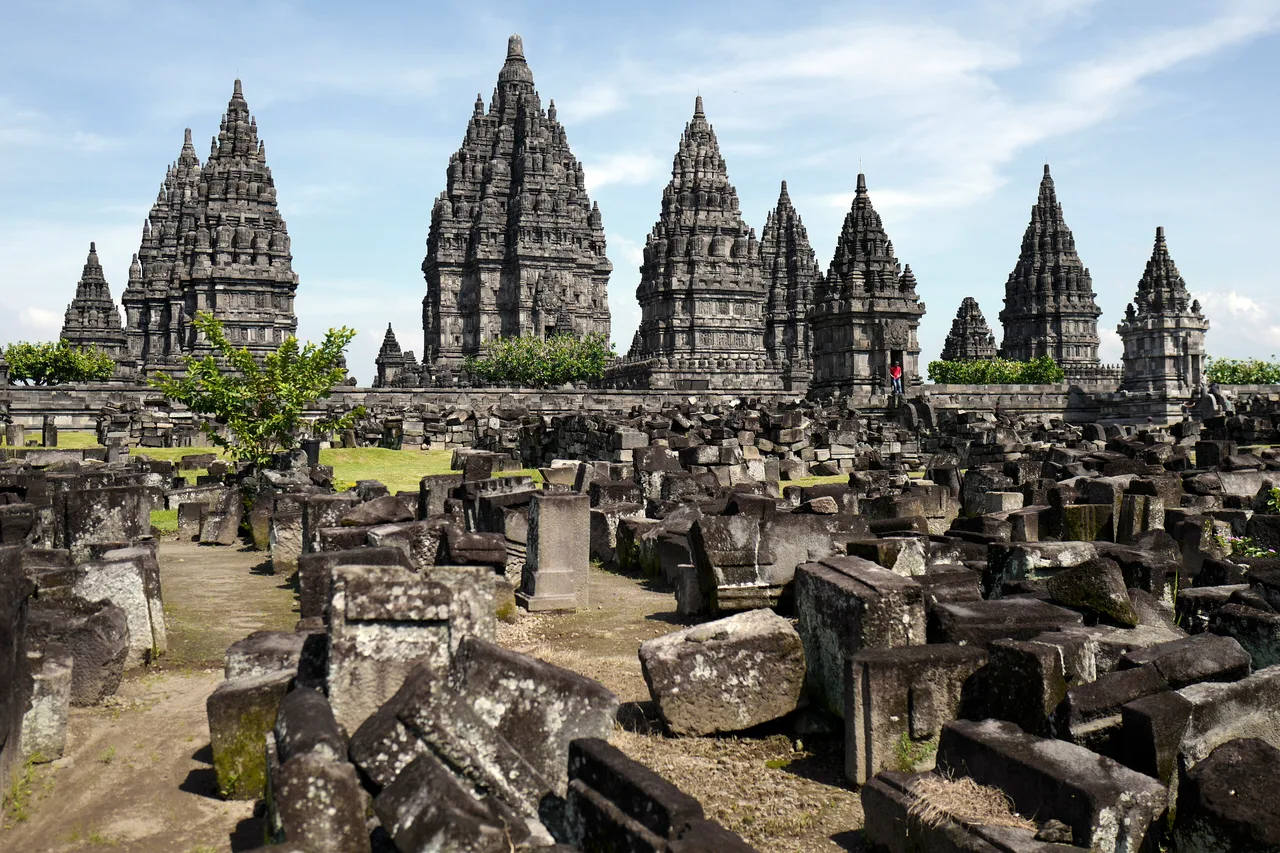
The three main towers of Prambanan at sunset, Java

Wikimedia Commons

Record continentale

Southernmost Known Site in Asia

TempioUNESCOIn evidenza

Prambanan

Seyfi Cem Baskin

Candi Prambanan850 d.C. – 930 d.C.

The largest Hindu temple complex in Southeast Asia, built on Java c. 850 CE, comprising 240 temples centered on three towers rising 47 m dedicated to Brahma, Vishnu, and Shiva.

21
Interesse 77

Posizione

Indonesia

7.75°S · 110.49°E · Asia

Central tower height

47 m (Shiva temple)

Total temples (original)

240

Construction date

c. 850 CE

Relief panel length (total)

~2 km of continuous narrative

Nearest active volcano

Mount Merapi, 28 km north

UNESCO

World Heritage Site since 1991

Graphite pencil sketch banner of Prambanan

Prambanan represents the peak of classical Javanese Hindu art and architecture.”

Posizione

Panoramica

Prambanan stands on the border of Central Java and Yogyakarta, 17 km northeast of Yogyakarta city, in the valley between Merapi volcano and the Indian Ocean. The complex was built during the Sanjaya dynasty of the Mataram kingdom, with the main temples constructed around 850 CE under King Rakai Pikatan or his successor. The complex originally comprised 240 individual temples arranged in three concentric squares around a central courtyard. The three principal towers (perwara) in the inner zone rise 47 m above the Prambanan Plain: the central Shiva temple, the Vishnu temple to its north, and the Brahma temple to its south. The towers are clad in bas-relief panels narrating the Ramayana (on the Shiva and Brahma temples) and the Krishnayana (on the Vishnu temple) — among the most extensive stone narrative cycles in the world. Prambanan was probably damaged by a major earthquake shortly after its construction and was abandoned following the shift of the Mataram kingdom's political center to East Java around 930 CE. The complex was largely forgotten, further damaged by a 1549 earthquake, and rediscovered by the Dutch colonialist C.A. Lons in 1733. Systematic restoration began in the 1930s and continues; the 2006 Yogyakarta earthquake (6.3 Mw) caused significant new damage.

Perché è importante

Prambanan represents the peak of classical Javanese Hindu art and architecture. Its 47-meter towers are among the tallest ancient religious structures in Southeast Asia. The 1,224 bas-relief panels on the outer walls of the main temples constitute an uninterrupted narrative stone frieze of the Ramayana and Krishnayana more than 2 km in total length — among the most comprehensive visual tellings of these epics anywhere. The complex's design principles — the central mountain-symbol of the cosmic Mount Meru surrounded by attendant shrines — influenced Hindu and Buddhist temple architecture across Java, Bali, and mainland Southeast Asia. The co-existence of Prambanan and the Buddhist Borobudur (built just 40 km away, 50 years earlier, by a different ruling house) testifies to the unusual religious pluralism of early Java.

Evidenze e interpretazione

Distinguere ciò che è ben consolidato da ciò che rimane dibattuto.

Fatti ben consolidati

2
  • The Shivagrha inscription (856 CE) records the construction of a Shiva temple — almost certainly Prambanan — by the Sanjaya king Rakai Pikatan, establishing a firm date for the complex's foundation.
  • The Ramayana bas-reliefs on the balustrades of the Shiva and Brahma temples constitute one of the world's most extensive stone narrative sequences of the epic, carved in a continuous strip more than 100 m long per temple.

Deduzioni accademiche

1
  • The complex was probably damaged by a large earthquake shortly after construction and may have been structurally compromised before its formal abandonment c. 930 CE following the eastward shift of the Mataram court.

Foto della comunità

Condividi la tua esperienza

Hai visitato questo sito? Carica le tue foto per aiutare gli altri a scoprirlo.

Come citare questa pagina

Atlas Anatolia. (850). Prambanan. Atlas Anatolia. https://atlasanatolia.com/it/site/prambanan

Contenuto con licenza CC BY-SA 4.0 — è richiesta l'attribuzione in caso di riutilizzo.

Fonti

  • Prambanan: Its Architecture, History and Cultural SignificanceHariani Santiko (1995)
  • UNESCO World Heritage — Prambanan Temple CompoundsCollegamento

Domande frequenti

Dove si trova Prambanan?

Prambanan si trova in Indonesia.

A quando risale Prambanan?

Prambanan risale all'incirca al 850 d.C. – 930 d.C..

Quali civiltà sono associate a Prambanan?

Prambanan è associato alla civiltà Majapahit.

Perché Prambanan è importante?

Prambanan represents the peak of classical Javanese Hindu art and architecture.

Prambanan è un sito Patrimonio Mondiale dell'UNESCO?

Sì — Prambanan è iscritto nella lista del Patrimonio Mondiale dell'UNESCO.