
Aller au contenu
Atlas Anatolia
ActualitésIce Age teeth in Sulawesi push betel-nut use back as far as 25,000 yearsRoman mosaic and Eros head uncovered in the basilica at Pompeiopolis, Kastamonu
Aerial view of the Winter Palace green facade on the Neva River, St Petersburg

Wikimedia Commons (CC BY)

PatrimoineComplexeUNESCOEn vedette

Winter Palace

Seyfi Cem Baskin

Зимний дворец1754 apr. J.-C. – 1917 apr. J.-C.

The green-and-white Baroque palace on Palace Embankment in St Petersburg — seat of the Romanov tsars from 1762 and core of the State Hermitage Museum — ranks second among missing sites in our multilingual pageview audit and defines Russian imperial spectacle.

21
Intérêt 76

Localisation

Russie

59.94°N · 30.31°E · Europe

Built

1754–1762 under Empress Elizabeth (Rastrelli)

Hermitage

Catherine II began collection 1764; museum from 1852

1917

Stormed 25 October — Bolshevik revolution icon

UNESCO

Historic Centre of Saint Petersburg (1990)

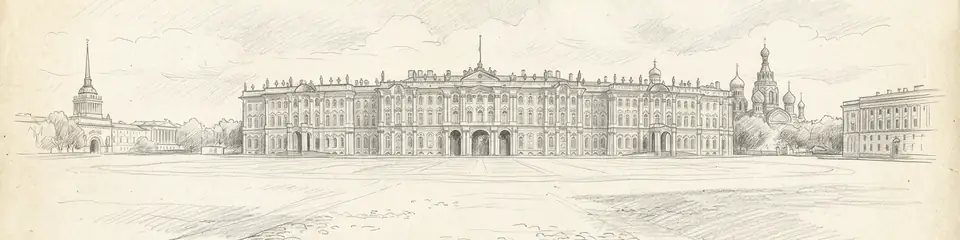
Graphite pencil sketch banner of Winter Palace

“The Winter Palace is where Romanov court ritual met global art collecting — architecture, monarchy, and museum in one Neva frontage.”

Localisation

Aperçu

The Winter Palace stands on the Neva River embankment in central St Petersburg, Russia. Peter the Great founded the city in 1703; after intermediate palaces, Empress Elizabeth commissioned Bartolomeo Rastrelli's Baroque masterpiece (1754–1762), a facade nearly a kilometre long with hundreds of rooms, gilded state apartments, and the Jordan Staircase where courtiers greeted the tsar on feast days.

Catherine the Great added the Small Hermitage (1764) to house her art collection — the nucleus of what became the State Hermitage Museum, one of the world's largest museums. Nicholas I rebuilt interiors after the 1837 fire. The palace witnessed the 1905 Bloody Sunday massacre on Palace Square and the Bolshevik storming of 25 October 1917 that toppled the Provisional Government.

The Romanovs abandoned it for the Alexander Palace after 1905, but the building remained the revolution's symbolic target. Today the state rooms and Hermitage galleries display imperial decor alongside Egyptian, Renaissance, and modern collections. UNESCO listed the "Historic Centre of Saint Petersburg" in 1990. Pair with Palace of Versailles for contrasting Baroque absolutist residences.

Pourquoi c'est important

The Winter Palace is where Romanov court ritual met global art collecting — architecture, monarchy, and museum in one Neva frontage. Its 1917 storming makes it the built icon of the Russian Revolution, driving search interest that links imperial luxury to modern political rupture.

Preuves et interprétation

Distinguer ce qui est bien établi de ce qui reste débattu.

Faits bien établis

2
  • Architectural plans, court records, and post-1837 fire rebuild documents date Baroque phases.
  • Photographs and Bolshevik accounts record the 1917 assault on the palace.

Inférences savantes

1
  • Elizabeth and Catherine used scale and art patronage to legitimise Romanov rule on a newly built capital.

Photos de la communauté

Partagez votre expérience

Avez-vous visité ce site ? Téléchargez vos photos pour aider les autres à le découvrir.

Comment citer cette page

Atlas Anatolia. (1754). Winter Palace. Atlas Anatolia. https://atlasanatolia.com/fr/site/winter-palace

Contenu sous licence CC BY-SA 4.0 — attribution requise en cas de réutilisation.

Sources

  • A People's Tragedy: The Russian Revolution — Orlando Figes (1996)
  • State Hermitage MuseumLien

Questions fréquentes

Où se trouve Winter Palace ?

Winter Palace est situé à/en Russia.

De quand date Winter Palace ?

Winter Palace remonte approximativement à 1754 apr. J.-C. – 1917 apr. J.-C..

Quelles civilisations sont associées à Winter Palace ?

Winter Palace est associé à la civilisation Romanov.

Pourquoi Winter Palace est-il important ?

The Winter Palace is where Romanov court ritual met global art collecting — architecture, monarchy, and museum in one Neva frontage.

Winter Palace est-il inscrit au patrimoine mondial de l'UNESCO ?

Oui — Winter Palace est inscrit sur la liste du patrimoine mondial de l'UNESCO.