
Aller au contenu
Atlas Anatolia
ActualitésIce Age teeth in Sulawesi push betel-nut use back as far as 25,000 yearsRoman mosaic and Eros head uncovered in the basilica at Pompeiopolis, Kastamonu
Colourful onion domes of St. Basil’s Cathedral on Red Square, Moscow

Wikimedia Commons (CC BY-SA 3.0)

PatrimoineTempleUNESCOEn vedette

St. Basil's Cathedral

Seyfi Cem Baskin

Собор Василия Блаженного1555 apr. J.-C. – 1561 apr. J.-C.

Ivan the Terrible’s firework of onion domes on Red Square — nine chapels fused into one church after the conquest of Kazan — is among the most recognised skylines in Eurasia and a top monument gap in our pageview rankings.

21
Intérêt 83

Localisation

Russie

55.75°N · 37.62°E · Europe

Built

1555–61 for Ivan IV after Kazan

Plan

Nine chapels around Intercession church

UNESCO

Kremlin and Red Square (1990)

Use

Museum (occasional services)

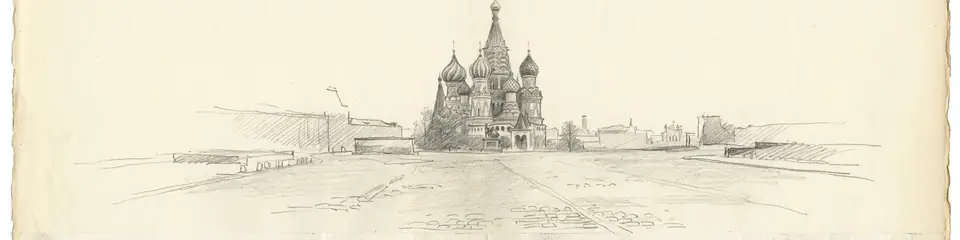
Graphite pencil sketch banner of St. Basil's Cathedral

“St.”

Localisation

Aperçu

St. Basil’s Cathedral stands at the south end of Red Square in Moscow. Built 1555–61 on Ivan IV’s order to commemorate the capture of Kazan, the cathedral unites nine chapels around a central Intercession church, each capped with a distinct coloured onion dome. Later additions include the shrine of the holy fool Basil the Blessed, whose popular name stuck to the whole ensemble.

Contrary to tourist myth, the builders Barma and Postnik were not blinded; the cathedral survived Napoleonic looting plans and Soviet demolition threats before becoming a museum. Its asymmetrical plan and painted brick exteriors broke with Byzantine-cross norms and became a Russian national emblem. Pair with the Winter Palace for contrasting Muscovite sacred and imperial Baroque stages.

Pourquoi c'est important

St. Basil’s fixed the onion-dome silhouette as Russia’s architectural brand and memorialised Muscovite expansion into the former Kazan Khanate. It remains the clearest standing manifesto of 16th-century Russian sacred experimentation outside the Kremlin cathedrals.

Preuves et interprétation

Distinguer ce qui est bien établi de ce qui reste débattu.

Faits bien établis

2
  • Chronicle entries and building inscriptions date the cathedral to Ivan IV’s Kazan commemorations of 1555–61.
  • Architectural surveys document the nine-chapel plan and later shrine of Basil the Blessed.

Interprétations débattues

1
  • Authorship attributions to Barma and Postnik versus a larger workshop remain incompletely resolved in the sources.

Photos de la communauté

Partagez votre expérience

Avez-vous visité ce site ? Téléchargez vos photos pour aider les autres à le découvrir.

Comment citer cette page

Atlas Anatolia. (1555). St. Basil's Cathedral. Atlas Anatolia. https://atlasanatolia.com/fr/site/st-basils-cathedral

Contenu sous licence CC BY-SA 4.0 — attribution requise en cas de réutilisation.

Sources

  • A History of Russian Architecture — Brumfield, William Craft (1993)
  • UNESCO — Kremlin and Red SquareLien

Questions fréquentes

Où se trouve St. Basil's Cathedral ?

St. Basil's Cathedral est situé à/en Russia.

De quand date St. Basil's Cathedral ?

St. Basil's Cathedral remonte approximativement à 1555 apr. J.-C. – 1561 apr. J.-C..

Quelles civilisations sont associées à St. Basil's Cathedral ?

St. Basil's Cathedral est associé à la civilisation Muscovite.

Pourquoi St. Basil's Cathedral est-il important ?

St.

St. Basil's Cathedral est-il inscrit au patrimoine mondial de l'UNESCO ?

Oui — St. Basil's Cathedral est inscrit sur la liste du patrimoine mondial de l'UNESCO.