
Aller au contenu
Atlas Anatolia
ActualitésIce Age teeth in Sulawesi push betel-nut use back as far as 25,000 yearsRoman mosaic and Eros head uncovered in the basilica at Pompeiopolis, Kastamonu
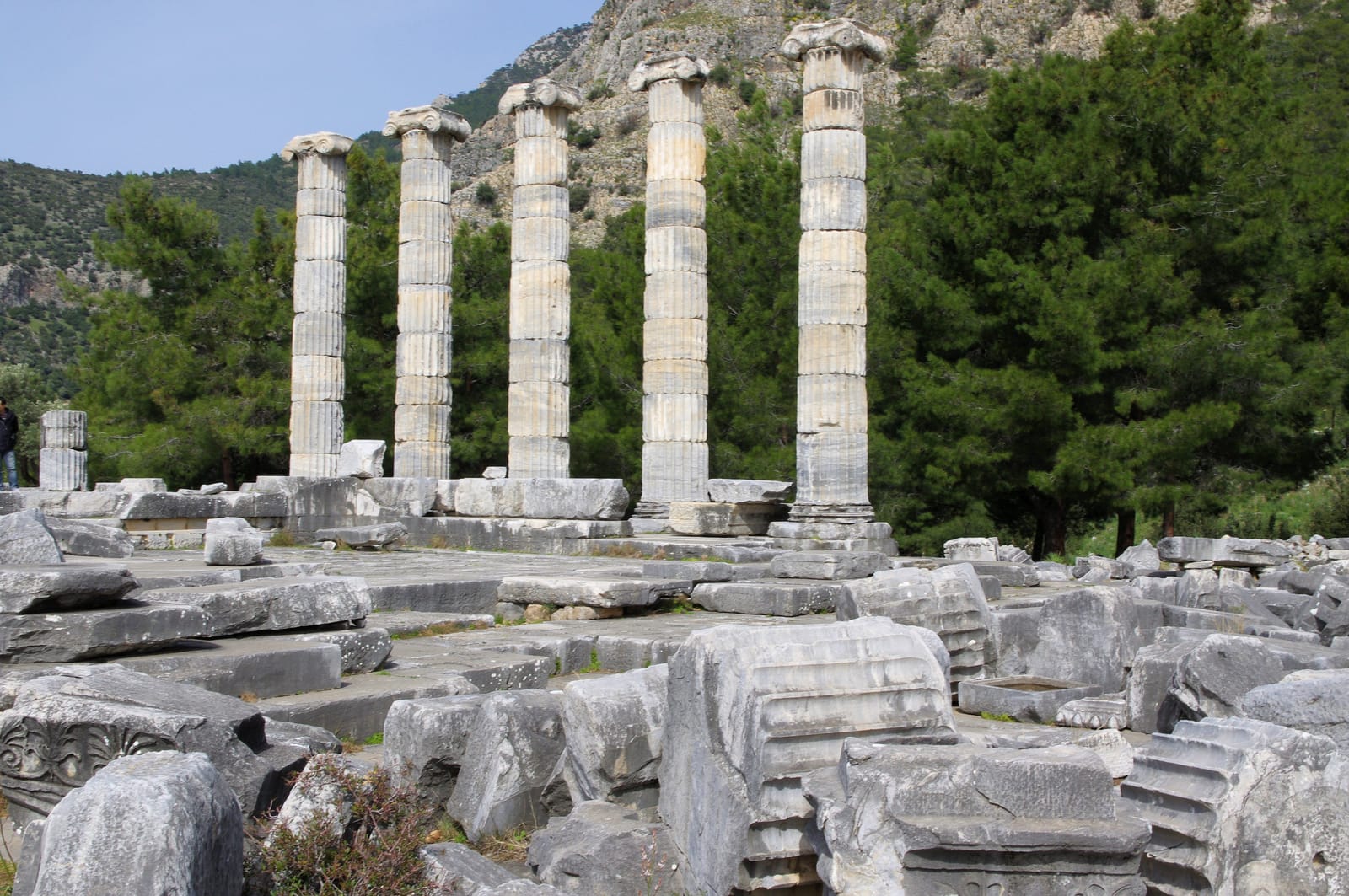
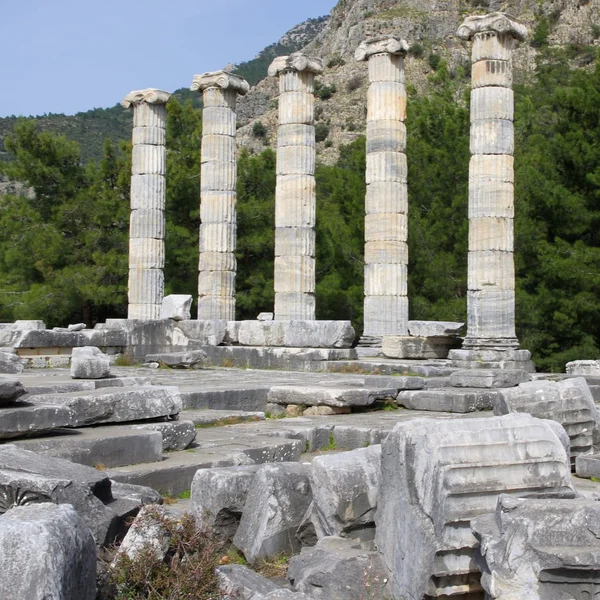
Columns of the Temple of Athena at Priene overlooking the Maeander plain

Wikimedia Commons (CC BY-SA)

Cité

Priene

Seyfi Cem Baskin

350 av. J.-C. – 300 apr. J.-C.

The textbook example of Hellenistic urban planning — a model Greek city laid out on a perfect grid by Hippodamos, crowned by the Temple of Athena designed by Pytheos, the same architect who built the Mausoleum at Halicarnassus.

312
Intérêt 50

Localisation

Aydin · Aegean · Turquie

37.66°N · 27.30°E · Asie

City Plan

Perfect Hippodamian grid

Temple Architect

Pytheos (also Mausoleum at Halicarnassus)

Alexander Dedication

334 BCE (inscription in British Museum)

Bouleuterion Capacity

640 citizens

Water Supply System

Extensive network of terracotta pipes and cisterns, including a 2.5 km long aqueduct from the mountain of Mycale.

Notable Inscription

The 'Law of Priene' stele (c. 200 BCE), a comprehensive civic legal code regulating public and private life, found in the agora.

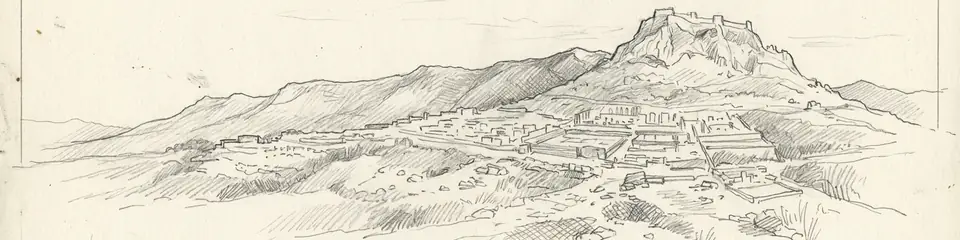
Graphite pencil sketch banner of Priene

“Priene is indispensable for architectural history.”

De Wikipédia

Priene was an ancient Greek city in Ionia, known for its Hippodamian grid plan and the Temple of Athena Polias designed by Pytheos.

Lire l'article complet sur Wikipédia →

Localisation

Aperçu

Priene is the architect's city. Re-founded in the mid-4th century BCE on a dramatic terrace overlooking the Maeander River plain, it was laid out on a strict Hippodamian grid plan that has been called the most perfectly preserved example of ancient Greek urban design. Every street, block, and public space follows the orthogonal system with mathematical precision, adapted to the steep hillside through a series of terraces.

The Temple of Athena Polias, designed by the celebrated architect Pytheos (who also designed the Mausoleum at Halicarnassus, one of the Seven Wonders of the Ancient World), was considered a model of Ionic temple architecture. Alexander the Great himself dedicated the temple during his campaign through Asia Minor in 334 BCE — the dedicatory inscription survives and is now in the British Museum.

"The city is built on a steep hill, with a temple of Athena Polias, the work of Pytheos, who also built the Mausoleum."
— Strabo, c. 7 BCE

The city's bouleuterion (council chamber) is the best-preserved example of a Greek democratic assembly building, with seating for 640 citizens arranged in a semi-circle around a central altar. The agora, gymnasium, stadium, and residential quarters are all preserved in remarkable detail, offering a complete snapshot of Hellenistic civic life.

Priene was gradually abandoned as the Maeander River silted up the harbor, leaving the once-coastal city stranded kilometers from the sea. This abandonment preserved the Hellenistic plan without later Roman rebuilding, making Priene uniquely valuable for understanding pre-Roman Greek urbanism.
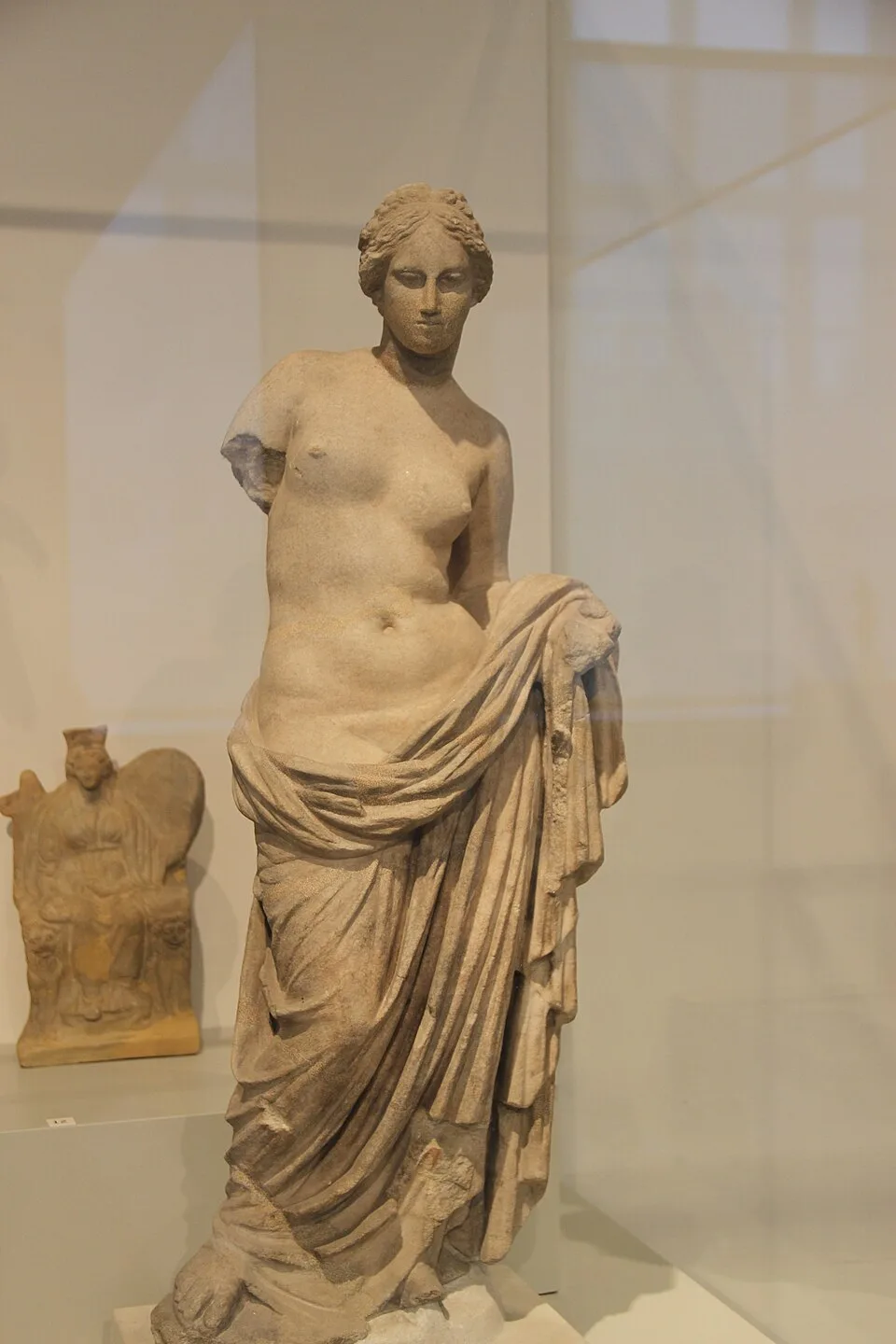
Marble Statue from Priene (28120553914)
Marble Statue from Priene (28120553914) | Gary Todd from Xinzheng, China (CC0)

Beyond its monumental public buildings, Priene offers a clear view of daily life in a middle-class Hellenistic city. The standardized residential blocks (insulae) contained comfortable houses built around central courtyards, often with mosaic floors and painted plaster. The city's infrastructure was advanced, featuring an extensive water supply system of terracotta pipes feeding public fountains and private homes, and a well-planned drainage network.

Priene's economy was supported by its port, which connected it to the maritime trade networks of the Aegean. This is reflected in the discovery of a sanctuary dedicated to the Egyptian gods Serapis, Isis, and Anubis, attesting to direct cultural and commercial contacts with Ptolemaic Egypt. The city's gradual decline began in the Roman Imperial period, as the relentless silting of the Maeander River delta by the 2nd century CE progressively isolated its harbor, leading to economic stagnation and eventual abandonment in favor of more accessible coastal settlements.

Pourquoi c'est important

Priene is indispensable for architectural history. It preserves the most complete example of Hippodamian grid planning, the system that influenced urban design from Rome to modern Manhattan. Pytheos's Temple of Athena was treated as a canonical example of Ionic architecture by Vitruvius and shaped centuries of temple building across the Hellenistic world. Because Priene was largely abandoned before the Roman period, it preserves the Hellenistic city plan without the heavy overbuilding that obscures Greek planning at sites like Ephesus or Miletus. For archaeologists studying Greek urbanism, Priene is the reference standard.

Preuves et interprétation

Distinguer ce qui est bien établi de ce qui reste débattu.

Faits bien établis

3
  • Alexander the Great dedicated the Temple of Athena in 334 BCE, as recorded in a dedicatory inscription now in the British Museum (BM 399).
  • The city follows a strict Hippodamian grid plan with uniform residential blocks of approximately 35 x 47 meters.
  • Vitruvius cites Pytheos's Temple of Athena at Priene as a model example of Ionic architecture (De Architectura, VII, preface).

Inférences savantes

1
  • The city was abandoned gradually as the Maeander River silted up the coast, moving the shoreline several kilometers to the west.

Interprétations débattues

2
  • Whether the original Priene (before the 4th-century refoundation) was located at the same site or at a different location remains contested.
  • The precise function and original appearance of the 'Sacred Stoa' in the agora, whether it was a single or two-story building and its exact role in the city's commercial and religious life, is debated.

Découverte et fouilles

1765

Rediscovery

The Society of Dilettanti sent Richard Chandler, who rediscovered Priene's ruins.

1895–1899

German excavations

Dirigé par Theodor Wiegand

Theodor Wiegand of the Berlin Museum conducted extensive excavations, revealing the full city plan.

1969

Turkish-German Agora Excavations

Dirigé par German Archaeological Institute (DAI) Istanbul Department

Systematic excavations of the agora and surrounding public buildings, led by the German Archaeological Institute and Turkish authorities, clarifying the city's civic center.

1998–2020

New German excavations

Dirigé par Wulf Raeck

Wulf Raeck of Goethe University Frankfurt resumed excavations, focusing on domestic architecture and the harbor area.

Photos de la communauté

Partagez votre expérience

Avez-vous visité ce site ? Téléchargez vos photos pour aider les autres à le découvrir.

Comment citer cette page

Atlas Anatolia. (350). Priene. Atlas Anatolia. https://atlasanatolia.com/fr/site/priene

Contenu sous licence CC BY-SA 4.0 — attribution requise en cas de réutilisation.

Lire l'article complet sur World History Encyclopedia
World History Encyclopedia · CC BY-NC-SA

Sources

  • Priene: Ergebnisse der Ausgrabungen und Untersuchungen — Theodor Wiegand & Hans Schrader (1904)
  • Priene: Architecture and Urban Context — Frank Rumscheid (1998)
  • Wikipedia — PrieneLien

Questions fréquentes

Où se trouve Priene ?

Priene est situé à/en Aydin, Aegean, Türkiye.

De quand date Priene ?

Priene remonte approximativement à 350 av. J.-C. – 300 apr. J.-C..

Quelles civilisations sont associées à Priene ?

Priene est associé à la civilisation Greek, Roman, Ionian.

Pourquoi Priene est-il important ?

Priene is indispensable for architectural history.

Priene est-il inscrit au patrimoine mondial de l'UNESCO ?

Priene n'est pas actuellement inscrit sur la liste du patrimoine mondial de l'UNESCO.