
Aller au contenu
Atlas Anatolia
ActualitésIce Age teeth in Sulawesi push betel-nut use back as far as 25,000 yearsRoman mosaic and Eros head uncovered in the basilica at Pompeiopolis, Kastamonu
The Leaning Tower of Pisa beside the cathedral, Tuscany

Wikimedia Commons (CC BY-SA 4.0)

PatrimoineMonumentUNESCOEn vedette

Leaning Tower of Pisa

Seyfi Cem Baskin

Torre pendente di Pisa1173 apr. J.-C. – 1372 apr. J.-C.

The white-marble campanile beside Pisa Cathedral — famous for its four-degree lean caused by soft subsoil — is among the most searched Italian monuments worldwide and complements the [Piazza dei Miracoli](/site/pisa-cathedral) ensemble.

21
Intérêt 88

Localisation

Italie

43.72°N · 10.40°E · Europe

Begun

1173; lean visible by third storey

Height

~56 m on low side; ~57 m on high side

Stabilization

1990–2001 and 2008 works reduced tilt

UNESCO

Piazza del Duomo, Pisa (1987)

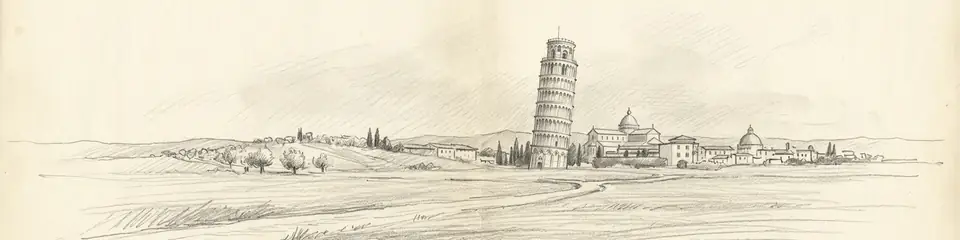
Graphite pencil sketch banner of Leaning Tower of Pisa

“The Leaning Tower is a case study in engineering failure turned icon — soft ground, interrupted construction, and modern stabilization science.”

Localisation

Aperçu

The Leaning Tower of Pisa is the freestanding bell tower (campanile) of Pisa Cathedral in the Piazza del Duomo (Campo dei Miracoli), Tuscany, Italy. Construction began in 1173; by the time workers reached the third storey the tower had begun to tilt on unstable alluvial soil. Work stopped and resumed across centuries; the cylindrical structure of white marble wraps eight storeys with a spiral staircase of 294 steps.

The lean reached more than 5 degrees before 20th–21st-century stabilization injected soil and adjusted mass, reducing tilt to safer levels while preserving the signature angle tourists expect. Ghiberti and other Renaissance masters referenced Pisa's marble ensemble as a benchmark of Tuscan Romanesque.

The tower is not separate from the cathedral complex UNESCO inscribed in 1987 — it is the most photographed element. Climbing the tilted stairs remains a bucket-list ritual; the view encompasses the Arno plain and Tuscan coast.

Pourquoi c'est important

The Leaning Tower is a case study in engineering failure turned icon — soft ground, interrupted construction, and modern stabilization science. Its search volume dwarfs many authentic Roman ruins because the lean makes it instantly legible in photographs and popular culture.

Preuves et interprétation

Distinguer ce qui est bien établi de ce qui reste débattu.

Faits bien établis

2
  • Building phases and pause/resume cycles documented in Pisan archives and fabric joints.
  • Soil extraction and counterweight engineering (1990s–2000s) measured tilt reduction geodetically.

Inférences savantes

1
  • Original intended vertical height unknown due to centuries of corrective building.

Photos de la communauté

Partagez votre expérience

Avez-vous visité ce site ? Téléchargez vos photos pour aider les autres à le découvrir.

Comment citer cette page

Atlas Anatolia. (1173). Leaning Tower of Pisa. Atlas Anatolia. https://atlasanatolia.com/fr/site/leaning-tower-pisa

Contenu sous licence CC BY-SA 4.0 — attribution requise en cas de réutilisation.

Sources

  • The Tower of Pisa — Pieroni, Daniele (2001)
  • UNESCO — Piazza del Duomo, PisaLien

Questions fréquentes

Où se trouve Leaning Tower of Pisa ?

Leaning Tower of Pisa est situé à/en Italy.

De quand date Leaning Tower of Pisa ?

Leaning Tower of Pisa remonte approximativement à 1173 apr. J.-C. – 1372 apr. J.-C..

Quelles civilisations sont associées à Leaning Tower of Pisa ?

Leaning Tower of Pisa est associé à la civilisation Roman, Renaissance Italian.

Pourquoi Leaning Tower of Pisa est-il important ?

The Leaning Tower is a case study in engineering failure turned icon — soft ground, interrupted construction, and modern stabilization science.

Leaning Tower of Pisa est-il inscrit au patrimoine mondial de l'UNESCO ?

Oui — Leaning Tower of Pisa est inscrit sur la liste du patrimoine mondial de l'UNESCO.