
Aller au contenu
Atlas Anatolia
ActualitésIce Age teeth in Sulawesi push betel-nut use back as far as 25,000 yearsRoman mosaic and Eros head uncovered in the basilica at Pompeiopolis, Kastamonu
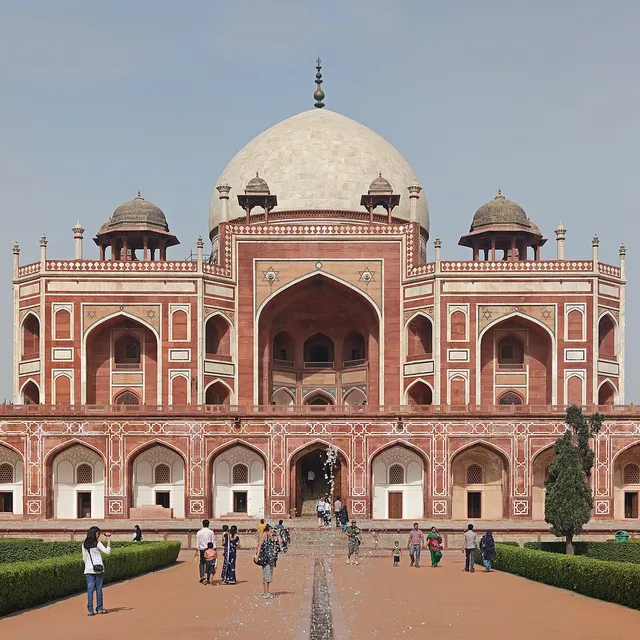
Humayun's Tomb and charbagh garden, Delhi

Wikimedia Commons

Country Record

Oldest Monument in India

PatrimoineMonumentUNESCOEn vedette

Humayun's Tomb

Seyfi Cem Baskin

हुमायूँ का मकबरा1565 apr. J.-C. – 1572 apr. J.-C.

The red-sandstone and white-marble garden tomb built in Delhi for the Mughal emperor Humayun (d. 1556) — a charbagh mausoleum whose double dome and symmetrical layout directly inspired the Taj Mahal and ranks among the most visited monuments in India.

21
Intérêt 71

Localisation

Inde

28.59°N · 77.25°E · Asie

Built

c. 1565–1572 CE for Emperor Humayun

Patron

Bega Begum (Haji Begum), Humayun's widow

Layout

Charbagh garden tomb with double dome

UNESCO

World Heritage Site (1993)

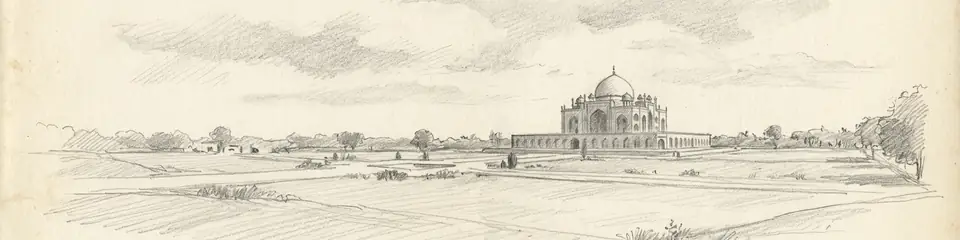
Graphite pencil sketch banner of Humayun's Tomb

“Humayun's Tomb is the structural prototype of the Taj Mahal — the first fully realised Mughal garden tomb on the Yamuna-Ganges plain.”

Localisation

Aperçu

Humayun's Tomb stands in the Nizamuddin district of Delhi on a platform within a charbagh garden divided by water channels. The empress Bega Begum (Haji Begum) commissioned the mausoleum after Humayun's death in 1556; construction began about 1565 and was substantially complete by 1572. Mirak Mirza Ghiyas, a Persian architect, is traditionally credited with the design.

The building combines Timurid tomb typology — a high double dome, pishtaq entrance arches, chhatri kiosks — with Indian red sandstone and white marble inlay. The central chamber holds Humayun's cenotaph; over 150 Mughal family members were later buried in the complex, making it a dynastic necropolis. After the 1857 rebellion and British occupation, the gardens deteriorated until a major Aga Khan Trust restoration in the early 21st century.

UNESCO inscribed Humayun's Tomb in 1993 as an early masterpiece of Mughal architecture that prefigured the Taj Mahal. It anchors Delhi's "Mughal triangle" with the Red Fort and Qutb Minar on heritage itineraries.

Pourquoi c'est important

Humayun's Tomb is the structural prototype of the Taj Mahal — the first fully realised Mughal garden tomb on the Yamuna-Ganges plain. Its restoration became a model for public–private heritage conservation in India and revived the charbagh landscape as integral to the monument.

Preuves et interprétation

Distinguer ce qui est bien établi de ce qui reste débattu.

Faits bien établis

2
  • Mughal chronicles and inscriptions name Humayun, Bega Begum, and the completion date in the 1570s.
  • Architectural comparison confirms Timurid tomb forms adapted to Delhi red sandstone–marble workshops.

Inférences savantes

1
  • The tomb's design directly influenced Shah Jahan's Taj Mahal programme — inferred from formal precedent and court workshop continuity.

Photos de la communauté

Partagez votre expérience

Avez-vous visité ce site ? Téléchargez vos photos pour aider les autres à le découvrir.

Comment citer cette page

Atlas Anatolia. (1565). Humayun's Tomb. Atlas Anatolia. https://atlasanatolia.com/fr/site/humayuns-tomb

Contenu sous licence CC BY-SA 4.0 — attribution requise en cas de réutilisation.

Sources

  • Mughal Architecture — Koch, Ebba (1991)
  • UNESCO — Humayun's TombLien

Questions fréquentes

Où se trouve Humayun's Tomb ?

Humayun's Tomb est situé à/en India.

De quand date Humayun's Tomb ?

Humayun's Tomb remonte approximativement à 1565 apr. J.-C. – 1572 apr. J.-C..

Quelles civilisations sont associées à Humayun's Tomb ?

Humayun's Tomb est associé à la civilisation Mughal.

Pourquoi Humayun's Tomb est-il important ?

Humayun's Tomb is the structural prototype of the Taj Mahal — the first fully realised Mughal garden tomb on the Yamuna-Ganges plain.

Humayun's Tomb est-il inscrit au patrimoine mondial de l'UNESCO ?

Oui — Humayun's Tomb est inscrit sur la liste du patrimoine mondial de l'UNESCO.