
Aller au contenu
Atlas Anatolia
ActualitésIce Age teeth in Sulawesi push betel-nut use back as far as 25,000 yearsRoman mosaic and Eros head uncovered in the basilica at Pompeiopolis, Kastamonu
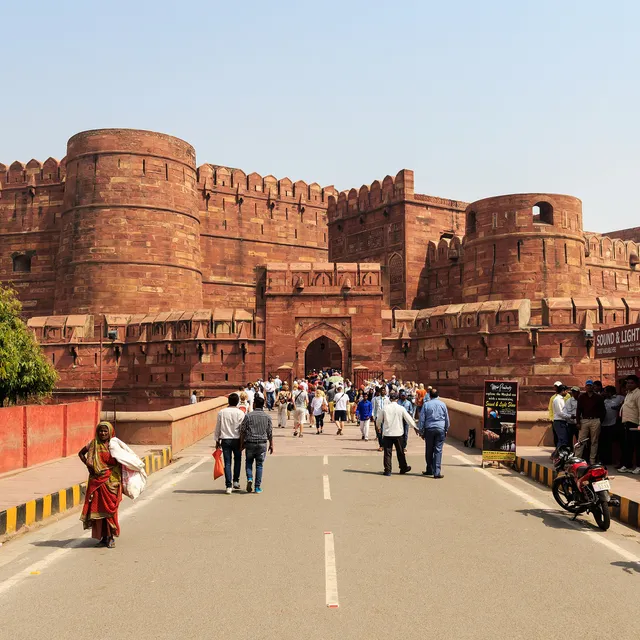
Red sandstone walls and gates of Agra Fort, India

Wikimedia Commons

Country Record

Oldest Fortress in India

PatrimoineForteresseUNESCOEn vedette

Agra Fort

Seyfi Cem Baskin

आगरा किला1565 apr. J.-C. – 1857 apr. J.-C.

The massive red-sandstone fortress on the Yamuna at Agra — seat of Akbar, Jahangir, and Shah Jahan before the Mughal court moved to Delhi — whose palaces and mosques face the Taj Mahal across the river and draw millions of visitors on India's Golden Triangle circuit.

21
Intérêt 75

Localisation

Inde

27.18°N · 78.02°E · Asie

Built

Major phase c. 1565–1573 CE under Akbar; later marble works by Shah Jahan

Material

Red sandstone with white marble imperial apartments

View

Musamman Burj overlooks the Taj Mahal across the Yamuna

UNESCO

World Heritage Site (1983)

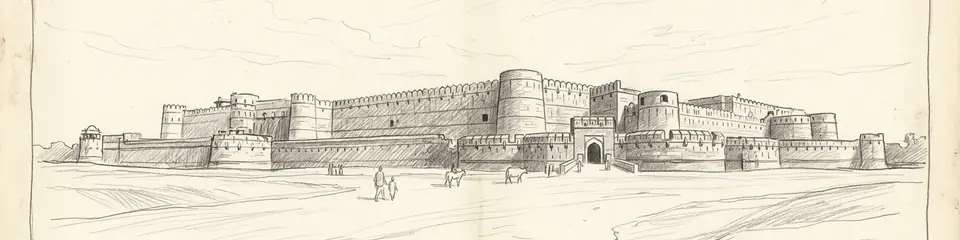
Graphite pencil sketch banner of Agra Fort

“Agra Fort is the military and residential counterpart to the Taj Mahal — together they document Mughal power, aesthetics, and riverine urban planning at its peak.”

Localisation

Aperçu

Agra Fort (Lal Qila) rises on the right bank of the Yamuna River in Agra, Uttar Pradesh, forming a crescent-shaped walled complex roughly 2.5 kilometres in circumference. Akbar the Great ordered its reconstruction in red sandstone beginning about 1565 on the site of an earlier fort; successive emperors added marble palaces, audience halls, and gardens. Shah Jahan's white-marble Musamman Burj tower — where he was imprisoned by Aurangzeb — offers the famous view toward the Taj Mahal.

The fort combines military architecture (double ramparts, moat, angled bastions) with refined residential courts: the Jahangir Mahal, Khas Mahal, Diwan-i-Am, and Diwan-i-Khas. Pietra dura, carved brackets, and inlaid marble reflect the same workshops that later built the Taj. After the Mughal decline the fort passed through Maratha and British control; much of the interior was adapted for barracks and administration.

The Archaeological Survey of India now manages the monument. UNESCO listed Agra Fort in 1983 alongside the Taj Mahal as a defining Mughal ensemble of the Yamuna corridor.

Pourquoi c'est important

Agra Fort is the military and residential counterpart to the Taj Mahal — together they document Mughal power, aesthetics, and riverine urban planning at its peak. Its continuous occupation from the 16th century preserves one of the largest and best-studied Islamic fort-palaces in South Asia.

Preuves et interprétation

Distinguer ce qui est bien établi de ce qui reste débattu.

Faits bien établis

2
  • Mughal court chronicles and inscriptions attribute the Akbar-period rebuilding and Shah Jahan marble additions to documented imperial workshops.
  • Architectural analysis confirms Timurid–Mughal vaulting, jali screens, and pietra dura consistent with 16th–17th-century imperial ateliers.

Inférences savantes

1
  • The fort's riverfront orientation was intended to integrate Yamuna transport and garden-tomb axes linking Agra's palatial and funerary landscapes.

Photos de la communauté

Partagez votre expérience

Avez-vous visité ce site ? Téléchargez vos photos pour aider les autres à le découvrir.

Comment citer cette page

Atlas Anatolia. (1565). Agra Fort. Atlas Anatolia. https://atlasanatolia.com/fr/site/agra-fort

Contenu sous licence CC BY-SA 4.0 — attribution requise en cas de réutilisation.

Sources

  • Mughal Architecture — Koch, Ebba (1991)
  • UNESCO — Agra FortLien

Questions fréquentes

Où se trouve Agra Fort ?

Agra Fort est situé à/en India.

De quand date Agra Fort ?

Agra Fort remonte approximativement à 1565 apr. J.-C. – 1857 apr. J.-C..

Quelles civilisations sont associées à Agra Fort ?

Agra Fort est associé à la civilisation Mughal.

Pourquoi Agra Fort est-il important ?

Agra Fort is the military and residential counterpart to the Taj Mahal — together they document Mughal power, aesthetics, and riverine urban planning at its peak.

Agra Fort est-il inscrit au patrimoine mondial de l'UNESCO ?

Oui — Agra Fort est inscrit sur la liste du patrimoine mondial de l'UNESCO.