
Aller au contenu
Atlas Anatolia
ActualitésIce Age teeth in Sulawesi push betel-nut use back as far as 25,000 yearsRoman mosaic and Eros head uncovered in the basilica at Pompeiopolis, Kastamonu
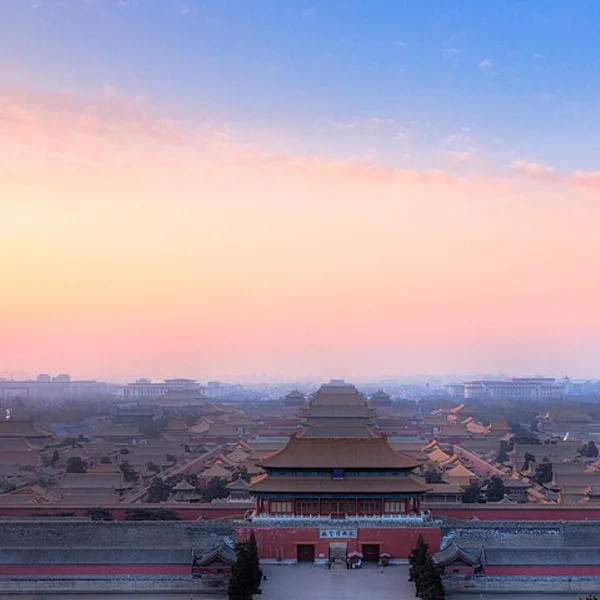
The Forbidden City palace roofs seen from Jingshan Coal Hill, Beijing

Wikimedia Commons

PatrimoineComplexeUNESCOEn vedette

Forbidden City

Seyfi Cem Baskin

紫禁城1406 apr. J.-C. – 1912 apr. J.-C.

The vast Ming–Qing imperial palace at the heart of Beijing — nearly a thousand buildings within vermilion walls — whose courts and gates staged five centuries of Chinese emperors and remains among the most visited historic sites in the world.

21
Intérêt 90

Localisation

Chine

39.92°N · 116.40°E · Asie

Built

1406–1420 CE under the Yongle Emperor (Ming)

Area

~72 ha within walls; ~980 buildings

Museum

Palace Museum (Gugong) since 1925

UNESCO

Imperial Palaces of Ming and Qing (1987)

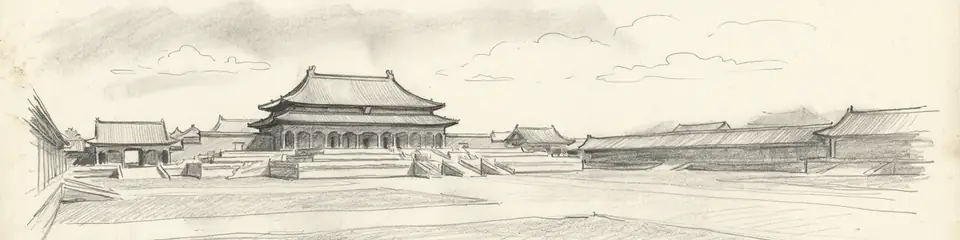
Graphite pencil sketch banner of Forbidden City

“The Forbidden City is the best-preserved imperial palace complex in East Asia and the physical expression of Chinese cosmological statecraft — axial order, colour codes, and gate hierarchies that structured imperial power for half a millennium.”

Localisation

Aperçu

The Forbidden City (Zijin Cheng, "Purple Forbidden City") occupies the central north–south axis of historic Beijing. The Yongle Emperor (Zhu Di) of the Ming dynasty began its construction in 1406, moving the primary capital from Nanjing; the complex was largely complete by 1420. For almost five centuries it housed the Ming and Qing imperial households, their bureaucracies, and ritual life, until the abdication of the last Qing emperor Puyi in 1912. Ordinary subjects were barred from entering — hence "forbidden" — while officials and envoys passed through a graded sequence of gates and courtyards toward the throne halls.

The palace covers roughly 72 hectares within a rectangular wall and moat, containing on the order of 980 surviving buildings and some 8,700 rooms (traditional counts vary). Architecture follows strict axial symmetry: the Outer Court (Taihe, Zhonghe, Baohe halls) hosted state ceremonies; the Inner Court housed the emperor's residence and the empress's quarters, with the Imperial Garden at the north end. Timber post-and-beam halls rest on white marble terraces; roofs are glazed yellow tile (imperial colour), with bracket sets (dougong) distributing weight. Qing rulers added Manchu ritual elements while preserving Ming spatial order.
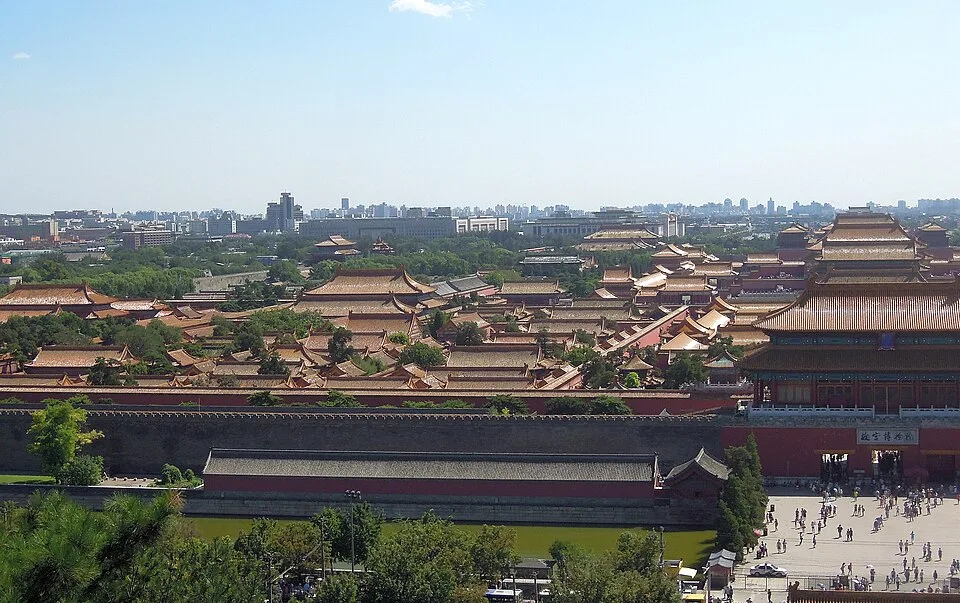
China (Beijing) Aerial view of Forbidden City (38884882275)
China (Beijing) Aerial view of Forbidden City (38884882275) | Güldem Üstün from Istanbul, TURKEY (CC BY 2.0)
"The Son of Heaven dwells in the centre of the earth; his palace faces south, the direction of virtue, and the five gates open upon the five directions of the realm."
— Paraphrase of Ming ritual cosmology applied to Beijing's axial palace layout
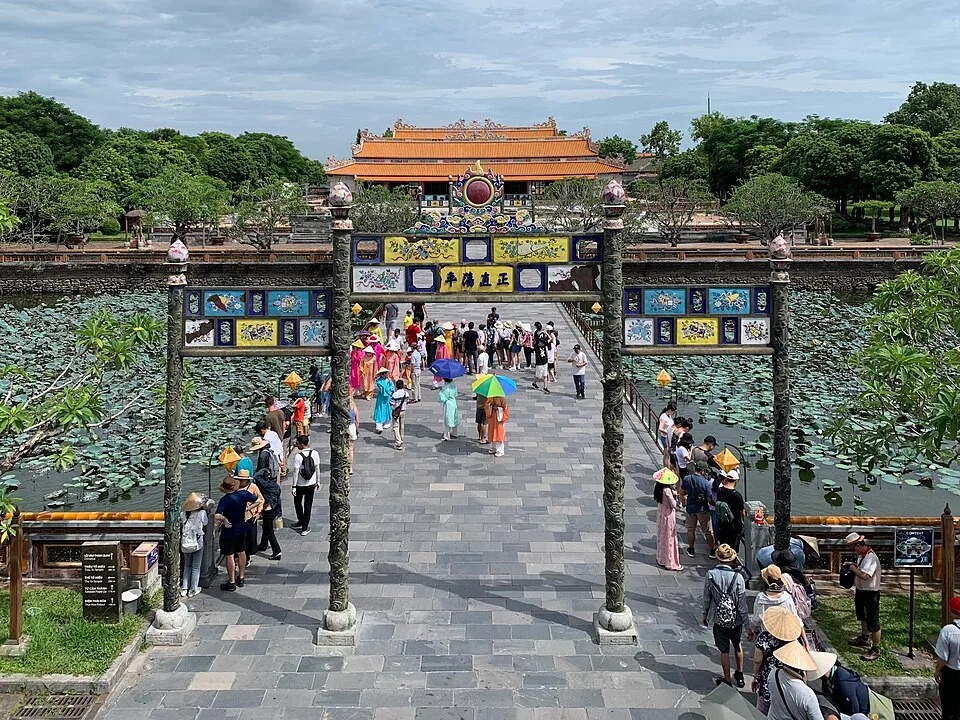
Huế 2024 - Meridian Gate - Ngọ Môn Hoàng thành Huế - img 07
Huế 2024 - Meridian Gate - Ngọ Môn Hoàng thành Huế - img 07 | Chainwit. (CC BY 4.0)
"Nine thousand rooms under yellow tiles — a city within the city, closed to the common wind."
— Paraphrase of Qing palace descriptions of the Forbidden City
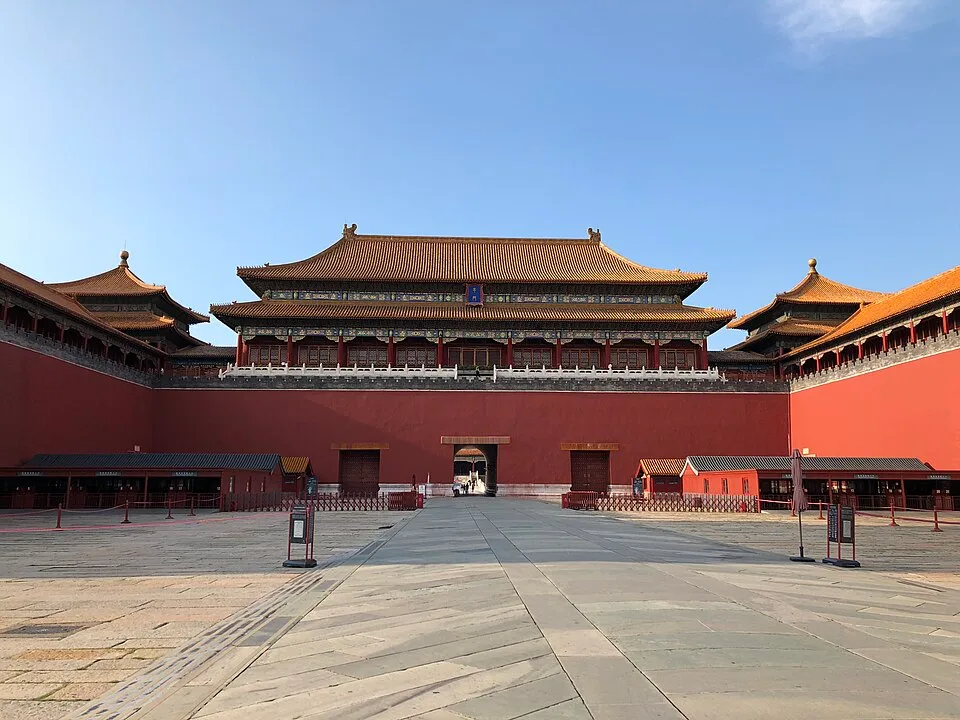
Meridian Gate Forbidden City 2018-08-18 170110
Meridian Gate Forbidden City 2018-08-18 170110 | David290 (CC BY-SA 4.0)

After 1925 the complex opened as the Palace Museum (Gugong), one of the world's largest collections of Chinese art — bronzes, ceramics, painting, jade, and court regalia evacuated to Taiwan during the civil war form a parallel collection at the National Palace Museum, Taipei. UNESCO listed the Imperial Palaces of the Ming and Qing in Beijing and Shenyang in 1987. Visitor numbers rank among the highest of any historic monument globally.
Pourquoi c'est important

The Forbidden City is the best-preserved imperial palace complex in East Asia and the physical expression of Chinese cosmological statecraft — axial order, colour codes, and gate hierarchies that structured imperial power for half a millennium. Its conversion into the Palace Museum made it the public face of Chinese art history, while its architecture remains the reference point for understanding Ming–Qing court ritual and urban planning.

Preuves et interprétation

Distinguer ce qui est bien établi de ce qui reste débattu.

Faits bien établis

2
  • Ming and Qing archival records, gate plaques, and ritual manuals document construction phases, court ceremonies, and spatial regulations.
  • Architectural survey confirms axial planning, dougong bracket systems, and marble terrace platforms consistent with 15th–18th-century imperial workshops.

Inférences savantes

1
  • Yongle's relocation of the capital from Nanjing to Beijing was intended to secure the northern frontier and reclaim Mongol-era prestige — inferred from contemporary policy and ritual emphasis.

Photos de la communauté

Partagez votre expérience

Avez-vous visité ce site ? Téléchargez vos photos pour aider les autres à le découvrir.

Récits liés

Comment citer cette page

Atlas Anatolia. (1406). Forbidden City. Atlas Anatolia. https://atlasanatolia.com/fr/site/forbidden-city

Contenu sous licence CC BY-SA 4.0 — attribution requise en cas de réutilisation.

Graphique

Connexions avec des sites et récits associés.

Sources

  • The Forbidden City — Roderick Whitfield (2006)
  • UNESCO — Imperial Palaces of the Ming and Qing Dynasties in Beijing and ShenyangLien

Questions fréquentes

Où se trouve Forbidden City ?

Forbidden City est situé à/en China.

De quand date Forbidden City ?

Forbidden City remonte approximativement à 1406 apr. J.-C. – 1912 apr. J.-C..

Quelles civilisations sont associées à Forbidden City ?

Forbidden City est associé à la civilisation Ming.

Pourquoi Forbidden City est-il important ?

The Forbidden City is the best-preserved imperial palace complex in East Asia and the physical expression of Chinese cosmological statecraft — axial order, colour codes, and gate hierarchies that structured imperial power for half a millennium.

Forbidden City est-il inscrit au patrimoine mondial de l'UNESCO ?

Oui — Forbidden City est inscrit sur la liste du patrimoine mondial de l'UNESCO.