
Aller au contenu
Atlas Anatolia
ActualitésIce Age teeth in Sulawesi push betel-nut use back as far as 25,000 yearsRoman mosaic and Eros head uncovered in the basilica at Pompeiopolis, Kastamonu
Brunelleschi's dome and marble façade of Florence Cathedral

Wikimedia Commons (CC BY-SA 4.0)

PatrimoineMonumentUNESCOEn vedette

Florence Cathedral

Seyfi Cem Baskin

Cattedrale di Santa Maria del Fiore1296 apr. J.-C. – 1436 apr. J.-C.

Filippo Brunelleschi's red-tiled dome over Florence's Gothic cathedral — still the largest masonry dome ever built — anchors the Tuscan skyline and ranks among the most searched Renaissance monuments in EN/DE/TR/ZH pageviews.

21
Intérêt 83

Localisation

Italie

43.77°N · 11.26°E · Europe

Dome

Brunelleschi, 1420–1436; largest masonry dome

Span

Octagonal crossing ~42 m

Façade

Gothic basilica; 19th-c. marble front completed

UNESCO

Historic Centre of Florence (1982)

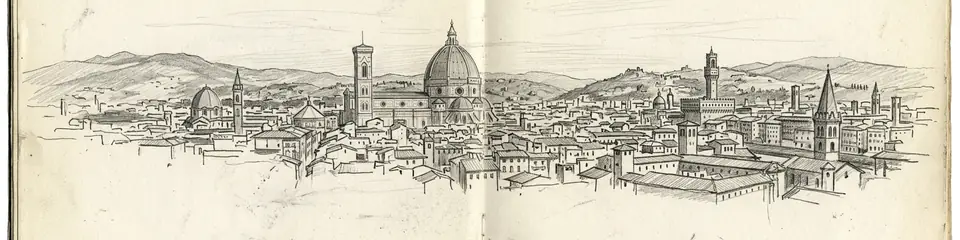
Graphite pencil sketch banner of Florence Cathedral

“The Duomo dome is Brunelleschi's proof that Renaissance engineers could surpass antiquity without Gothic buttresses — a turning point in architectural history.”

Localisation

Aperçu

Florence Cathedral (Santa Maria del Fiore) dominates the Piazza del Duomo in Florence, Tuscany. Arnolfo di Cambio began the Gothic basilica in 1296; the polychrome marble façade (green, white, pink) was completed in the 19th century in historicising style. The great challenge was roofing the octagonal crossing — 42 metres across — without buttresses.

Filippo Brunelleschi won the commission (1418) and built a double-shell dome between 1420 and 1436 using herringbone brick courses and horizontal chains, inventing lifting machines documented in his notebooks. Giorgio Vasari and Federico Zuccari frescoed the interior of the drum with the Last Judgment (1572–79). Giotto's campanile stands beside the church; the Baptistery opposite with its bronze doors (including Ghiberti's "Gates of Paradise") predates the cathedral.

UNESCO lists the Historic Centre of Florence (1982). Climbing between Brunelleschi's dome shells remains a defining Florence experience. Pair with the Leaning Tower of Pisa for Tuscan Romanesque–Renaissance contrasts.

Pourquoi c'est important

The Duomo dome is Brunelleschi's proof that Renaissance engineers could surpass antiquity without Gothic buttresses — a turning point in architectural history. Florence Cathedral's marble ensemble defines the visual identity of the Italian Renaissance city-state at peak cultural power.

Preuves et interprétation

Distinguer ce qui est bien établi de ce qui reste débattu.

Faits bien établis

2
  • Brunelleschi's contracts, hoist patents, and brick herringbone courses documented in Florentine archives.
  • Structural analysis confirms double-shell dome with horizontal tension chains.

Inférences savantes

1
  • Brunelleschi studied Roman Pantheon and ruins — inferred from notebooks and Renaissance historiography.

Photos de la communauté

Partagez votre expérience

Avez-vous visité ce site ? Téléchargez vos photos pour aider les autres à le découvrir.

Comment citer cette page

Atlas Anatolia. (1296). Florence Cathedral. Atlas Anatolia. https://atlasanatolia.com/fr/site/florence-cathedral

Contenu sous licence CC BY-SA 4.0 — attribution requise en cas de réutilisation.

Sources

  • Brunelleschi's Dome — King, Ross (2000)
  • UNESCO — Historic Centre of FlorenceLien

Questions fréquentes

Où se trouve Florence Cathedral ?

Florence Cathedral est situé à/en Italy.

De quand date Florence Cathedral ?

Florence Cathedral remonte approximativement à 1296 apr. J.-C. – 1436 apr. J.-C..

Quelles civilisations sont associées à Florence Cathedral ?

Florence Cathedral est associé à la civilisation Renaissance Italian.

Pourquoi Florence Cathedral est-il important ?

The Duomo dome is Brunelleschi's proof that Renaissance engineers could surpass antiquity without Gothic buttresses — a turning point in architectural history.

Florence Cathedral est-il inscrit au patrimoine mondial de l'UNESCO ?

Oui — Florence Cathedral est inscrit sur la liste du patrimoine mondial de l'UNESCO.