
Aller au contenu
Atlas Anatolia
ActualitésIce Age teeth in Sulawesi push betel-nut use back as far as 25,000 yearsRoman mosaic and Eros head uncovered in the basilica at Pompeiopolis, Kastamonu
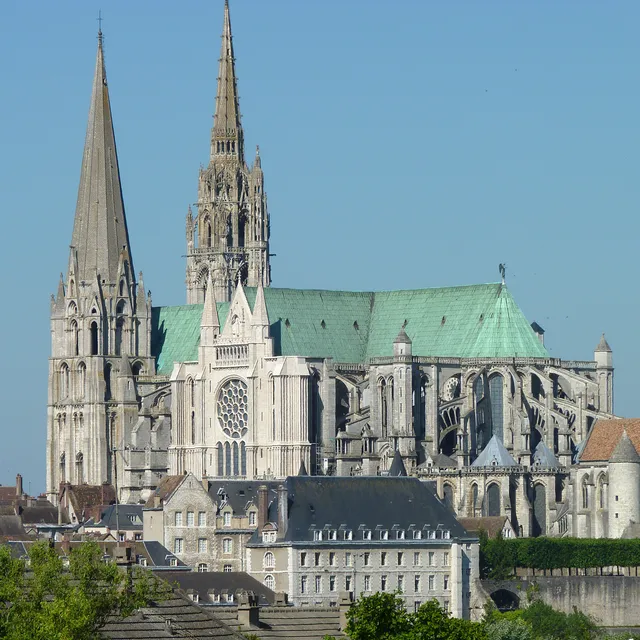
The west façade and spires of Chartres Cathedral, France

Wikimedia Commons

Country Record

Earliest Known Site in France

PatrimoineMonumentUNESCOEn vedette

Chartres Cathedral

Seyfi Cem Baskin

Cathédrale Notre-Dame de Chartres1194 apr. J.-C. – 1250 apr. J.-C.

The High Gothic cathedral southwest of Paris — largely rebuilt after 1194 with twin spires, a labyrinth, and 176 stained-glass windows — a UNESCO masterpiece whose geometry, relic cult, and blue "Chartres" glass make it among the most studied and visited churches in Europe.

21
Intérêt 77

Localisation

France

48.45°N · 1.49°E · Europe

Rebuilt

1194 fire; Gothic reconstruction c. 1194–1250

Spires

Romanesque south (349 ft) and Gothic north (377 ft)

Glass

~176 stained-glass windows; much 13th-century original

UNESCO

World Heritage Site (1979)

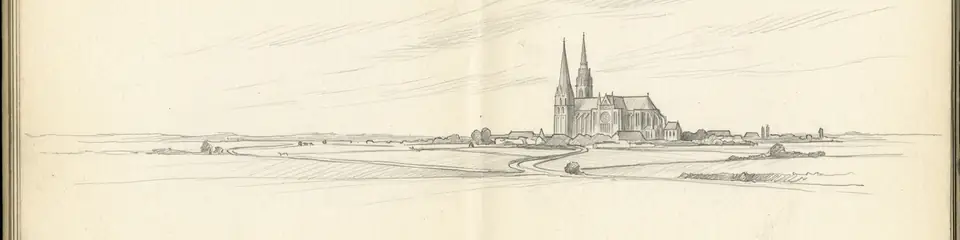
Graphite pencil sketch banner of Chartres Cathedral

“Chartres is the best-preserved High Gothic cathedral ensemble — architecture, glass, and sculpture from a single building campaign.”

Localisation

Aperçu

Chartres Cathedral stands on a hill above the Eure River in Chartres, Centre-Val de Loire, France. A bishopric from the Roman period, the site attracted Marian pilgrimage; a fire in 1194 destroyed much of the earlier Romanesque church while the western façade and towers survived. Reconstruction in the new Gothic style proceeded with unusual speed — the choir by 1221, the whole church by about 1250 — producing one of the most coherent High Gothic interiors in existence.

The cathedral houses the Sancta Camisa, a relic believed to be the tunic Mary wore at the Nativity, which fueled medieval pilgrimage. The stone floor labyrinth (c. 1200) survives for ritual walking. Stained-glass windows — including three great rose windows and the "Blue Virgin" window — retain extensive 13th-century glass, rare among European cathedrals after wars and iconoclasm.

UNESCO inscribed Chartres in 1979. The cathedral remains an active Catholic church and a touchstone for Gothic architecture studies from Viollet-le-Duc to modern sacred-geometry theories.
Pourquoi c'est important

Chartres is the best-preserved High Gothic cathedral ensemble — architecture, glass, and sculpture from a single building campaign. Its labyrinth, relic cult, and scholastic school linked medieval theology, pilgrimage, and urban identity in one monument.

Preuves et interprétation

Distinguer ce qui est bien établi de ce qui reste débattu.

Faits bien établis

2
  • Building accounts, bishopric records, and stylistic analysis date the post-1194 campaign to the early–mid 13th century.
  • Dendrochronology and glass chemistry support extensive survival of original 13th-century stained glass.

Interprétations débattues

1
  • Sacred-geometry theories claiming the plan encodes medieval cosmological ratios are popular but contested among architectural historians.

Photos de la communauté

Partagez votre expérience

Avez-vous visité ce site ? Téléchargez vos photos pour aider les autres à le découvrir.

Récits liés

Comment citer cette page

Atlas Anatolia. (1194). Chartres Cathedral. Atlas Anatolia. https://atlasanatolia.com/fr/site/chartres-cathedral

Contenu sous licence CC BY-SA 4.0 — attribution requise en cas de réutilisation.

Graphique

Connexions avec des sites et récits associés.

Sources

  • Chartres Cathedral — Miller, Malcolm (1996)
  • UNESCO — Chartres CathedralLien

Questions fréquentes

Où se trouve Chartres Cathedral ?

Chartres Cathedral est situé à/en France.

De quand date Chartres Cathedral ?

Chartres Cathedral remonte approximativement à 1194 apr. J.-C. – 1250 apr. J.-C..

Quelles civilisations sont associées à Chartres Cathedral ?

Chartres Cathedral est associé à la civilisation Medieval French.

Pourquoi Chartres Cathedral est-il important ?

Chartres is the best-preserved High Gothic cathedral ensemble — architecture, glass, and sculpture from a single building campaign.

Chartres Cathedral est-il inscrit au patrimoine mondial de l'UNESCO ?

Oui — Chartres Cathedral est inscrit sur la liste du patrimoine mondial de l'UNESCO.