
Saltar al contenido
Atlas Anatolia
NoticiasIce Age teeth in Sulawesi push betel-nut use back as far as 25,000 yearsRoman mosaic and Eros head uncovered in the basilica at Pompeiopolis, Kastamonu
Aerial view of the Mosque–Cathedral of Córdoba and the Guadalquivir

Wikimedia Commons (CC BY-SA 4.0)

PatrimonioTemploUNESCODestacado

Mosque–Cathedral of Córdoba

Seyfi Cem Baskin

Mezquita-Catedral de Córdoba785 d. C. – 1600 d. C.

The hypostyle forest of Umayyad Córdoba — striped arches over Roman and Visigothic spolia — later pierced by a Renaissance cathedral nave, is among the most important surviving monuments of medieval Islamic Spain.

21
Interés 79

Ubicación

España

37.88°N · 4.78°W · Europa

Founded

785–786, Abd al-Rahman I

Mihrab

Al-Hakam II, 961–976

Cathedral conversion

1236; Renaissance nave 16th c.

UNESCO

Historic Centre of Córdoba

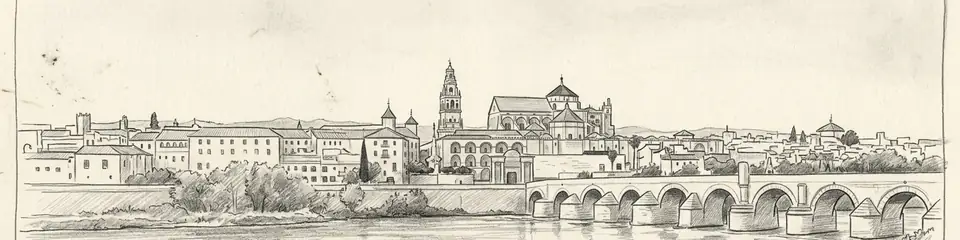
Graphite pencil sketch banner of Mosque–Cathedral of Córdoba

Córdoba’s mosque is the architectural manifesto of Umayyad al-Andalus and a rare case where a major Islamic ritual space survives largely intact beneath later Christian insertions.”

Ubicación

Resumen

The Great Mosque of Córdoba was founded in 785–786 under Abd al-Rahman I on the site of a Visigothic church tradition. Successive Umayyad enlargements under Abd al-Rahman II, Al-Hakam II, and Almanzor created a vast hypostyle hall of superimposed horseshoe arches on recycled columns, culminating in Al-Hakam’s luminous maqsura and mihrab (961–976). After the Christian conquest of 1236 the building became a cathedral; in the 16th century a towering cruciform nave and transept were inserted into the prayer hall, producing the hybrid Mosque–Cathedral visible today.

The Patio de los Naranjos, bell tower rising from the former minaret, and the Cordoban marble and jasper of the mihrab remain key experiences. UNESCO protects the Mosque–Cathedral within the Historic Centre of Córdoba. Pair with the Alhambra and Topkapi Palace for contrasting Islamic court architectures of the western and eastern Mediterranean.

Por qué es importante

Córdoba’s mosque is the architectural manifesto of Umayyad al-Andalus and a rare case where a major Islamic ritual space survives largely intact beneath later Christian insertions. It anchors debates about reuse, conquest, and heritage identity in medieval Iberia.

Evidencia e interpretación

Distinguir lo bien establecido de lo que sigue en debate.

Hechos bien establecidos

2
  • Dated Arabic inscriptions, endowment texts, and stratified fabric record the successive Umayyad expansions and the post-1236 cathedral conversion.
  • Column shafts and capitals include identifiable Roman and Visigothic spolia reused in the hypostyle grid.

Interpretaciones debatidas

1
  • The exact footprint of any pre-Islamic church beneath the first mosque remains incompletely resolved archaeologically.

Fotos de la comunidad

Comparte tu experiencia

¿Has visitado este sitio? Sube tus fotos para ayudar a otros a descubrirlo.

Cómo citar esta página

Atlas Anatolia. (785). Mosque–Cathedral of Córdoba. Atlas Anatolia. https://atlasanatolia.com/es/site/mosque-cathedral-cordoba

Contenido bajo licencia CC BY-SA 4.0 — se requiere atribución al reutilizar.

Fuentes

  • Architecture and Ideology in Early Medieval SpainDodds, Jerrilynn D. (1990)
  • UNESCO — Historic Centre of CórdobaEnlace

Preguntas frecuentes

¿Dónde se encuentra Mosque–Cathedral of Córdoba?

Mosque–Cathedral of Córdoba se encuentra en Spain.

¿Qué antigüedad tiene Mosque–Cathedral of Córdoba?

Mosque–Cathedral of Córdoba se fecha aproximadamente en 785 d. C. – 1600 d. C..

¿Qué civilizaciones se relacionan con Mosque–Cathedral of Córdoba?

Mosque–Cathedral of Córdoba se relaciona con Islamic / Medieval, Umayyad.

¿Por qué es importante Mosque–Cathedral of Córdoba?

Córdoba’s mosque is the architectural manifesto of Umayyad al-Andalus and a rare case where a major Islamic ritual space survives largely intact beneath later Christian insertions.

¿Mosque–Cathedral of Córdoba es Patrimonio Mundial de la UNESCO?

Sí. Mosque–Cathedral of Córdoba está inscrito en la Lista del Patrimonio Mundial de la UNESCO.