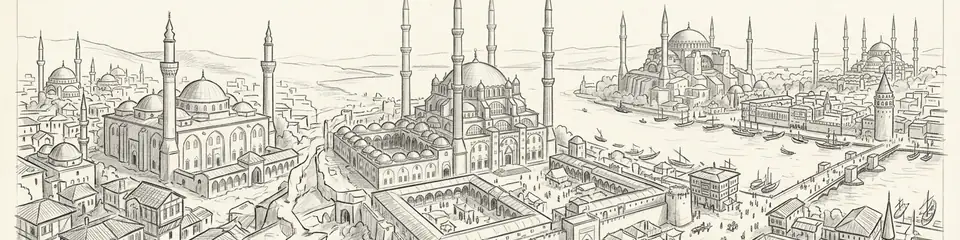
The Ottoman Empire lasted six centuries and stretched across three continents. It had, in the course of its history, four capitals — but three of them are still here, and the journey between them traces not just a political history but an architectural one, from the intimate wooden city of the early sultans to the great imperial mosques that remain among the most audacious buildings ever constructed.
Bursa: Where It Began
"I have built this mosque to rival the great Hagia Sophia."
— Attributed to Mimar Sinan on the Selimiye Mosque (1575)
!The Green Mosque and Green Tomb complex in Bursa with Uludağ in the background
Bursa was the first Ottoman capital, captured from Byzantium in 1326 and the center of Ottoman power for roughly a century before the capital moved to Edirne. It sits at the foot of Mount Uludağ, in a green valley above the Marmara plain, and it preserves the tombs of the first sultans in a garden of plane trees that has the feeling of something carefully tended for a very long time.
The Green Mosque (Yeşil Cami) and its associated Green Tomb, built in the early fifteenth century under Mehmed I, are considered the finest examples of early Ottoman architecture. The mosque's interior tiles, in a jade and turquoise palette that gives the buildings their name, were made by craftsmen from Tabriz and represent a meeting of Persian, Seljuk, and emerging Ottoman sensibilities. The nearby Grand Bazaar is one of the oldest covered markets in the world, continuously in operation since the fourteenth century.
Bursa is also the birthplace of Karagöz, the shadow puppet tradition that became one of the emblematic arts of Ottoman popular culture. The tradition is said to have been inspired by two workers — Karagöz and Hacivat — who worked on the construction of the Bursa mosque and whose comic arguments entertained the other laborers. Whether the story is true, it captures something real about Bursa: a city comfortable with its own mythology.
Edirne: The Gateway to Europe
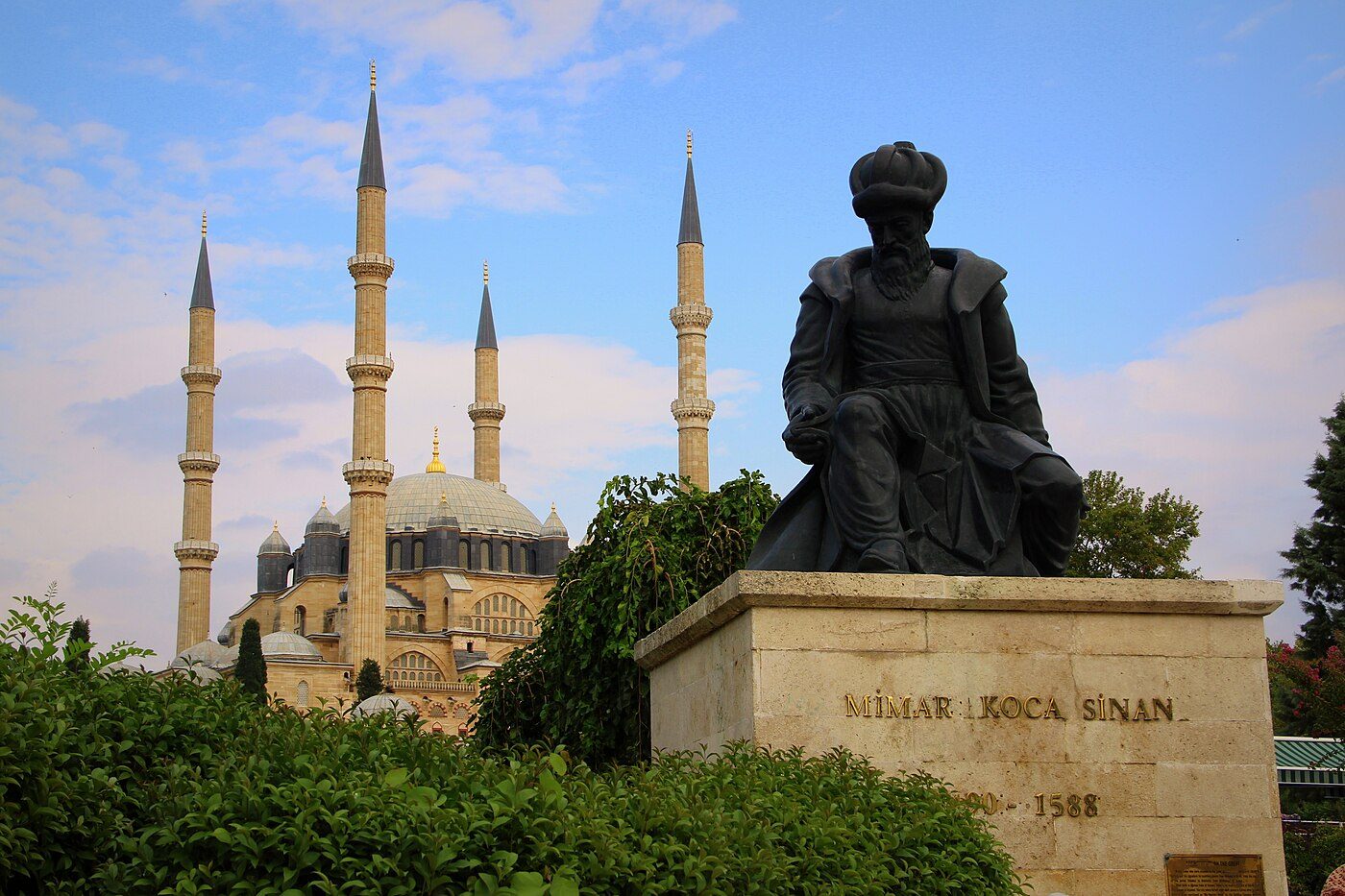
!The Selimiye Mosque by Mimar Sinan rising above the city of Edirne · Wikimedia Commons")
Edirne (ancient Adrianople) sits near the junction of two rivers at the edge of the European continent. It served as the Ottoman capital from 1369 to 1453, the staging point for the campaigns that would eventually take Constantinople. After the capital moved, Edirne remained the second city of the empire and the site of its finest architectural achievement.
The Selimiye Mosque, completed in 1575 under Sultan Selim II and designed by the imperial architect Mimar Sinan, is considered by many historians of Islamic architecture to be the greatest building in the Ottoman tradition. Sinan himself, who was already in his eighties when it was completed, described it as his masterwork — the building that demonstrated he had surpassed the Byzantine achievement at Hagia Sophia. The dome of the Selimiye is slightly larger than Hagia Sophia's. The four minarets are the tallest built under the classical Ottoman style. The interior, flooded with light from 999 windows, is an exercise in controlled transcendence.
Sinan was himself a remarkable figure. Born in the early sixteenth century, he entered the janissary corps, served in multiple military campaigns, and turned his organizational and mathematical talents to architecture. By the time of his death in 1588 at approximately age ninety, he had designed or overseen the construction of more than 370 structures across the empire.
Safranbolu: The Wooden City
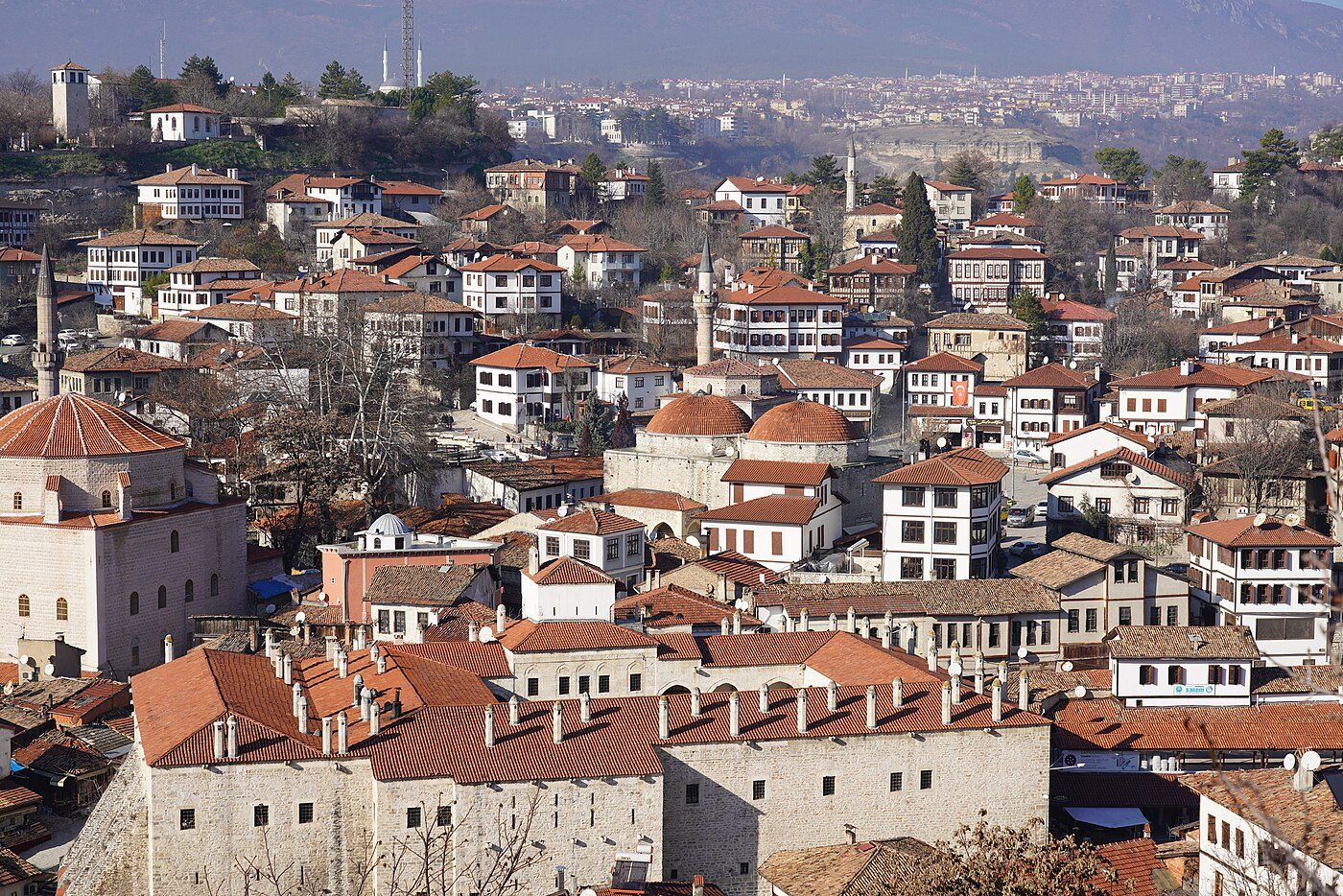
!Traditional Ottoman timber houses cascading down the valley in Safranbolu
Safranbolu, designated a UNESCO World Heritage Site in 1994, preserves the best surviving example of traditional Ottoman residential architecture. Its steep valleys are filled with roughly two thousand timber-framed houses built between the seventeenth and nineteenth centuries. Each house has overhanging upper floors, ornate carved interiors, and a spatial organization that separates the public reception rooms from the private family quarters.
The houses of Safranbolu were built when the city was a major stop on the caravan route between Istanbul and the Black Sea. The saffron trade — safran means saffron in Turkish, giving the city its name — brought wealth; the wealth built houses; the relative isolation of later centuries preserved them. Walking the backstreets of Safranbolu is as close as you can get to understanding what an ordinary Ottoman town looked like before modernization.
Konya: Spiritual Capital
!The iconic turquoise dome of the Mevlana Museum in Konya · Wikimedia Commons")
Konya was the capital of the Seljuk Sultanate of Rum in the twelfth and thirteenth centuries, and it is here that Rumi — the Sufi poet Jalal ad-Din Muhammad Rumi — spent the most productive decades of his life and was buried in 1273. The Mevlana Museum, which incorporates his tomb and the lodge of the Mevlevi order of dervishes he founded, is one of the most visited sites in Turkey and one of the most significant in the history of Islamic mysticism.
The Architecture of Power and Piety
What connects these cities is a consistent architectural logic: the mosque complex as the engine of urban development, combining places of worship, education, soup kitchens, and markets into a single endowment that shaped the fabric of the city. Whether you approach it architecturally, historically, or simply as a traveler moving between remarkable places, the journey from Bursa to Edirne to Safranbolu offers a coherent encounter with one of history's great building traditions — one that built not just monuments, but cities.