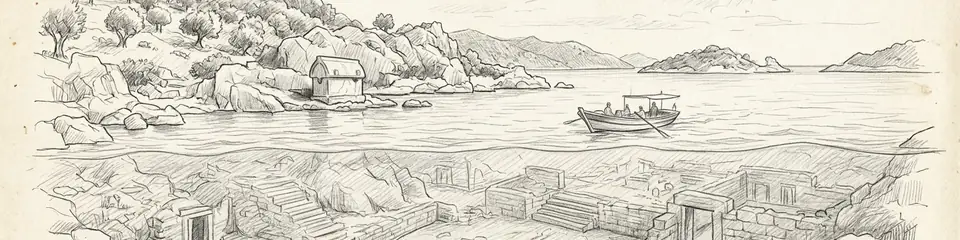
The best way to see the sunken city of Kekova is from a small wooden boat on a calm morning, when the water is clear enough to make out the outline of streets and stairways two meters below the surface. There are no dive tours here — the site is protected, and swimming above the ruins is prohibited. You drift over them instead, looking down, watching walls materialize from the green water and then dissolve again as the boat moves on.
Kekova Island lies in a shallow lagoon off the Lycian coast of southwestern Turkey. The sunken ruins that line its northern shore are the remains of a city that toppled into the sea during a series of earthquakes in the second century CE. The ancient sources give the city's name as Dolchiste, though locals and sailors have called the island by various names over the centuries.
"The coasts of Lycia are full of ancient cities, many of which have sunk beneath the waves."
— Captain Francis Beaufort, Karamania (1817)
A City in Two Parts
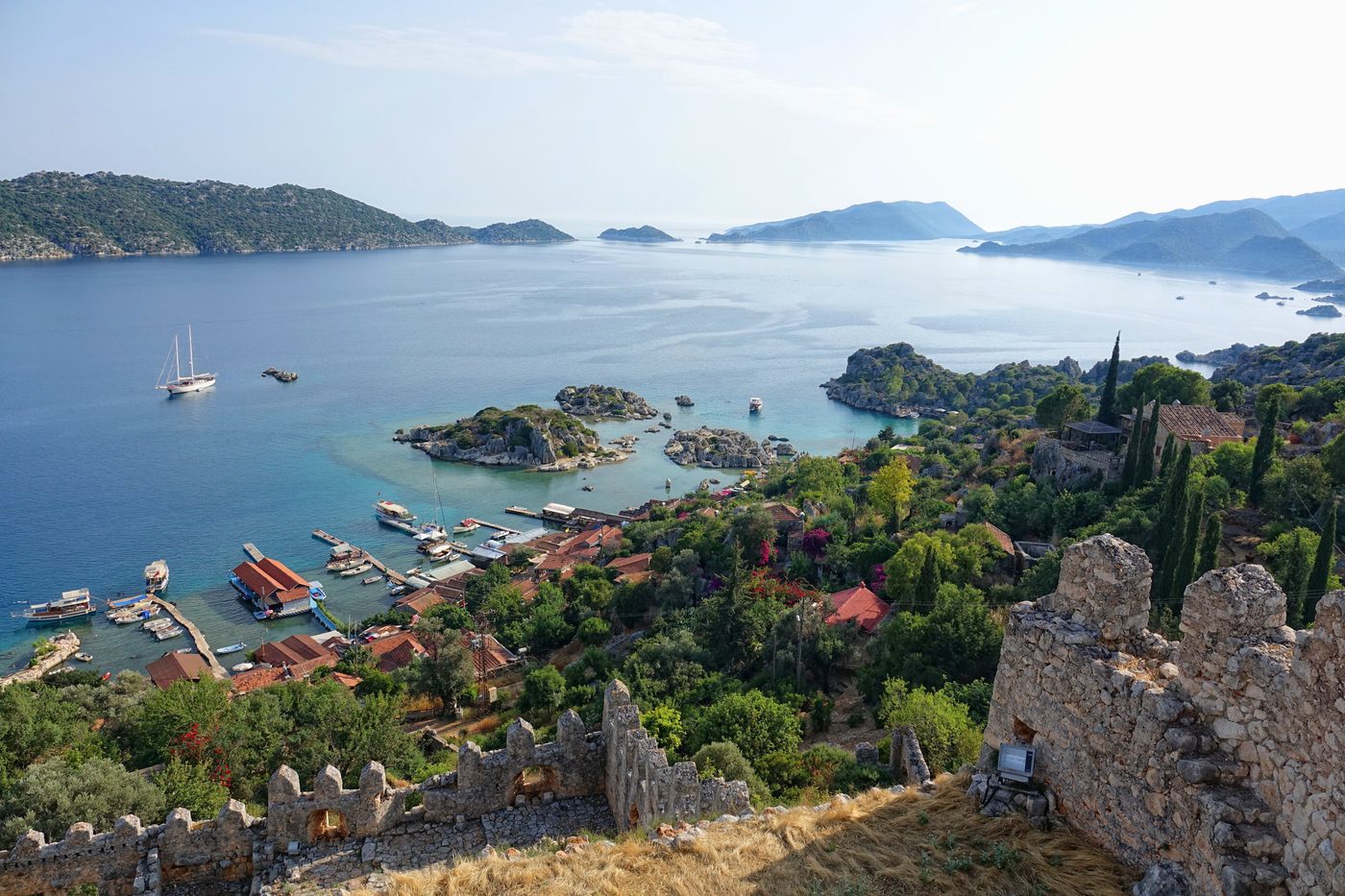
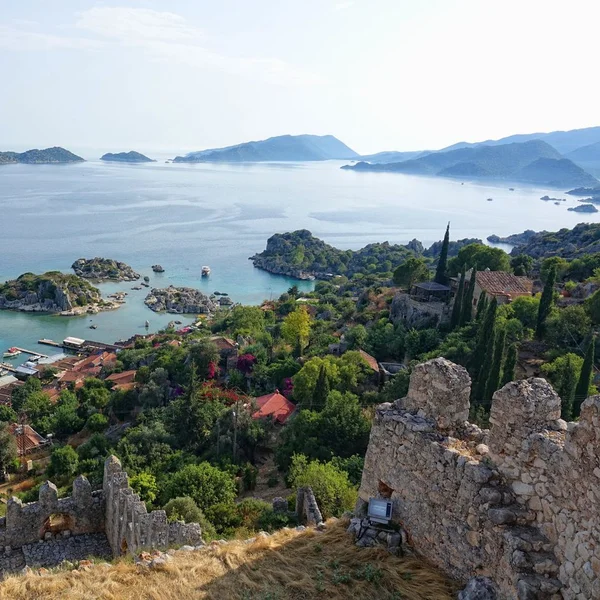
The city was not entirely destroyed. On the mainland opposite the island, the small modern village of Kaleköy (ancient Simena) sits on a promontory beneath a medieval castle. Below the castle, Lycian rock-cut tombs protrude directly from the water, their lids still in place, standing in the shallows where the shoreline has risen and fallen over two millennia. A short boat ride away, the larger ruins on the island itself extend below the waterline in an unbroken progression from the surviving foundations on the hillside down into the sea.
What the earthquakes preserved was the plan. The collapsed structures, resting where they fell, create an accidental map of the ancient city: the outlines of houses, a harbor with its submerged quays, what appears to be a basilica, a necropolis running along the island's edge. The ruins are shallow enough to be clearly visible but deep enough to have been largely undisturbed since the second century.
The Lycian Context
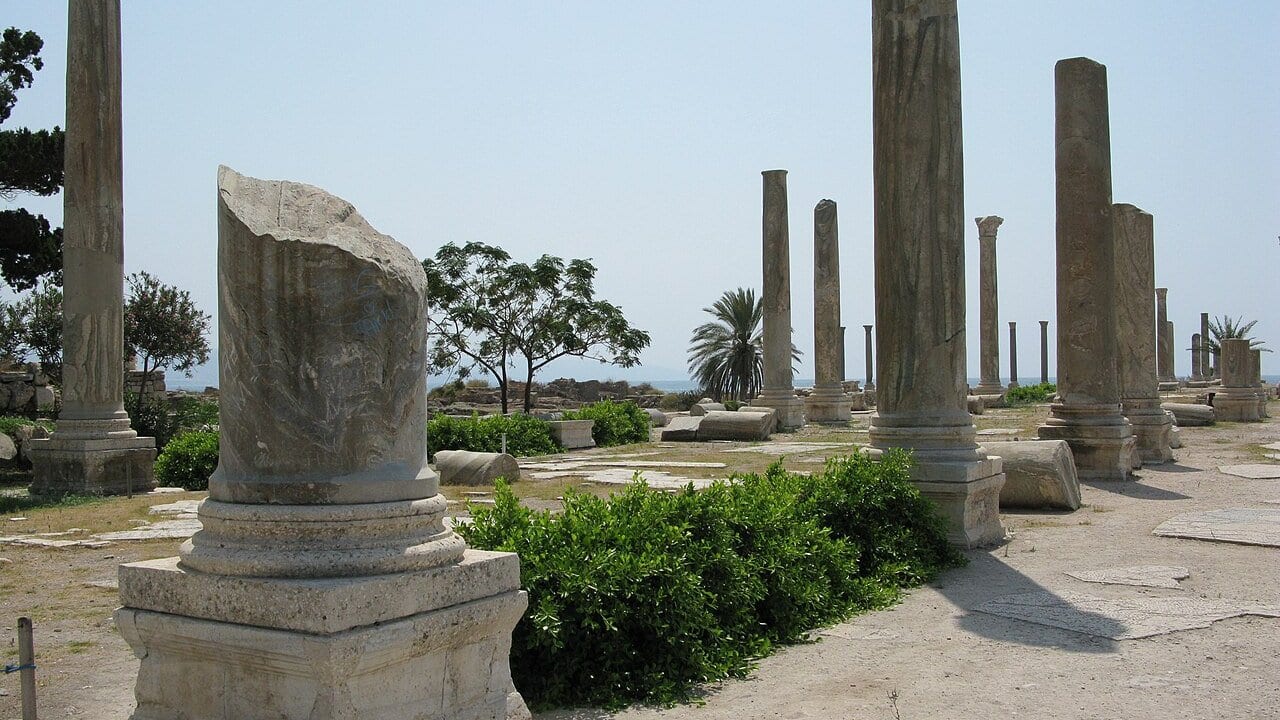
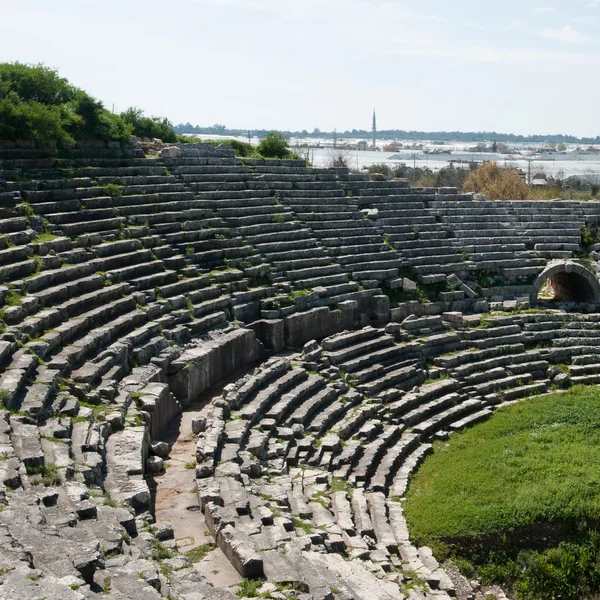
!The ancient theatre and assembly hall at Patara with Mediterranean coastline")
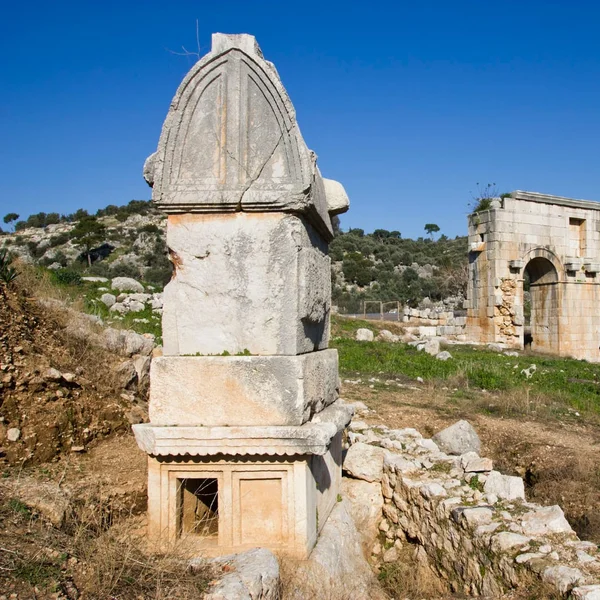
Kekova sits within one of the most archaeologically rich coastal landscapes in the Mediterranean. The Lycians — an indigenous people who resisted Persian conquest in 545 BCE by burning their own city rather than surrendering — left a remarkable material legacy along this stretch of coastline. Their characteristic rock-cut tombs, carved directly into cliff faces, appear throughout the region. Their cities — Xanthos, Patara, Letoon, Myra, Pinara — are scattered along the valleys and headlands that form the ancient Lycian landscape.
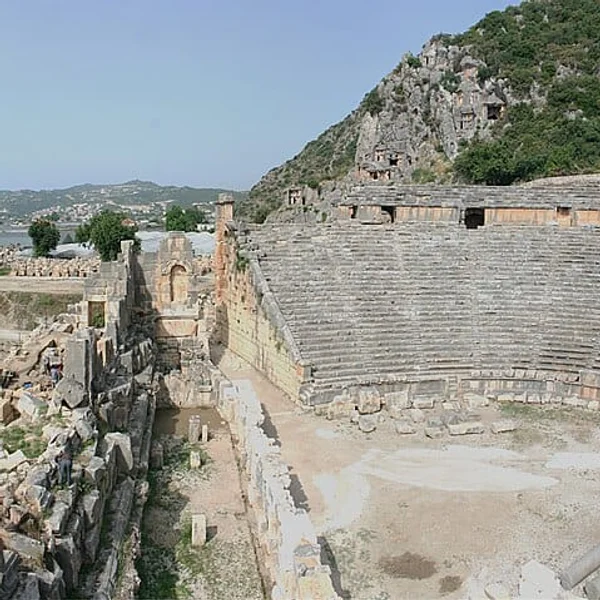
Myra, the largest Lycian city in the area, lies a few kilometers from Kekova. Its theater, built into the base of a cliff, is one of the best preserved in the region. Above the theater, the famous cliff tombs rise in tiers, their facades decorated with carved scenes from Lycian life. The city later became famous for another reason: it was the home of Bishop Nicholas of Myra, the fourth-century Christian clergyman whose historical persona was transformed over centuries into Santa Claus.
Xanthos and the Lycian League
!Xanthos archaeological site")
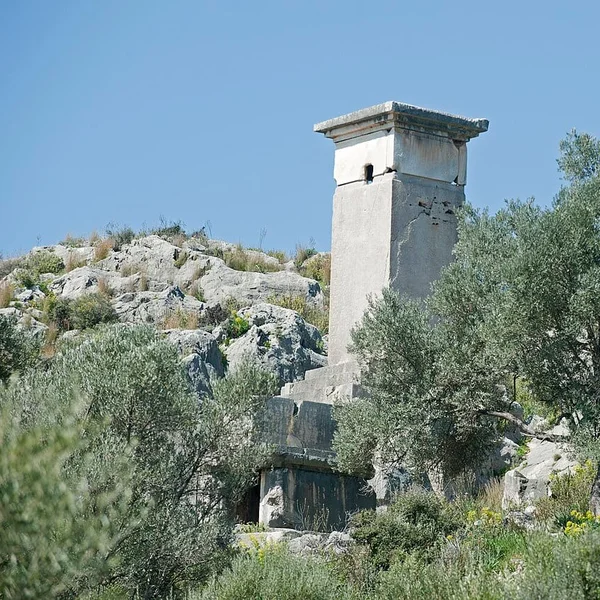
Upstream on the Xanthos River, the Lycian capital preserves some of the most dramatic monuments of the Lycian world. The pillar tombs that stand in the city center — some rising eight to ten meters above the ground — are a uniquely Lycian form that held the dead elevated above the living.
Xanthos was the capital of the Lycian League, one of the ancient world's earliest experiments in federal democracy. The League comprised twenty-three cities, each assigned votes proportional to its size. A central council met regularly to debate common policy. When the American founders were designing a federal system in the late eighteenth century, they studied the Lycian League as an ancient precedent for shared sovereignty among independent states.
The Sunken City Today
!Submerged ruins of the ancient city visible through the clear waters at Kekova
Kekova is accessible only by boat, which preserves something of its remoteness. The protection status that prohibits swimming over the ruins also prohibits construction. Kekova remains, in this sense, genuinely archaeological — a place that has not been developed for visitors but has instead been left for visitors to encounter on its own terms.
The sunken city is not the most spectacular archaeological site in the Mediterranean. What it has is atmosphere: the quality of light off the water, the silhouettes of ruined walls below the surface, the medieval castle above, and the stone tombs standing in the shallows between the ancient world and the modern one.
Türkiye
Myra
An ancient Lycian city famous for its rock-cut tombs carved into cliff faces and the Church of St. Nicholas (S
Türkiye
Patara
Capital of the Lycian League and birthplace of St. Nicholas, Patara housed the oldest known lighthouse in the
Türkiye
Kekova
A partially sunken Lycian city whose ruins shimmer beneath crystal-clear Mediterranean waters, destroyed by a
Türkiye
Xanthos
Capital of ancient Lycia, famous for its monumental pillar tombs and the Nereid Monument. The city was twice d
Türkiye
Letoon
The federal sanctuary of the Lycian League, dedicated to the goddess Leto, mother of Apollo and Artemis. This