
Overview
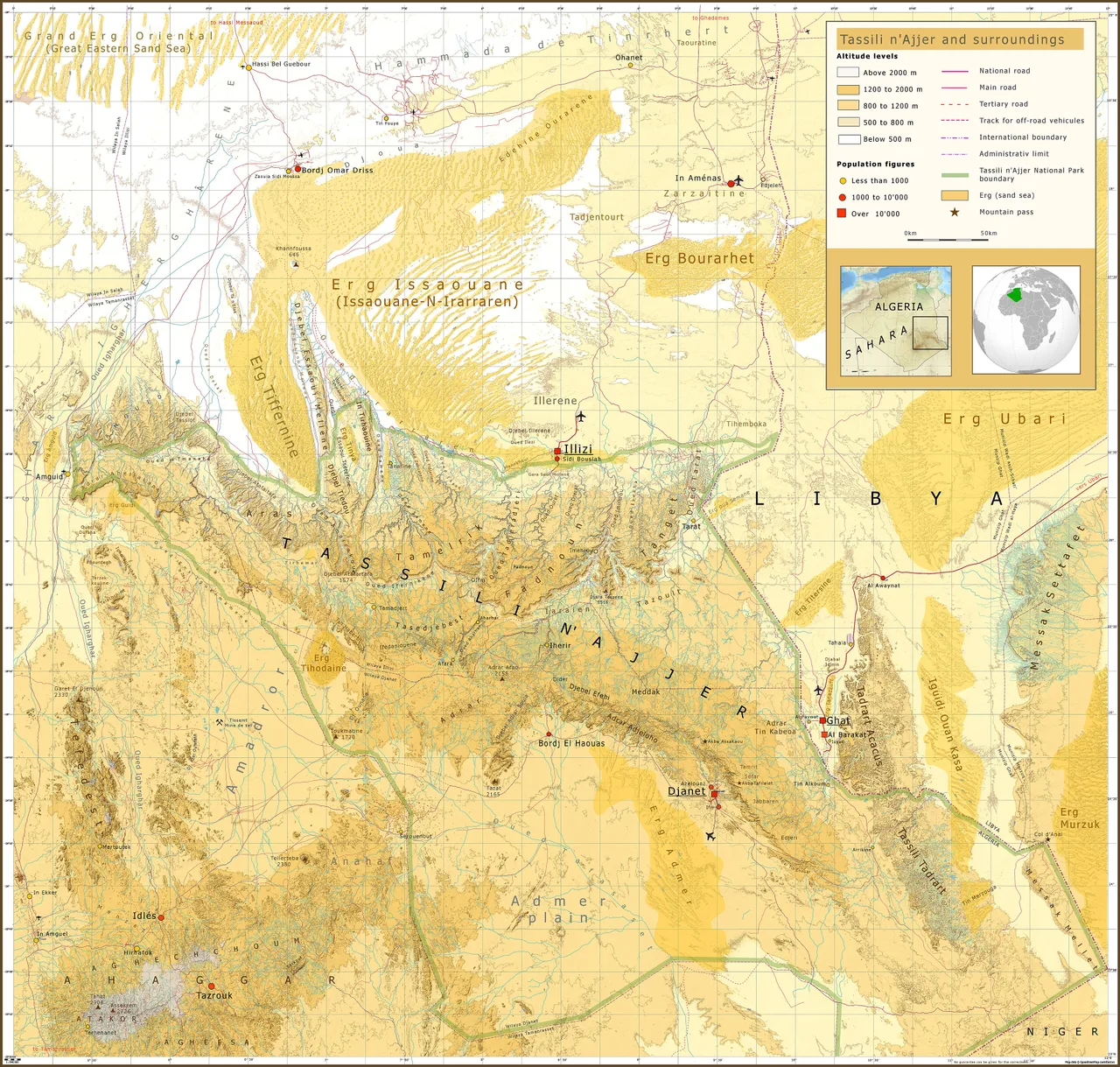
Tassili n'Ajjer occupies a 72,000 km2 sandstone massif in the eastern Algerian Sahara, near the borders of Libya and Niger. The name means "plateau of the rivers" in Tuareg — an accurate description of what this now-hyperarid landscape once was. Between approximately 10,000 BCE and 3,000 BCE the Sahara experienced a "Green Period" when a wetter climate supported grasslands, lakes, rivers, and abundant wildlife including hippos, elephants, giraffes, and crocodiles.
The rock art of Tassili n'Ajjer is the supreme visual archive of that vanished world. Over 15,000 individual drawings and engravings — many of extraordinary artistic quality — are scattered across the plateau's rock faces and shelters. Scholars divide the sequence into broad phases: the Round Head phase (c. 10,000-6,000 BCE) shows large stylised human figures with rounded featureless heads; the Pastoral phase (c. 7,500-3,500 BCE) documents domesticated cattle and the herdspeople who tended them; the Horse and Camel phases record the progressive desiccation of the Sahara.
The images include hunting scenes, cattle herds, ritual dances, and extraordinary depictions of wild animals rendered with vitality that rivals any prehistoric art in the world. UNESCO inscribed Tassili n'Ajjer as a mixed cultural and natural World Heritage Site in 1982.