

Skip to content
Atlas AnatoliaAtlas Anatolia
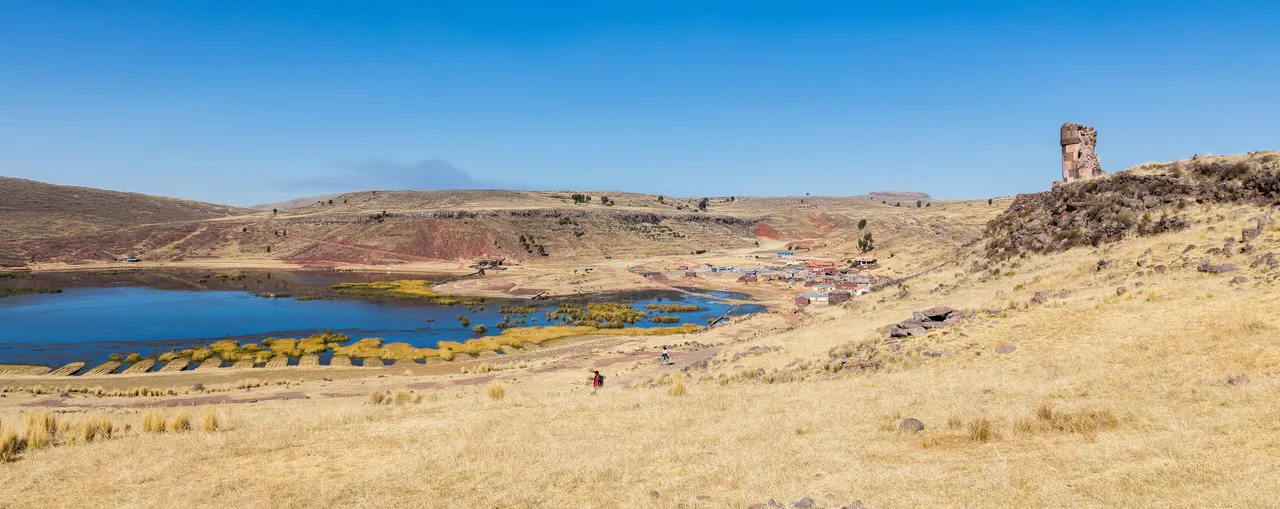
Cylindrical stone chullpa funerary towers at Sillustani overlooking Lake Umayo, Puno, Peru

Sillustani

1200 CE – 1500 CE
50

Interest

High MedievalPre-ColumbianIncaColla

Chullpas

Cylindrical stone funerary towers, the tallest over 12 m high

Builders

The Aymara-speaking Colla people, later continued by the Inca

Setting

Peninsula in Lake Umayo, near Lake Titicaca, at ~3,900 m elevation

Masonry

Finest towers rival Inca Cusco stonework in precision

Function

Elite tombs housing mummified dead, openings facing the sunrise

Sillustani provides one of the clearest and most visually striking windows into Andean beliefs about death, ancestry, and the afterlife — beliefs in which the mummified dead were not removed from society but remained active, honoured presences whose towers marked the landscape and whose favour the living continued to seek.”

Overview

Sillustani sits on a windswept peninsula reaching into Lake Umayo, on the high Altiplano plateau near Puno and the shores of Lake Titicaca, at an elevation of roughly 3,900 metres. It is the most spectacular of a number of chullpa cemeteries in the Lake Titicaca region, associated primarily with the Colla, an Aymara-speaking people who dominated the northern Titicaca basin in the centuries before the Inca conquest of the region in the 15th century CE.

The chullpas are above-ground funerary towers, cylindrical and typically wider at the top than the base, built to house the mummified remains of important individuals along with their families and grave goods. Inside, the dead were placed in a fetal position, often mummified, and the tower sealed — with a single small opening, generally facing east toward the rising sun, through which the interred were symbolically connected to the cycle of death and rebirth. The largest and most famous tower at Sillustani, sometimes called the "Lizard Chullpa" after a carving on its surface, stands over 12 metres tall.

What makes Sillustani exceptional is the quality of its finest stonework. While many chullpas across the Altiplano are built of rough fieldstone, the most accomplished towers at Sillustani are constructed from large, carefully dressed blocks fitted together with remarkable precision, their smoothly curving outer walls achieved despite the difficulty of shaping and fitting stone to a convex surface — a technical feat that reflects the fusion of local Colla funerary tradition with the sophisticated stoneworking associated with the Inca, who conquered the Colla and continued to build and use chullpas at the site. Some of the most refined towers are attributed to this Inca-influenced or Inca-period phase, and their masonry invites direct comparison with the famous fitted stonework of Cusco and other Inca centres.

Many of the towers were left unfinished, and several show evidence of having been struck by lightning or damaged over the centuries, while others were looted long ago, their contents removed. Nonetheless, archaeological study of the chullpas and surrounding remains has illuminated the funerary practices, social hierarchy, and beliefs about ancestors and the afterlife that were central to Andean societies of the Titicaca basin, in which the mummified dead remained important social presences, consulted and honoured by the living rather than simply buried and forgotten. Sillustani is one of Peru's most visited archaeological sites, though it is not individually a UNESCO World Heritage Site.

Why It Matters

Sillustani provides one of the clearest and most visually striking windows into Andean beliefs about death, ancestry, and the afterlife — beliefs in which the mummified dead were not removed from society but remained active, honoured presences whose towers marked the landscape and whose favour the living continued to seek. The chullpas make tangible a cosmology of ancestor veneration that shaped Andean life for centuries. The site is also a superb illustration of cultural fusion under Inca expansion: the finest chullpas blend an indigenous Colla funerary form with Inca-quality precision stonework, showing how the Inca, rather than simply replacing the traditions of the peoples they conquered, often absorbed and elevated local practices — here taking an existing Altiplano tower-tomb tradition and executing it with the empire's renowned masonry expertise. As the most accomplished example of chullpa architecture in the Titicaca basin, Sillustani anchors understanding of the Colla and the wider Aymara kingdoms of the pre-Inca Altiplano — powerful highland societies that are far less famous than the Inca who eventually conquered them, but whose distinctive monumental funerary architecture remains among the most memorable in all of the pre-Columbian Andes.

Stay curious

New stories and sites, once a month. No spam.

Evidence & Interpretation

Distinguishing what is well-established from what remains debated.

Well-Established Facts

3
  • Archaeological study confirms the chullpas functioned as above-ground funerary towers housing mummified elite dead, with interior burial chambers and characteristic east-facing openings.
  • The most refined towers exhibit precision-dressed, tightly fitted masonry on convex surfaces, technically comparable to Inca stonework, consistent with the site's documented Colla and later Inca-period use.
  • The site is securely associated with the Colla, an Aymara-speaking people who controlled the northern Lake Titicaca basin prior to the 15th-century Inca conquest recorded in Andean historical tradition and Spanish colonial sources.

Scholarly Inferences

1
  • The attribution of specific individual towers to the pre-Inca Colla phase versus the later Inca-influenced phase is based on masonry style and construction technique rather than direct dating of each tower, and some attributions remain approximate.

Discovery & Excavation

1900

Early documentation

Early photographic and descriptive documentation of the chullpas by travellers and archaeologists working in the Titicaca basin.

1970

Titicaca basin archaeological survey

Systematic regional study of chullpa cemeteries including Sillustani, clarifying Colla funerary practice and the Inca-period building phase.

More Photos

Museum Artifacts

Community Photos

Share your experience

Have you visited this site? Upload your photos to help others discover it.

Location

Sources

  • Ancient Titicaca: The Evolution of Complex Society in Southern Peru and Northern BoliviaStanish, Charles (2003)
  • Chulpas of the Lupaca Zone of the Peruvian High PlateauHyslop, John (1977)
  • Peruvian Archaeology: A Critical HistoryTantaleán, Henry (2014)

Research Papers

Frequently Asked Questions

Where is Sillustani located?

Sillustani is located in Puno, Peru.

How old is Sillustani?

Sillustani dates to approximately 1200 CE – 1500 CE.

Which civilizations are associated with Sillustani?

Sillustani is associated with the Inca, Colla.

Why is Sillustani important?

Sillustani provides one of the clearest and most visually striking windows into Andean beliefs about death, ancestry, and the afterlife — beliefs in which the mummified dead were not removed from society but remained active, honoured presences whose towers marked the landscape and whose favour the living continued to seek.

Is Sillustani a UNESCO World Heritage Site?

Sillustani is not currently inscribed on the UNESCO World Heritage List.