
Overview
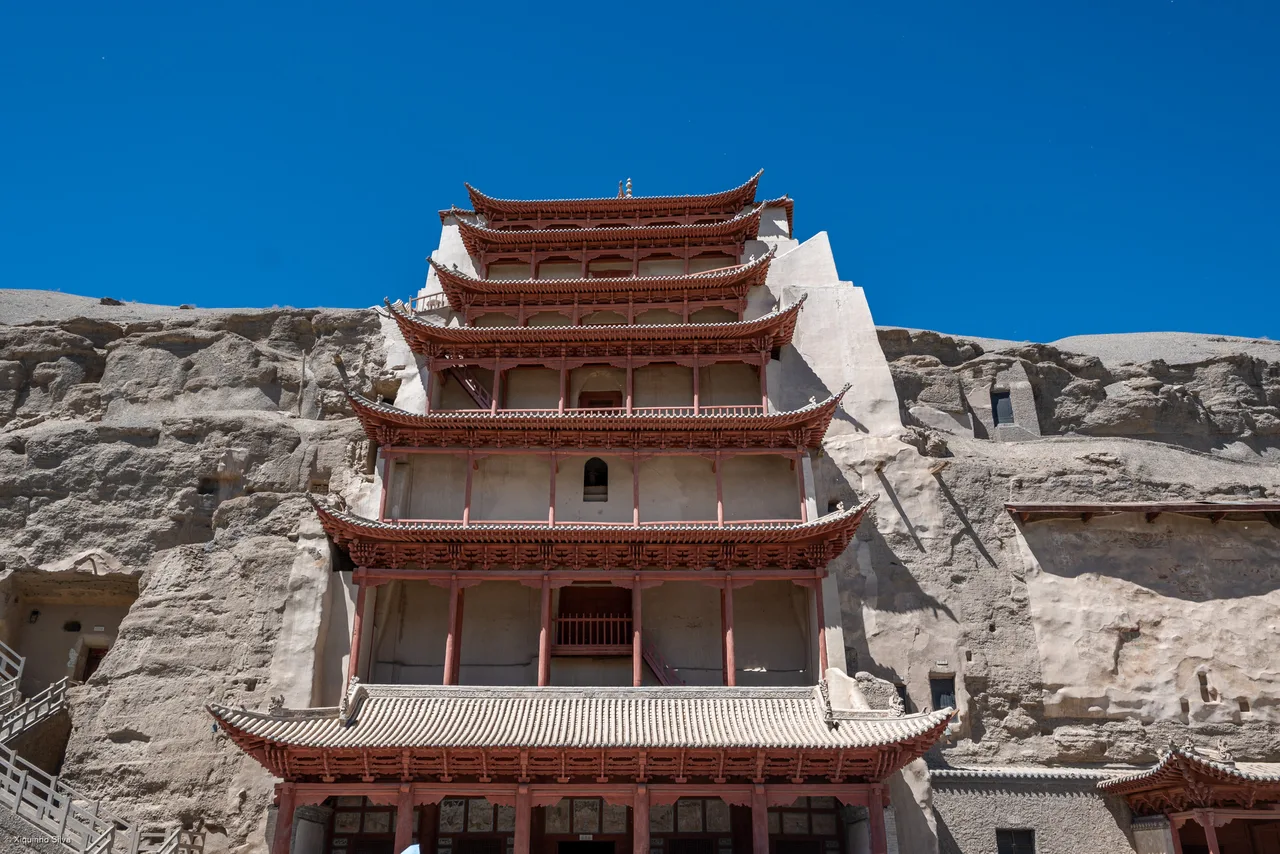
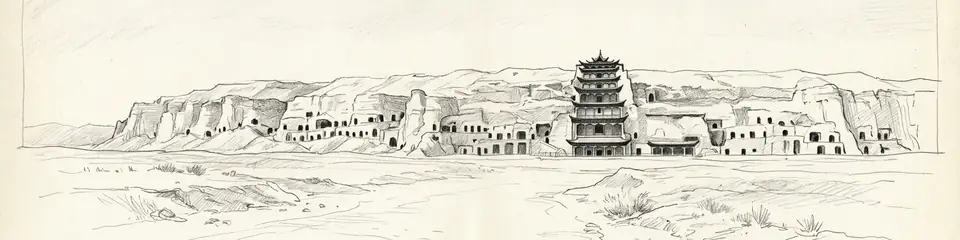
The Mogao Caves are cut into a 1.6-kilometre stretch of cliff face on the eastern edge of the Mingsha Dunes, near the oasis town of Dunhuang in China's Gansu province. Dunhuang sat at a critical junction of the Silk Road, where the northern and southern routes around the Taklamakan Desert converged before continuing toward Central Asia, making it a natural meeting point for merchants, pilgrims, and the Buddhist monks who travelled with them.
According to a Tang-dynasty inscription, the first cave was carved in 366 CE by a wandering monk named Yuezun, who reported a vision of a thousand Buddhas bathed in golden light above the cliff. Construction continued almost without interruption for the next thousand years, through the Northern Liang, Northern Wei, Sui, Tang, Five Dynasties, Song, Western Xia, and Yuan periods, each leaving a distinct artistic signature. Of the roughly 800 caves originally carved, 492 survive with wall paintings or sculpture intact, comprising some 45,000 square metres of murals and over 2,000 painted clay sculptures — the largest, most diverse, and most continuously documented body of Buddhist art anywhere in the world.
The artistic peak came during the Tang dynasty (618–907 CE), when Dunhuang's wealth from Silk Road trade funded elaborate multi-chamber caves featuring monumental seated Buddha statues — including a 35.5-metre-tall Buddha carved directly into the cliff — alongside intricately detailed murals depicting Buddhist paradises, jataka tales, donor portraits, and scenes of daily and courtly life that provide historians with an unparalleled visual record of medieval Central Asian society.
In 1900, a Daoist monk named Wang Yuanlu, acting as the caves' self-appointed caretaker, discovered a sealed side chamber — now known as Cave 17 or the Library Cave — behind a wall in one of the main caves. Inside were an estimated 50,000 manuscripts, printed documents, and paintings on paper and silk, dating from the 4th to the early 11th century, written in Chinese, Tibetan, Sanskrit, Old Uyghur, Sogdian, and other Silk Road languages. Among them was a printed copy of the Diamond Sutra dated to 868 CE, the earliest complete dated printed book known to survive anywhere in the world. Scholars believe the chamber was sealed around 1006 CE, possibly to protect its contents from an anticipated military threat, and then forgotten for nearly nine centuries.
Following the discovery, foreign explorers including Aurel Stein, Paul Pelliot, and Otani Kozui purchased and removed large portions of the Library Cave's contents to institutions in Britain, France, Japan, and elsewhere — a history that remains a source of controversy in China. The dispersed manuscripts nonetheless became the foundation of "Dunhuang Studies" (敦煌学), a major international field of scholarship spanning history, linguistics, religion, and art history. The Mogao Caves were inscribed as a UNESCO World Heritage Site in 1987.