
Skip to content
Atlas AnatoliaAtlas Anatolia
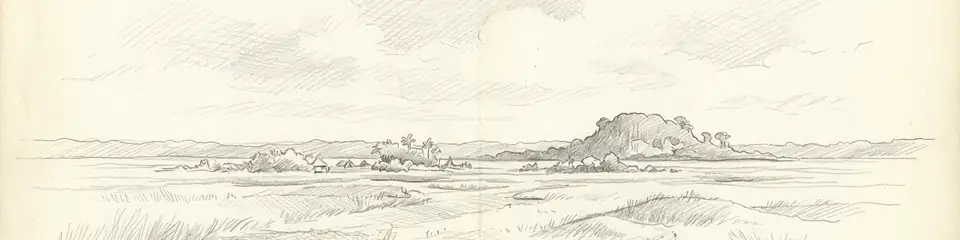
The waterlogged wetland landscape of the Kuk early agricultural site, Western Highlands, Papua New Guinea

Continent Record

Northernmost Known Site in Oceania

Kuk Swamp

Kuk8000 BCE – 1 BCE
47

Interest

NeolithicPapuan

Agriculture origin

Independent invention of farming c. 7,000–10,000 years ago

Crops

Locally domesticated taro and banana, from wild ancestors native to New Guinea

Preservation

Waterlogged soils preserved ancient ditches, mounds, and plant microfossils

Significance

One of only a handful of independent centres of plant domestication on Earth

UNESCO

World Heritage Site 2008

Kuk Swamp is one of the cornerstones of the modern understanding that agriculture was not invented once and then spread across the world, but arose independently and repeatedly in different regions from local wild plants — a fundamental reframing of one of the most important transitions in all of human history.”

Overview

Kuk Swamp lies at roughly 1,560 metres elevation in the Wahgi Valley of the Western Highlands of Papua New Guinea. Its permanently waterlogged, oxygen-poor soils have preserved a record of prehistoric wetland cultivation that would have decomposed and vanished almost anywhere else — a sequence of ancient drainage channels, planting mounds, and buried plant remains that together constitute one of the very few places worldwide where the independent, indigenous origins of agriculture can be directly documented in the ground.

Archaeological investigation, led substantially by Jack Golson from the 1970s and greatly refined by later researchers including Tim Denham, has identified multiple distinct phases of human landscape modification at Kuk stretching back around 10,000 years. The earliest phase shows evidence of plant exploitation and possible cultivation from about 10,000 years ago; a clearer phase of organised mounded cultivation dates to roughly 7,000 years ago; and later phases show the development of the more systematic ditched-field drainage systems used to manage water for wetland-edge farming. Microfossil evidence — including starch grains, phytoliths (microscopic plant silica bodies), and pollen recovered from the buried soils — has identified the crops involved, most importantly taro (Colocasia esculenta) and banana (Musa species), both of which have wild ancestors native to the New Guinea region and were domesticated locally rather than introduced from elsewhere.

This matters because for much of the 20th century, the "Neolithic Revolution" — the transition from foraging to farming — was understood primarily through a small number of well-studied centres, above all the Fertile Crescent of the Middle East, with agriculture in other regions sometimes assumed to have spread outward from these cores. Kuk Swamp provided decisive evidence that New Guinea was an independent centre of plant domestication in its own right, one of only a handful of places on Earth where agriculture is now understood to have been invented from scratch rather than adopted from neighbours — joining the Fertile Crescent, China, Mesoamerica, the Andes, and a small number of other independent centres.

The wetland cultivation practices first evidenced at Kuk are, moreover, directly ancestral to farming systems still practised in the New Guinea highlands today, giving the site a continuity between deep prehistory and living agricultural tradition. Kuk Swamp was inscribed as a UNESCO World Heritage Site in 2008, explicitly recognised as demonstrating one of the world's independent transformations from plant gathering to cultivation.

Why It Matters

Kuk Swamp is one of the cornerstones of the modern understanding that agriculture was not invented once and then spread across the world, but arose independently and repeatedly in different regions from local wild plants — a fundamental reframing of one of the most important transitions in all of human history. Without Kuk, New Guinea's status as an independent centre of domestication would rest on far weaker evidence. The site's exceptional waterlogged preservation captures the physical infrastructure of early farming — the actual ditches and mounds people dug — rather than only the indirect traces (seeds, tools) that survive at most early agricultural sites, giving researchers a rare direct view of how the earliest farmers reshaped their landscape to manage water and grow crops. By documenting the local domestication of banana and taro — staples that would eventually spread across the tropical world — Kuk also anchors the deep history of crops that remain globally important today, tracing their cultivation back to a specific highland valley thousands of years before written records of any kind existed anywhere on Earth.

Stay curious

New stories and sites, once a month. No spam.

Evidence & Interpretation

Distinguishing what is well-established from what remains debated.

Well-Established Facts

3
  • Excavation has documented multiple superimposed phases of wetland cultivation infrastructure — drainage channels, planting mounds, and ditched fields — preserved in the waterlogged soils and dated by radiocarbon across roughly the last 10,000 years.
  • Starch grain, phytolith, and pollen analysis of buried soils has identified taro and banana among the cultivated plants, both with wild ancestors native to the New Guinea region, supporting local domestication rather than introduction.
  • The stratigraphic sequence establishes New Guinea as an independent centre of agricultural origin, corroborated by the presence of locally domesticable species and the absence of evidence for introduced Old World crops in the early phases.

Debated Interpretations

1
  • The precise date at which activity at Kuk crosses the threshold from intensive plant management to full domestication and agriculture is debated, with interpretations of the earliest (c. 10,000-year-old) phase differing among researchers.

Discovery & Excavation

1972–1977

Jack Golson excavations

Pioneering excavations identifying the ancient drainage systems and establishing Kuk as a candidate independent agricultural origin.

1998–2003

Tim Denham microfossil research

Refined dating and microfossil analysis confirming local domestication of taro and banana and the independent-origin status of the site.

More Photos

Museum Artifacts

Community Photos

Share your experience

Have you visited this site? Upload your photos to help others discover it.

Location

Sources

  • Origins of Agriculture at Kuk Swamp in the Highlands of New GuineaDenham, Tim P. et al. (2003)
  • Ten Thousand Years of Cultivation at Kuk Swamp in the Highlands of Papua New GuineaGolson, Jack et al. (2017)
  • UNESCO — Kuk Early Agricultural SiteLink

Research Papers

Frequently Asked Questions

Where is Kuk Swamp located?

Kuk Swamp is located in Western Highlands, Papua New Guinea.

How old is Kuk Swamp?

Kuk Swamp dates to approximately 8000 BCE – 1 BCE.

Which civilizations are associated with Kuk Swamp?

Kuk Swamp is associated with the Papuan.

Why is Kuk Swamp important?

Kuk Swamp is one of the cornerstones of the modern understanding that agriculture was not invented once and then spread across the world, but arose independently and repeatedly in different regions from local wild plants — a fundamental reframing of one of the most important transitions in all of human history.

Is Kuk Swamp a UNESCO World Heritage Site?

Yes — Kuk Swamp is inscribed as a UNESCO World Heritage Site.