Overview
Diocletian's Palace stands on a small peninsula on the Adriatic coast at the centre of present-day Split, Croatia. It was commissioned by Diocletian, the emperor who reorganised the late Roman state through the system of the Tetrarchy (rule by four), in preparation for his abdication. In 305 CE Diocletian did something no Roman emperor had voluntarily done before: he retired from power and withdrew to this palace near his birthplace of Salona, where he reportedly devoted himself to gardening until his death around 311 CE.
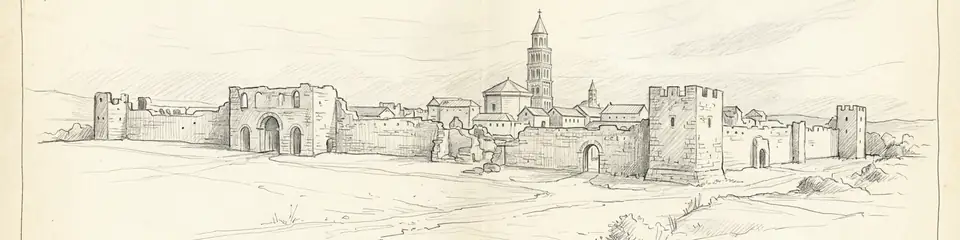
The complex is a hybrid of palatial villa and Roman military fortress. Roughly rectangular and covering about 38,000 square metres, it is enclosed by high stone walls reinforced with square and octagonal towers, pierced by four monumental gates — the Golden Gate (north), Silver Gate (east), Iron Gate (west), and the sea-facing Bronze Gate (south). Two colonnaded streets, the cardo and decumanus, divide the interior into quarters in the manner of a Roman legionary camp. The southern, seaward half contained the emperor's private apartments, raised over a series of vaulted substructures — among the best-preserved Roman cellars anywhere, now a major attraction — that supported the living quarters above.
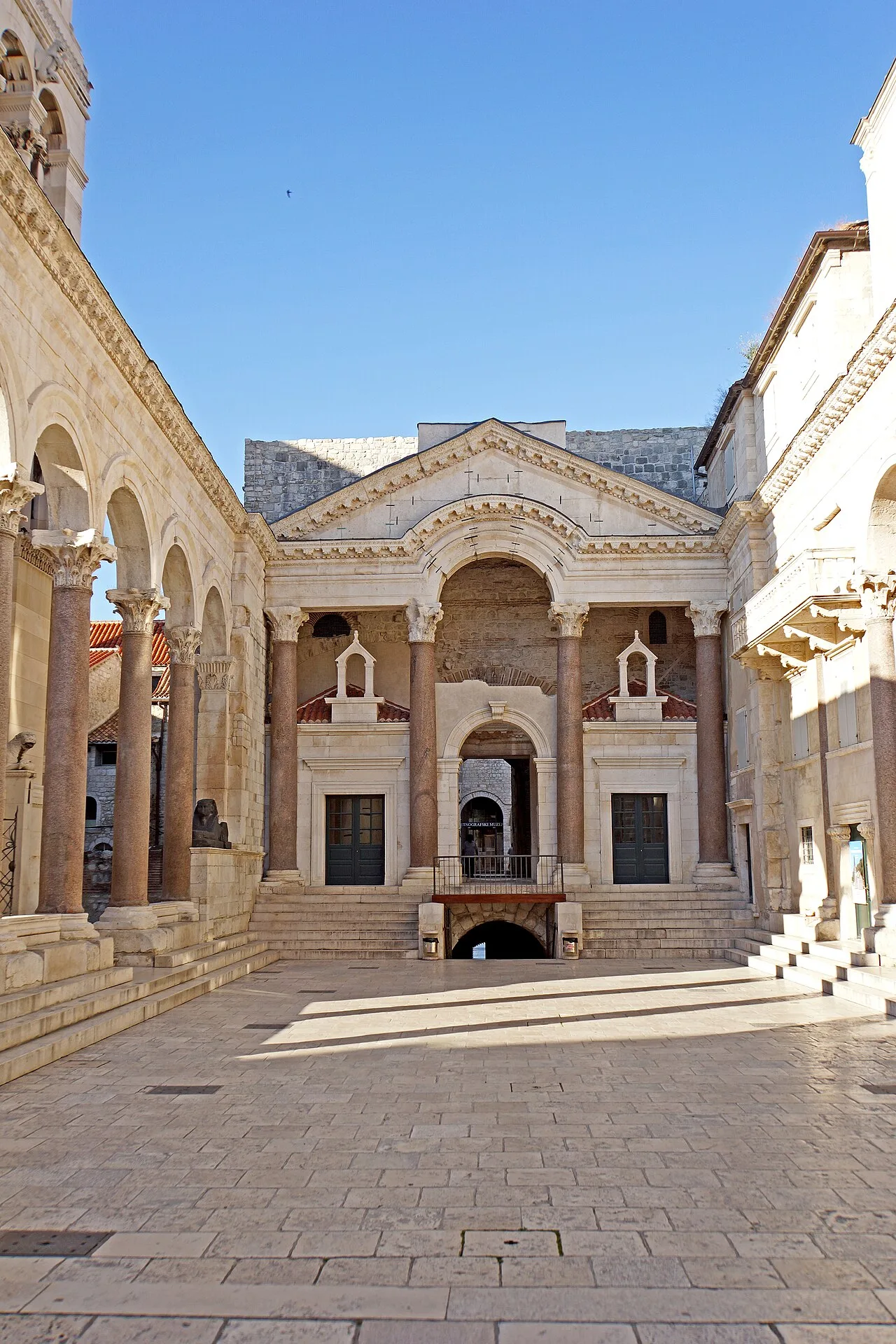
At the heart of the palace lies the Peristyle, a colonnaded ceremonial courtyard where the emperor would have appeared before his subjects. Around it stand the Imperial Mausoleum — an octagonal domed building intended as Diocletian's tomb — and the Temple of Jupiter. In one of history's sharper ironies, the mausoleum of Diocletian, the emperor remembered for the last and most severe persecution of Christians, was converted in the early medieval period into the Cathedral of Saint Domnius, dedicated to a bishop martyred under his own persecution; it is among the oldest cathedral structures still in use.
After the nearby Roman city of Salona was sacked in the 7th century, refugees moved into the abandoned imperial palace, adapting its halls, walls, and substructures into homes. Over the following centuries a continuous living city — Split — developed within and around the Roman shell, building medieval, Renaissance, and Baroque structures against and on top of the ancient walls. The palace was studied and published by the Scottish architect Robert Adam in 1764, and his drawings profoundly influenced the Neoclassical movement in Britain.