
Skip to content
Atlas AnatoliaAtlas Anatolia
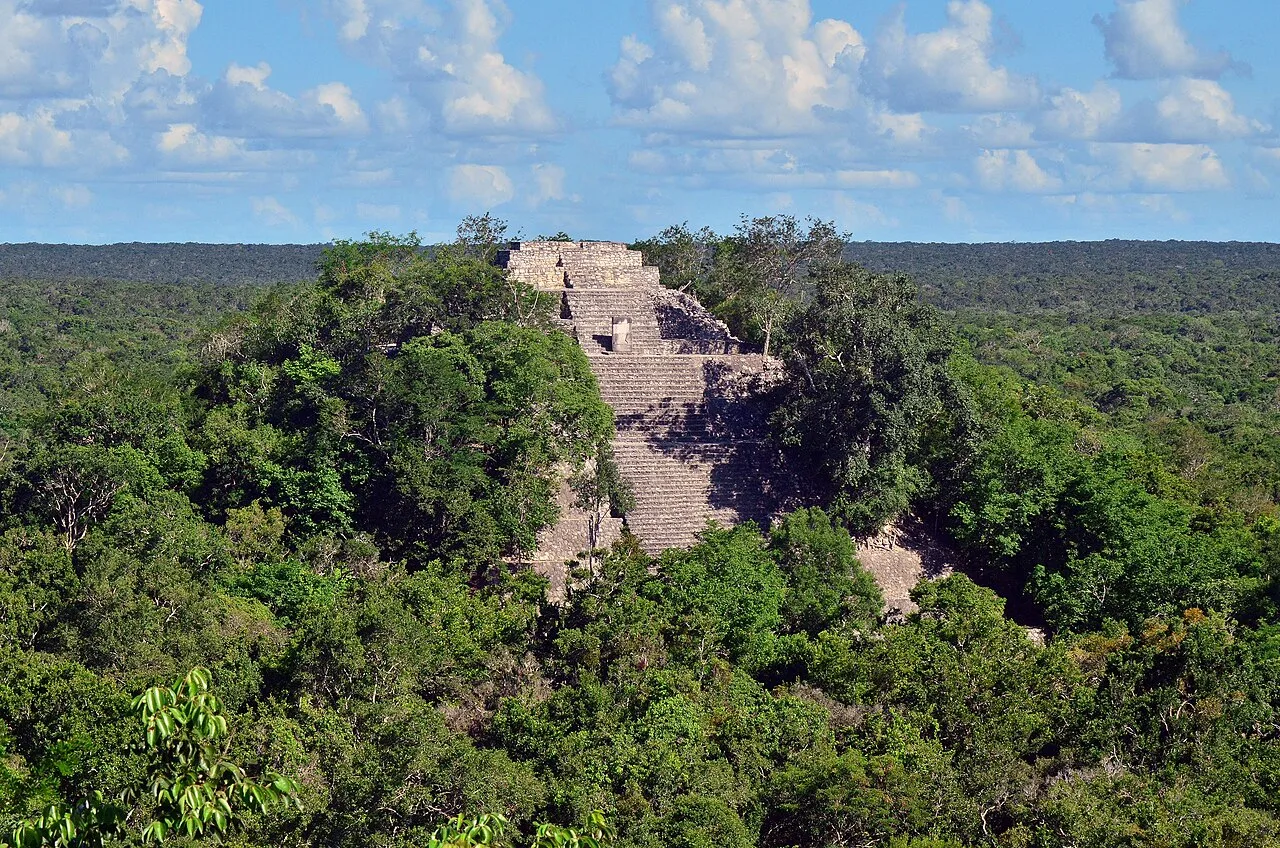
The great pyramids of Calakmul rising above the rainforest, Campeche, Mexico

Calakmul

300 BCE – 900 CE
61

Interest

Pre-ColumbianMaya

Dynasty

Capital of the Kaan ("Snake") dynasty

Rivalry

Superpower struggle with Tikal (6th–7th c. CE)

Structure II

~45 m — among the most massive of all Maya pyramids

Stelae

Over 100 carved monuments — a major hieroglyphic archive

Turning point

Defeated by Tikal in 695 CE (king Yuknoom Yich'aak K'ahk')

UNESCO

World Heritage Site 2002; mixed site 2014

Calakmul was one of the two great superpowers of the Classic Maya world, and its long rivalry with Tikal was the central geopolitical drama of Maya civilisation at its height.”

Overview

Calakmul lies deep within the Calakmul Biosphere Reserve in the southern Mexican state of Campeche, only about 35 kilometres from the Guatemalan border, in one of the largest tracts of tropical forest remaining in Mesoamerica. Its modern name means "two adjacent mounds" in Yucatec Maya, after its two great pyramids; in antiquity the city was associated with the toponym Ox Te' Tuun and was the seat of the Kaan or "Snake" dynasty, whose royal emblem glyph was a serpent head.

Calakmul was one of the two most powerful Maya kingdoms of the Classic period, the other being Tikal in the Petén of Guatemala, roughly 100 kilometres to the south. For much of the 6th and 7th centuries CE the Snake kings of Calakmul built a far-reaching network of alliances and vassal states that encircled and repeatedly defeated Tikal, making Calakmul the dominant hegemon of the central Maya lowlands. The rivalry between the two superpowers — fought through proxy wars, dynastic marriages, and direct conflict — structured much of Classic Maya geopolitics. Tikal eventually turned the tables, defeating Calakmul's king Yuknoom Yich'aak K'ahk' in 695 CE, after which Calakmul's power waned.

The city is enormous. Surveys have mapped thousands of structures, and its largest pyramid, Structure II, rises about 45 metres and is among the most massive of all Maya buildings; from its summit, on a clear day, the distant pyramids of other cities can be seen above the forest canopy. Calakmul has yielded one of the greatest concentrations of carved stelae of any Maya site — well over a hundred — recording its rulers and their deeds, though many are badly eroded by the humid climate. Excavations have also uncovered elite tombs with jade masks and, remarkably, painted murals depicting ordinary people engaged in commerce and the consumption of food and drink, a rare glimpse of Maya daily life.

The peak population of the city and its surrounding territory has been estimated in the tens of thousands. Calakmul declined along with the rest of the southern lowland Maya cities during the 9th-century collapse and was swallowed by forest, rediscovered from the air in 1931.
Why It Matters

Calakmul was one of the two great superpowers of the Classic Maya world, and its long rivalry with Tikal was the central geopolitical drama of Maya civilisation at its height. Reconstructing this "superpower" struggle from inscriptions transformed modern understanding of the Maya from a patchwork of isolated city-states into a world of large, competing political blocs. The site preserves one of the richest bodies of Maya hieroglyphic monuments anywhere, along with exceptionally informative painted murals of everyday economic life. Its setting in a vast biosphere reserve also makes it a rare mixed natural-and-cultural property: it was inscribed by UNESCO as a World Heritage Site in 2002 and extended as a mixed site in 2014.

Stay curious

New stories and sites, once a month. No spam.

Evidence & Interpretation

Distinguishing what is well-established from what remains debated.

Well-Established Facts

4
  • Calakmul's rulers used the Kaan ("Snake") emblem glyph, read across its own monuments and on inscriptions at allied and rival sites, allowing its political network to be mapped.
  • Hieroglyphic texts at Tikal and other sites record the defeat of Calakmul's king Yuknoom Yich'aak K'ahk' by Tikal in 695 CE, a documented turning point in the rivalry.
  • Painted murals at the Chiik Nahb acropolis depict named individuals consuming and trading food and drink — a rare direct depiction of Maya commercial and everyday life.
  • Elite burials with jade mortuary masks and rich offerings have been excavated, confirming the wealth and status of Calakmul's ruling dynasty.

Debated Interpretations

1
  • Peak population estimates (commonly tens of thousands) and the full extent of Calakmul's hegemony are debated, as many of its 100-plus stelae are severely eroded and the site is only partly excavated.

More Photos

Museum Artifacts

Community Photos

Share your experience

Have you visited this site? Upload your photos to help others discover it.

Location

Sources

  • Chronicle of the Maya Kings and QueensMartin, Simon; Grube, Nikolai (2008)
  • Daily life of the ancient Maya recorded on murals at CalakmulCarrasco Vargas, Ramón et al. (2009)

Research Papers