
Skip to content
Atlas AnatoliaAtlas Anatolia
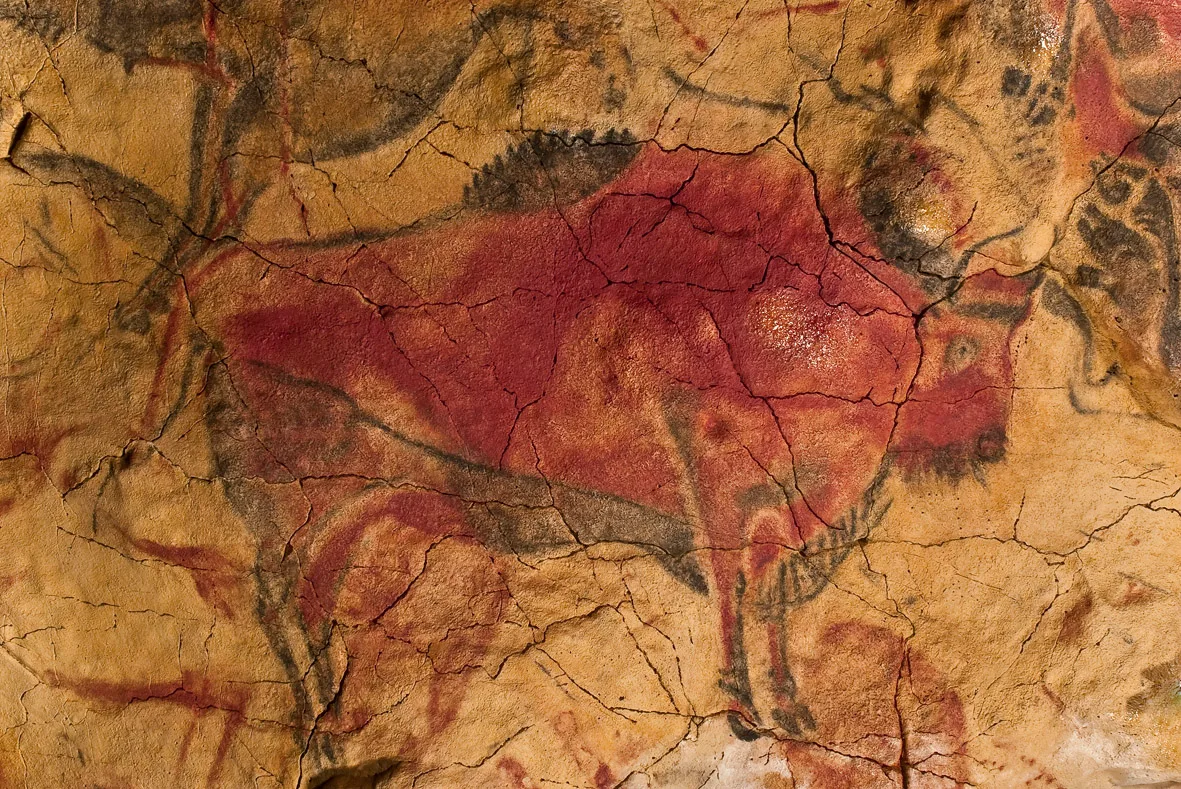
Polychrome painted bison on the ceiling of Altamira Cave, Cantabria, Spain, created c. 14,000–16,500 years ago

Altamira Cave

Cueva de Altamira35000 BCE – 13000 BCE
70

Interest

PaleolithicMagdalenian

Great Ceiling

c. 16,500–14,000 years ago (Magdalenian) — 20+ polychrome bison plus horses, deer, boar

Discovery

1879, by Marcelino Sanz de Sautuola and his daughter María

Rejection

Dismissed as forgery by European scientists until 1902

Vindication

Émile Cartailhac's public "Mea Culpa d'un Sceptique" retraction, 1902

UNESCO

World Heritage Site 1985; extended 2008

Altamira fundamentally changed how the modern world understood the cognitive and artistic capacity of Ice Age humans.”

Overview

Altamira Cave lies near the town of Santillana del Mar in Cantabria, on Spain's northern coast. The cave was formed by a collapsed karst passage and consists of a main chamber roughly 270 metres long, connected to smaller side galleries. It was sealed by a rockfall around 13,000 years ago, which preserved its contents in near-pristine condition until modern rediscovery.

Altamira contains art spanning multiple periods of Upper Paleolithic occupation, from roughly the Aurignacian and Gravettian (35,000–20,000 years ago) through the Solutrean and, most famously, the Magdalenian period (approximately 16,500–14,000 years ago), to which the cave's celebrated polychrome ceiling belongs. This "Great Ceiling," located just inside the cave entrance in what would have been a low, easily accessible chamber, features more than twenty large bison depicted in red ochre and black manganese pigment, their forms skilfully using the cave's natural rock bulges and contours to create a striking three-dimensional effect — along with images of horses, a deer, and a wild boar, painted, engraved, and shaded with a technical sophistication that took art historians decades to fully appreciate.

The cave was rediscovered in 1868 by a hunter, but its paintings went unnoticed until 1879, when amateur archaeologist Marcelino Sanz de Sautuola, excavating the cave floor for stone tools, was shown the ceiling paintings by his young daughter María, who had wandered further into the low chamber than her father and looked up. Sautuola recognised the paintings' significance and presented them to the scientific community in 1880, proposing they dated to the Paleolithic period, contemporary with the stone tools and animal bones he had excavated from the cave floor.

The reaction from the European scientific establishment was overwhelmingly hostile. Leading prehistorians, led by the French archaeologist Émile Cartailhac, dismissed the paintings as a modern forgery, arguing that Ice Age humans — then widely regarded as primitive brutes — could not possibly have produced art of such technical accomplishment. Sautuola was accused, without evidence, of having commissioned the paintings himself, possibly with the help of a Spanish artist, to defraud the scientific community; he died in 1888 without seeing his discovery vindicated.

Vindication came gradually over the following two decades, as further Paleolithic painted caves — including Marsoulas, La Mouthe, and Font-de-Gaume in France — were discovered with paintings in styles and contexts that could not be dismissed as forgeries, and as excavation methods confirmed that painted surfaces at these sites were sealed beneath undisturbed Paleolithic archaeological deposits. In 1902, Cartailhac himself published a formal retraction, "La Grotte d'Altamira, Espagne: Mea Culpa d'un Sceptique," publicly acknowledging the authenticity of Altamira's art — a rare and celebrated act of scientific self-correction that opened the modern study of Paleolithic art as a serious field. Altamira was inscribed as a UNESCO World Heritage Site in 1985, later extended to include seventeen other painted caves of northern Spain in 2008. Due to conservation concerns from carbon dioxide and humidity introduced by visitor breath, the original cave has been closed to general public access since 2002, with a precise full-scale replica, the Neocueva, built adjacent to the site museum.

Why It Matters

Altamira fundamentally changed how the modern world understood the cognitive and artistic capacity of Ice Age humans. Before its vindication, the dominant view held that Paleolithic people were incapable of symbolic or representational thought beyond crude tool-making — Altamira's paintings, once accepted as genuine, proved that fully modern artistic sophistication, technical skill, and probably complex symbolic or ritual belief systems existed among humans tens of thousands of years before writing, agriculture, or settled life. The Sautuola controversy remains one of the most instructive case studies in the history of science regarding the danger of interpreting evidence through the lens of prior assumption. An entire generation of Europe's leading prehistorians rejected genuine, verifiable evidence for two decades simply because it contradicted their preconceptions about "primitive" ancestors — a cautionary story still taught in archaeology and philosophy-of-science courses today. Altamira's rediscovery and eventual vindication effectively founded Paleolithic cave art as a field of study, directly leading to the identification and protection of hundreds of subsequent painted cave sites across Europe, including the later discoveries at Lascaux and Chauvet, and establishing the excavation and authentication standards still used to evaluate prehistoric art sites today.

Stay curious

New stories and sites, once a month. No spam.

Evidence & Interpretation

Distinguishing what is well-established from what remains debated.

Well-Established Facts

3
  • Uranium-series dating of calcite formations overlying sections of the paintings, combined with radiocarbon dating of charcoal pigment, places the Great Ceiling's polychrome bison panel at approximately 14,000–16,500 years old, within the Magdalenian period.
  • Stone tools and faunal remains excavated from the cave floor by Sautuola in 1879 were stratigraphically associated with Upper Paleolithic material culture, consistent with his original proposed dating.
  • Subsequent excavation confirmed the cave entrance was sealed by a rockfall roughly 13,000 years ago, which explains the exceptional preservation of the paintings until modern rediscovery.

Debated Interpretations

1
  • The specific ritual, religious, or social purpose of the painted images remains a matter of ongoing scholarly debate, with hypotheses ranging from hunting magic to shamanistic practice to more abstract cosmological symbolism.

Discovery & Excavation

1879

Marcelino Sanz de Sautuola excavation and discovery

Amateur excavation of the cave floor leads to the discovery of the painted ceiling, first presented to the scientific community in 1880.

1902

Émile Cartailhac vindication

Formal published retraction acknowledging the authenticity of the Altamira paintings, following corroborating discoveries at other French painted caves.

2012

Uranium-series dating study

Modern U-series dating of calcite deposits established a robust chronology for the Great Ceiling and other painted panels within the cave.

More Photos

Museum Artifacts

Community Photos

Share your experience

Have you visited this site? Upload your photos to help others discover it.

Location

Sources

  • La Grotte d'Altamira, Espagne: Mea Culpa d'un SceptiqueCartailhac, Émile (1902)
  • U-Series Dating of Paleolithic Art in 11 Caves in SpainPike, A.W.G. et al. (2012)
  • UNESCO — Cave of Altamira and Paleolithic Cave Art of Northern SpainLink

Research Papers

Frequently Asked Questions

Where is Altamira Cave located?

Altamira Cave is located in Cantabria, Spain.

How old is Altamira Cave?

Altamira Cave dates to approximately 35000 BCE – 13000 BCE.

Which civilizations are associated with Altamira Cave?

Altamira Cave is associated with the Magdalenian.

Why is Altamira Cave important?

Altamira fundamentally changed how the modern world understood the cognitive and artistic capacity of Ice Age humans.

Is Altamira Cave a UNESCO World Heritage Site?

Yes — Altamira Cave is inscribed as a UNESCO World Heritage Site.