Skip to content
Atlas AnatoliaAtlas Anatolia
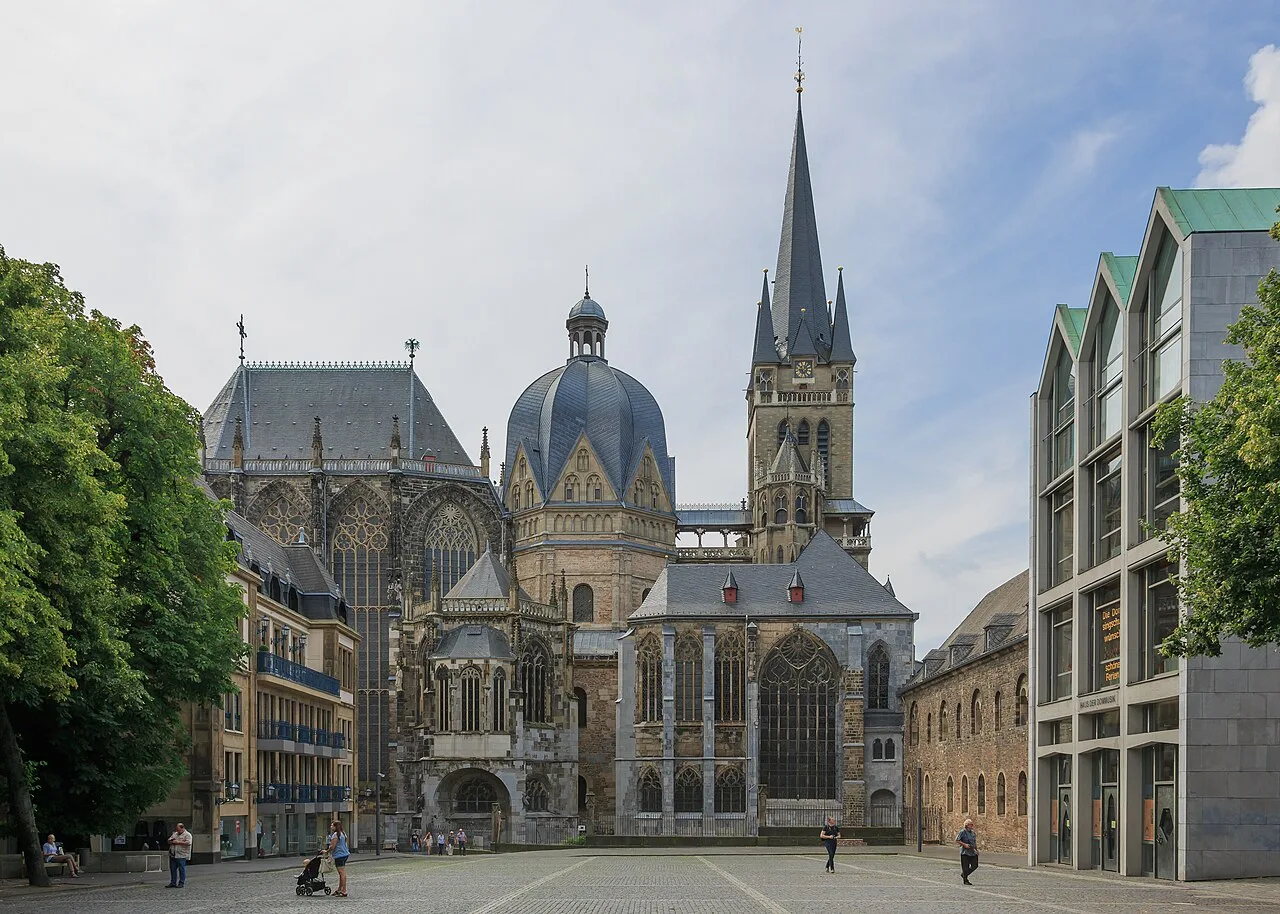
The Carolingian octagon and Gothic choir of Aachen Cathedral, Germany

Aachen Cathedral

Aachener Dom796 CE – 1414 CE
72

Interest

Early MedievalHigh MedievalCarolingianHoly Roman Empire

Built

c. 796–805 CE (Palatine Chapel); Gothic choir 1355–1414

Architect

Odo of Metz, for Charlemagne

Model

Domed octagon echoing San Vitale (Ravenna) and Byzantium

Coronation church

30+ German kings crowned here, 936–1531

Burial

Charlemagne (d. 814), now in the Shrine of Charlemagne

UNESCO

Germany's first World Heritage Site (1978)

Aachen Cathedral is the founding monument of medieval European civilization.”

Overview

Aachen Cathedral stands at the heart of Aachen, in the far west of Germany near the Belgian and Dutch borders, on a site whose hot springs had drawn the Romans, who called the place Aquae Granni. Around 796 CE the Frankish king Charlemagne chose Aachen as the principal residence of his revived Western empire and ordered the construction of a grand palace complex. Its centrepiece, and the only major part to survive, is the Palatine Chapel, designed by Odo of Metz and consecrated around 805.

The chapel is the supreme architectural achievement of the Carolingian Renaissance. Its core is a domed octagon ringed by a sixteen-sided ambulatory and two-storey galleries, deliberately echoing the great imperial churches of the Mediterranean — above all San Vitale in Ravenna and the churches of Byzantine Constantinople — as a statement that Charlemagne's empire was the legitimate heir of Rome. Bronze railings and doors cast in Aachen, marble columns brought from Italy, and glittering mosaics made it, in its day, the most ambitious vaulted structure north of the Alps in centuries. In the upper gallery sits the simple marble throne of Charlemagne.

Charlemagne died in 814 and was buried in the chapel; his remains now rest in the golden Shrine of Charlemagne. After his canonisation in 1165 Aachen became a major pilgrimage destination, and from 936 to 1531 the chapel served as the coronation church of the kings of the Holy Roman Empire — more than thirty German kings were crowned on or beside Charlemagne's throne. To accommodate the crowds of pilgrims, a soaring Gothic choir hall, often called the "glass house of Aachen" for its vast stained-glass windows, was added between 1355 and 1414, and further chapels accreted around the Carolingian octagon over the centuries.

The cathedral treasury is among the most important church treasuries in the world, holding Carolingian, Ottonian, and medieval masterpieces including the Cross of Lothair, the bust reliquary of Charlemagne, and the Shrine of the Virgin Mary. In 1978 Aachen Cathedral became the first site in Germany, and one of the first twelve sites anywhere, to be inscribed on the UNESCO World Heritage List.
Why It Matters

Aachen Cathedral is the founding monument of medieval European civilization. As Charlemagne's palace chapel it embodied his project to renew the Roman Empire in the West and to fuse Roman, Byzantine, and Frankish traditions into a new Christian imperial culture, the movement historians call the Carolingian Renaissance. Architecturally, its domed octagon reintroduced monumental vaulted construction to northern Europe and influenced church building for generations. Its role as the coronation church of the Holy Roman Empire for six centuries made it the symbolic heart of German and European kingship, and the tomb and cult of Charlemagne turned it into one of the great pilgrimage sites of the Middle Ages. Recognised in 1978 as Germany's very first UNESCO World Heritage Site, it remains the single most important surviving structure of the Carolingian age.

Stay curious

New stories and sites, once a month. No spam.

Evidence & Interpretation

Distinguishing what is well-established from what remains debated.

Well-Established Facts

4
  • The Carolingian Palatine Chapel survives largely intact as the core of the cathedral, with its domed octagon, two-storey galleries, and bronze fittings cast in Aachen around 800 CE — the best-preserved monument of Carolingian architecture.
  • Charlemagne's burial at Aachen in 814 is recorded by contemporary sources, including his biographer Einhard. His remains were later translated into the gilded Shrine of Charlemagne, completed in 1215.
  • From 936 (Otto I) to 1531, more than thirty kings of the Holy Roman Empire were crowned at Aachen, documented in coronation records; the marble throne in the upper gallery survives in place.
  • The Gothic choir hall was added between 1355 and 1414, dated by building records and architectural analysis; its tall stained-glass windows gave it the nickname the "glass house of Aachen."

Scholarly Inferences

1
  • The deliberate imitation of San Vitale in Ravenna and Byzantine imperial churches is read by historians as a political statement that Charlemagne's realm was the legitimate heir of the Roman Empire, reinforced by the reuse of Italian marble columns.

More Photos

Museum Artifacts

Community Photos

Share your experience

Have you visited this site? Upload your photos to help others discover it.

Location

Sources

  • Charlemagne: The Formation of a European IdentityMcKitterick, Rosamond (2008)
  • Early Medieval ArtNees, Lawrence (2002)

Research Papers

Frequently Asked Questions

Where is Aachen Cathedral located?

Aachen Cathedral is located in Germany.

How old is Aachen Cathedral?

Aachen Cathedral dates to approximately 796 CE – 1414 CE.

Which civilizations are associated with Aachen Cathedral?

Aachen Cathedral is associated with the Carolingian, Holy Roman Empire.

Why is Aachen Cathedral important?

Aachen Cathedral is the founding monument of medieval European civilization.

Is Aachen Cathedral a UNESCO World Heritage Site?

Yes — Aachen Cathedral is inscribed as a UNESCO World Heritage Site.